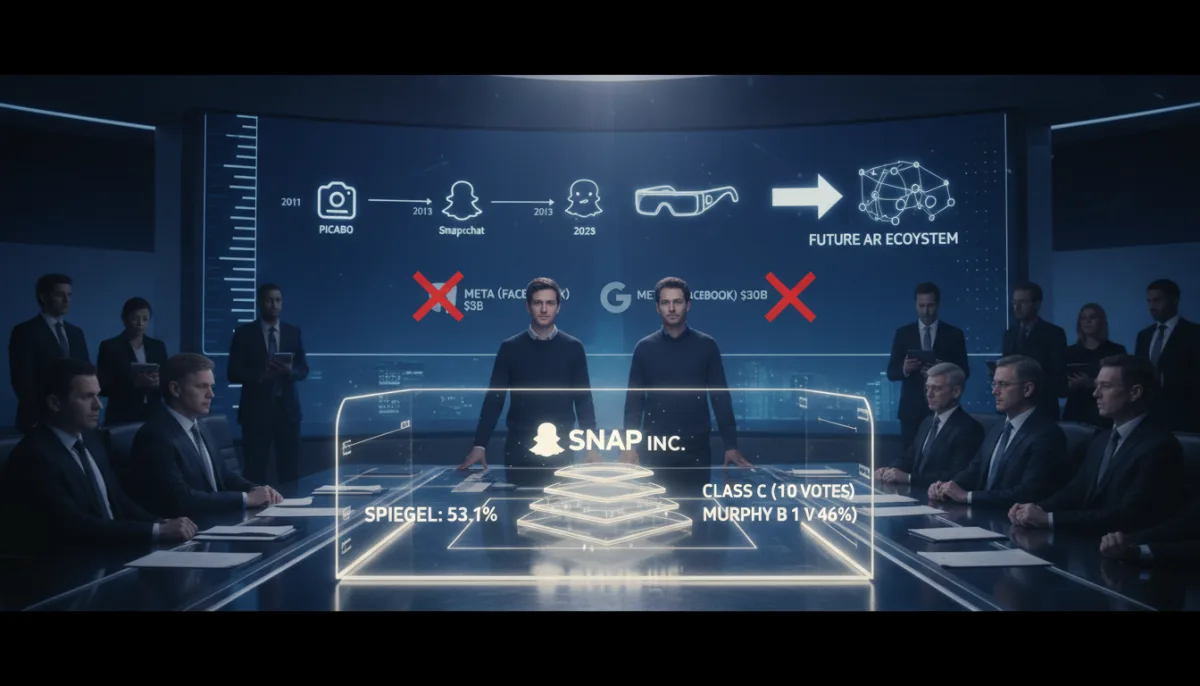
Snapchat is officially owned by its parent company, Snap Inc., a corporate restructuring that allowed the social media giant to expand into augmented reality and wearable technology. Originally launched in 2011 under the name "Picaboo," the vanishing chat app was founded by Evan Spiegel, Bobby Murphy, and Reggie Brown. While Brown was ousted early on - eventually receiving a $158 million settlement following a lawsuit - Spiegel and Murphy remain at the helm as CEO and CTO, respectively. Today, Snap Inc. operates not only Snapchat but also the Bitmoji, Spectacles, and Looksery brands.
Despite Snap Inc. (SNAP) being a publicly traded company, its founders maintain an ironclad grip on its operations. According to a 2026 SEC report, Spiegel and Murphy hold 99% of the company's voting power. This is achieved through a tiered stock structure: Class A shares offer no voting rights, Class B shares grant one vote per share, and Class C shares provide 10 votes per share. Spiegel controls 53.1% of the total voting power, holding 2.1% of Class A, 26% of Class B, and 53.4% of Class C stocks. Murphy commands 46% of the voting power, owning 4.2% of Class A, 26% of Class B, and 46.6% of Class C stocks.
Because the company is publicly traded, major asset management firms hold substantial financial stakes without wielding operational control. FMR, LLC holds the largest institutional stake with 88.74 million shares, valued at over $401 million. Vanguard's divisions hold a combined 94.34 million shares (47.69 million in Capital Management and 46.65 million in Portfolio Management). Other major players include BlackRock Inc. with 47.26 million shares and JP Morgan with 26.5 million shares.
This unique voting structure has allowed Snap Inc. to aggressively defend its independence against massive acquisition attempts. In 2013, Meta (then Facebook) attempted to buy the company for $3 billion. When rebuffed, CEO Mark Zuckerberg retaliated by replicating Snapchat's core features - including face filters, vanishing messages, and stories - directly into Instagram. Four years later, in 2017, Google reportedly offered a staggering $30 billion to acquire Snap Inc., which was also rejected.
The AR Gamble Protecting Snap's Independence
The absolute voting control held by Spiegel and Murphy is the single most critical factor in Snap Inc.'s current business strategy. By insulating themselves from the short-term profit demands of Wall Street and hostile takeovers, the founders have the freedom to make expensive, long-term bets that traditional shareholders might otherwise block. Even if the board attempted to fire them from their executive roles, their stock holdings guarantee they would retain the exact same voting power over business matters.
This structural immunity explains why Snap Inc. is currently pouring massive resources into the high-priced AR glasses market. While competitors like Apple and Meta are heavily subsidizing their own mixed-reality hardware, Snap is leveraging its independence to position Spectacles as a foundational pillar of its future, rather than just a social media accessory. The rejection of Google's $30 billion offer proves that Snap's leadership views the company not as an app to be sold, but as a hardware ecosystem waiting to mature.