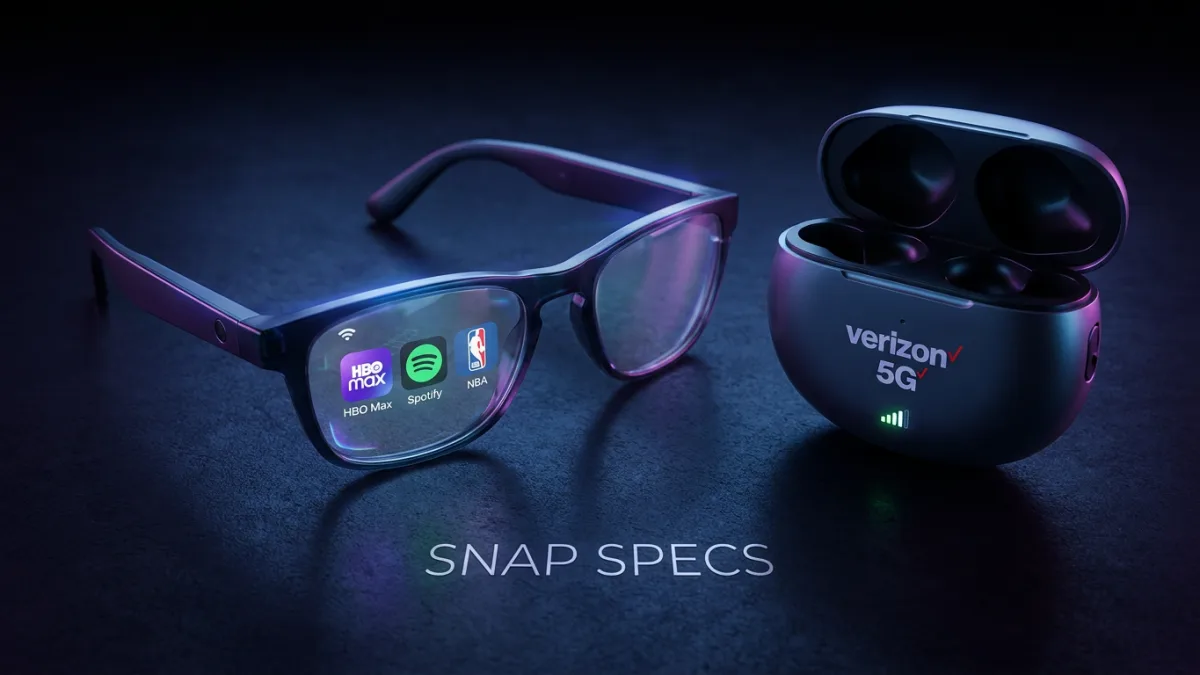
Tech enthusiasts and early adopters ready to drop over $2,000 on next-generation wearables finally have a reason to look at the Snap Specs AR glasses. Snap has officially unveiled the software ecosystem and standalone cellular capabilities that justify the steep price tag, transforming these frames from a developer novelty into a standalone spatial computer. By integrating anticipatory AI and untethering the device from local Wi-Fi networks, the company is targeting power users who want seamless augmented reality integrated into their daily routines.
The most notable hardware revelation is a new charging case equipped with built-in cellular connectivity. Snap partnered with Verizon to provide this untethered experience, ensuring the glasses remain online even when a smartphone or Wi-Fi network is out of reach. This shift addresses a major pain point for AR wearables, which traditionally suffer from severe functionality drops the moment users step outside their home networks.
Expanding the AR App Ecosystem
Snap is pushing far beyond basic social media capture by introducing a robust lineup of interactive applications. Entertainment takes center stage with a dedicated HBO Max app for consuming content in augmented reality, alongside an upcoming Spotify integration for music playback. Surprisingly, the ecosystem also includes a Shopify app designed to facilitate 3D shopping experiences directly through the lenses.
Interactive and educational software forms the second pillar of the new platform. Snap announced an Apollo 11 educational experience and a Harry Potter integration tied to the upcoming HBO television series. For sports enthusiasts, partnerships with the NBA and WNBA have yielded an interactive basketball app that utilizes visual guidance to assist users with real-world drills and practice sessions.
Snapchat Integration and Specs Intelligence
Addressing a glaring omission from the initial June announcement, Snap confirmed a native Snapchat app built specifically for the Snap Specs AR glasses. The application allows users to take video calls and capture photos completely hands-free. In a clever nod to the brand's identity, the physical gesture required to snap a picture is simply snapping your fingers.
The software experience is anchored by Specs Intelligence, an anticipatory AI service that operates across iPhone, Mac, and the glasses themselves. The AI is designed to proactively surface relevant information and actions without requiring manual prompts. For example, it can aggregate flight and hotel details for an upcoming trip while simultaneously reminding the user of a pending work deadline, all while claiming to avoid collecting personal content from connected apps.
How to Pre-Order and Choose Your Data Plan
If you are ready to invest in Snap's vision for spatial computing, the hardware is available to reserve immediately. The rollout is currently limited to the U.S., U.K., and France, with shipping expected to begin later this fall.
- Reserve the base model: Place a $200 refundable deposit at specs.com to secure the standard glasses, which carry a total MSRP of $2,195.
- Upgrade to the cellular bundle: Opt for the $2,395 bundle to receive the Verizon-powered cellular charging case alongside the glasses.
- Select a data plan: To activate the cellular case, Verizon customers must pay an additional $10 per month. Non-Verizon customers can access the network for $20 per month.
The High-Stakes Gamble on Standalone AR
Snap is taking a massive risk by pricing the Snap Specs AR glasses at $2,195, placing them in direct competition with premium mixed-reality headsets rather than lightweight smart glasses. While Meta has found mainstream success by keeping its Ray-Ban smart glasses affordable and tethered to a phone, Snap is betting that users will pay a massive premium for true, untethered augmented reality. The inclusion of a cellular charging case is a brilliant engineering workaround to the battery and thermal limits of AR frames, effectively offloading the modem while keeping the glasses connected anywhere.
However, the success of this hardware hinges entirely on Specs Intelligence and the third-party app ecosystem. If the NBA visual guidance drills and the anticipatory AI prove genuinely useful rather than gimmicky, Snap could carve out a lucrative niche among developers and prosumers. But with a $20 monthly cellular tax on top of a $2,395 bundle, the company must prove that snapping your fingers to take a photo is just the beginning of a much larger spatial computing revolution.