Meta's $12.1 billion teen addiction settlement comes with a massive financial catch that is dictating the company's public strategy. Following a high-profile trial brought by state attorneys general from California, New Jersey, Kentucky, and Colorado, Meta has agreed to sweeping changes to curb minor addiction on its platforms. This legal maneuvering directly impacts parents, teenagers, and digital marketers, as the implementation of strict daily limits on Instagram and Facebook could fundamentally alter how Gen Z consumes social media.
The lawsuit alleged that Meta knowingly designed its platforms to addict minors and illegally surveilled young users. To mitigate the fallout, Meta is publishing an open letter in major U.S. newspapers urging its biggest rivals to adopt the exact same restrictions. However, the company is conspicuously leaving Snapchat out of its public plea.
The $5 Billion Loophole
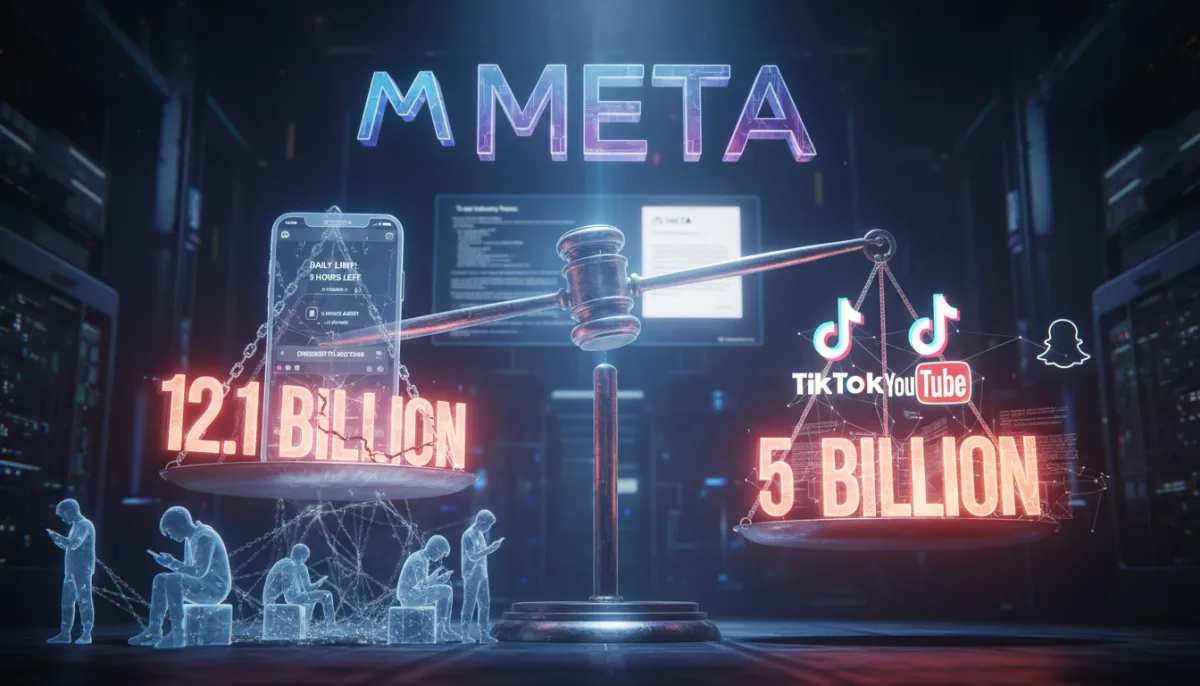
The structure of the proposed settlement reveals exactly why Meta is selectively pressuring its competitors. The legal filing defines "Core Industry Members" as Snap, TikTok, and YouTube. If all three of these platforms voluntarily handcuff their apps with the same restrictions as Meta, the monetary penalty Meta must pay jumps from $12.1 billion to approximately $17.1 billion.
By publicly calling out only TikTok and YouTube, Meta is attempting to force its primary competitors to limit their engagement metrics without triggering the clause that requires all three core members to join. According to usage data from Statista, Facebook and Instagram each boast over 3 billion monthly active users globally. YouTube follows with 2.6 billion, and TikTok holds about 2 billion. Snapchat, with less than one billion users, is simply not viewed as a severe enough threat to justify a $5 billion penalty.
Because teens move fluidly across dozens of apps, we need an industry-wide solution. We therefore call on our industry peers, TikTok and YouTube, to implement this new framework, right away.
- C.J. Mahoney, Chief Legal Officer, Meta
New Restrictions Coming to Teen Accounts
If the settlement moves forward, Meta will be legally required to implement aggressive friction points designed to break addictive scrolling habits. Parents and users should prepare for the following mandatory changes:
- Two-Hour Daily Limit: A hard cap on daily usage for teens across both Instagram and Facebook.
- 15-Minute Alerts: Persistent notifications interrupting the user experience every 15 minutes.
- Overnight Block: A system-level lockout designed to prevent minors from losing sleep due to late-night scrolling.
- Push Notification Limits: Restrictions on alerts during standard school hours to prevent classroom disruptions.
- Enhanced Parental Controls: New dashboard tools granting parents deeper oversight into account activity.
Weaponizing Legal Concessions
Meta is executing a masterclass in corporate judo. By framing its open letter as a moral crusade to "support teens," the company is attempting to weaponize its own legal defeat against its biggest rivals. If TikTok and YouTube refuse to implement the two-hour limit, Meta can publicly paint them as negligent regarding child safety. If they comply, Meta successfully levels the playing field, ensuring its competitors suffer the exact same drop in ad inventory and user engagement.
The intentional exclusion of Snapchat is the most telling detail of the entire ordeal. It proves that this industry-wide push is not purely about establishing a universal safety standard for minors; it is a calculated financial equation. Meta has determined that kneecapping TikTok and YouTube is worth the effort, but paying an extra $5 billion to include Snapchat is a bad return on investment.
This article was written by AI from reporting by gizmodo.com.