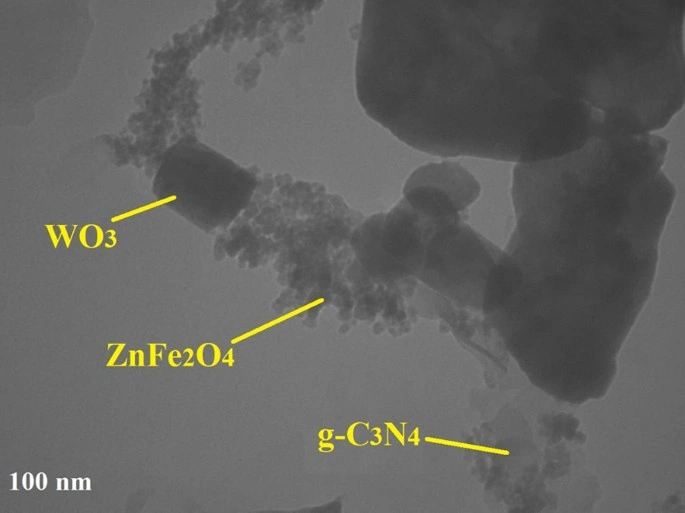
A new composite material combining zinc oxide (ZnO) and tungsten trioxide (WO3) has demonstrated exceptional photocatalytic performance under solar light, offering a sustainable solution for removing organic pollutants from contaminated water. This advancement represents a significant step forward in green chemistry and environmental remediation technologies.
The ZnO/WO3 composite was synthesized using a hydrothermal approach, a method that leverages controlled temperature and pressure to create highly ordered crystalline structures. The synergistic interaction between ZnO and WO3 creates a composite material with enhanced light absorption capabilities and improved charge carrier dynamicsthe movement of electrons and holes that drive the photocatalytic reaction.
How the Photocatalytic Process Works
Photocatalysis is a chemical process where light energy activates a catalyst to break down pollutants. When the ZnO/WO3 composite is exposed to solar radiation, photons excite electrons from the valence band to the conduction band, creating electron-hole pairs. These charge carriers interact with water molecules and dissolved oxygen to generate highly reactive hydroxyl radicals and superoxide ions, which attack and degrade organic dye molecules like methylene blue.
The combination of ZnO and WO3 is particularly effective because each material compensates for the limitations of the other. ZnO exhibits a wide band gap, which limits its visible light absorption, but WO3 has a narrower band gap that captures more of the solar spectrum. Together, they create a heterojunction structure that reduces electron-hole recombinationa process where charge carriers neutralize each other without contributing to the degradation reactionthereby improving overall catalytic efficiency.
Performance Metrics and Comparative Analysis
Research on similar composite systems provides context for the effectiveness of ZnO/WO3 materials. Ternary composites incorporating graphene oxide, graphitic carbon nitride, and ZnO have achieved photocatalytic degradation rates of approximately 90% for methylene blue under light exposure within 60 minutes. Pure ZnO alone achieves only 22.9% degradation under identical conditions, demonstrating the dramatic improvement that composite structures provide. Ti-doped ZnO nanoparticles have shown degradation rate constants increased by over 80% compared to pure ZnO, highlighting how strategic doping and composite formation enhance photocatalytic activity.
The WO3/ZnO/molecular sieves composite represents another variant that combines the adsorption capacity of porous molecular sieves with the photocatalytic properties of the metal oxide pair. This three-component system demonstrates that degradation efficiency improves with increased material loading and decreases with higher initial pollutant concentrationsa pattern consistent across photocatalytic systems.
Advantages Over Conventional Water Treatment
Traditional wastewater treatment methods rely on energy-intensive processes such as activated carbon adsorption, chemical oxidation, or biological treatment. These approaches often require continuous chemical inputs and generate secondary waste streams. Photocatalytic degradation using solar energy offers several distinct advantages: it harnesses renewable solar radiation, requires no chemical additives beyond the catalyst itself, and can mineralize organic pollutants into harmless byproducts like carbon dioxide and water.
The hydrothermal synthesis method used to create ZnO/WO3 composites is also scalable and cost-effective compared to more complex multi-step synthesis routes. The resulting material exhibits high surface area and porosity, providing abundant active sites for pollutant degradation. Temperature control during synthesis ensures consistent crystal structure and particle size distribution, which directly correlates with photocatalytic performance.
Real-World Applications and Environmental Impact
Methylene blue, the model pollutant used in this research, represents a class of synthetic organic dyes commonly found in textile industry wastewater. The textile sector generates approximately 92 trillion liters of wastewater annually, with dyes comprising a significant portion of the organic load. Photocatalytic materials capable of degrading these dyes under solar light could be deployed in decentralized treatment systems, particularly in regions with high solar irradiance and limited access to centralized water treatment infrastructure.
Beyond textile wastewater, ZnO/WO3 composites show potential for treating pharmaceutical residues, pesticide metabolites, and other persistent organic pollutants that resist conventional biological treatment. The material could be incorporated into fixed-bed reactors, slurry reactors, or immobilized on substrates for continuous-flow applications. Integration with solar concentrators or photoreactors designed to maximize light utilization could further enhance degradation rates in practical systems.
Challenges and Future Development
While the photocatalytic performance of ZnO/WO3 composites is promising, several technical challenges remain. Catalyst recovery and reuse are critical for economic viabilitythe material must maintain structural integrity and photocatalytic activity across multiple degradation cycles. Photocorrosion, where the catalyst itself degrades under illumination, can reduce long-term performance. Additionally, scaling from laboratory photoreactors to industrial-scale systems requires optimization of reactor design, light distribution, and mass transfer dynamics.
Future research directions include doping the composite with noble metals like palladium or platinum to further enhance electron-hole separation, incorporating the material into three-dimensional structures or membranes for easier separation from treated water, and testing performance against real wastewater matrices rather than model pollutants. Integration with other renewable energy technologies, such as coupling photocatalytic treatment with solar thermal systems, could unlock additional synergies.
My Take
The ZnO/WO3 composite represents a meaningful advance in photocatalytic water treatment, but it remains in the research-to-commercialization transition phase. The material's ability to leverage solar energy for pollutant degradation aligns perfectly with global sustainability imperatives, particularly for developing nations facing water scarcity and industrial pollution. However, the path to widespread adoption requires solving the practical engineering challenges of catalyst immobilization, long-term durability, and cost-competitive manufacturing. Within the next 5-10 years, we should expect pilot-scale deployments in textile-producing regions and integration into hybrid water treatment systems that combine photocatalysis with membrane filtration. The real breakthrough will come when these materials are deployed not in research labs, but in actual industrial wastewater streams, where their performance under real-world conditions will determine their transformative potential.
This article was written by AI from reporting by nature.com.