As industries struggle to move away from fossil fuels for high-temperature operations, a surprisingly simple material is emerging as a viable alternative: sand. Finland-based Polar Night Energy is proving that massive, heavily insulated silos filled with crushed rock and industrial slag can store renewable energy as heat for months. This approach offers a highly scalable solution to the global energy storage bottleneck, bypassing the supply chain constraints of traditional chemical batteries.
This development matters immensely for municipal planners and heavy industries - such as food, beverage, and pharmaceuticals - that require constant heat between 100°C and 250°C. By capturing excess wind and solar power during off-peak hours, this thermal energy storage system allows companies to decarbonize their operations. Crucially, it enables them to do so without entirely ripping out their existing infrastructure.
The Pornainen Installation and Scaling Up
The technology has already moved beyond the theoretical phase and into rigorous real-world testing. The company's flagship installation in Pornainen, Finland, became operational in 2025 and recently endured one of the country's coldest winters in years. This facility represents a major leap in scale, measuring roughly twenty times larger than Polar Night Energy's previous deployments.
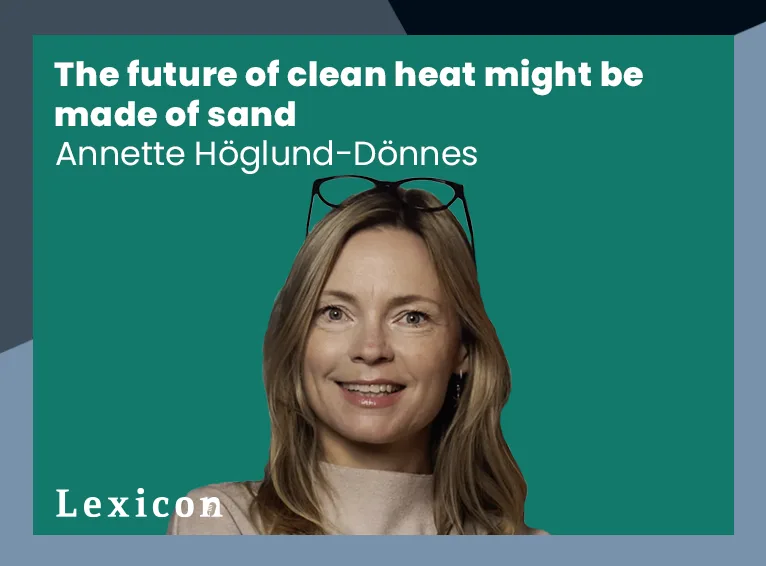
"We were very pleased to see that the battery performed at the upper end of what the simulations predicted," said Annette Höglund-Dönnes, Chief Commercial Officer at Polar Night Energy. She noted that the system actually exceeded the promised performance values, breaking the mold for emerging energy technologies that often fail to meet early expectations.
Scaling up to the Pornainen facility introduced a new set of engineering challenges. While the core concept is straightforward, the execution requires precise coordination of heat transfer, airflow, insulation, and control systems. The team had to build entirely new capabilities to manage the detailed engineering required at such a massive scale.
Why Sand Beats Lithium for Thermal Storage
The mechanics of the sand battery are deceptively simple. Electricity generated during periods of low demand is used to heat air, which is then circulated through thousands of tonnes of sand inside the silo. Unlike lithium-ion batteries, the sand does not degrade over time, change phases, or pose any risk of toxic leaks or explosions.
It is not the complexity, it is the simplicity. I think we are going to look back and say, 'Why didn't we start sooner?'
- Annette Höglund-Dönnes, Chief Commercial Officer, Polar Night Energy
Furthermore, the system champions circular economy principles by utilizing widely available materials. The storage medium does not require pristine desert sand; it can utilize industrial waste materials like slag. This allows the company to source materials locally, creating regional energy ecosystems where local wind and solar power become local heat without the need for long-distance transportation.
The Industrial Decarbonization Bridge
The real genius of Polar Night Energy's approach isn't just the physical medium; it is their pragmatic integration strategy. By targeting the 100°C to 250°C industrial heat range, they are attacking a massive, often-ignored segment of global carbon emissions. While the tech world obsesses over grid-scale lithium-ion batteries for electricity, thermal storage offers a cheaper, safer bridge for heavy industry.
The fact that these sand batteries can run in tandem with existing natural gas boilers is a game-changer for adoption rates. It means companies can adopt a hybrid model, gradually reducing their dependence on fossil fuels while maintaining operational resilience. This dual-source approach drastically lowers the barrier to entry for risk-averse manufacturers who cannot afford the downtime of a complete infrastructure overhaul.