Controlling the chaotic, multiscale dynamics of magnetically confined fusion devices has long been a massive hurdle for clean energy development. To solve this, researchers from the Southwestern Institute of Physics and partner universities have introduced FusionMAE, a self-supervised pre-trained artificial intelligence model designed to optimize and simplify the diagnostic and control systems of fusion plasma. By acting as a unified interface between diagnostic sensors and control actuators, this new model directly addresses the tangled interrelations that complicate modern fusion reactors.
This breakthrough is highly significant for nuclear engineers, plasma physicists, and energy researchers working on next-generation reactors. By streamlining how diagnostic data is processed, FusionMAE enables more stable plasma control, reducing system redundancy and bringing the scientific community one step closer to viable, high-performance fusion energy.
Compressing 88 Diagnostic Signals
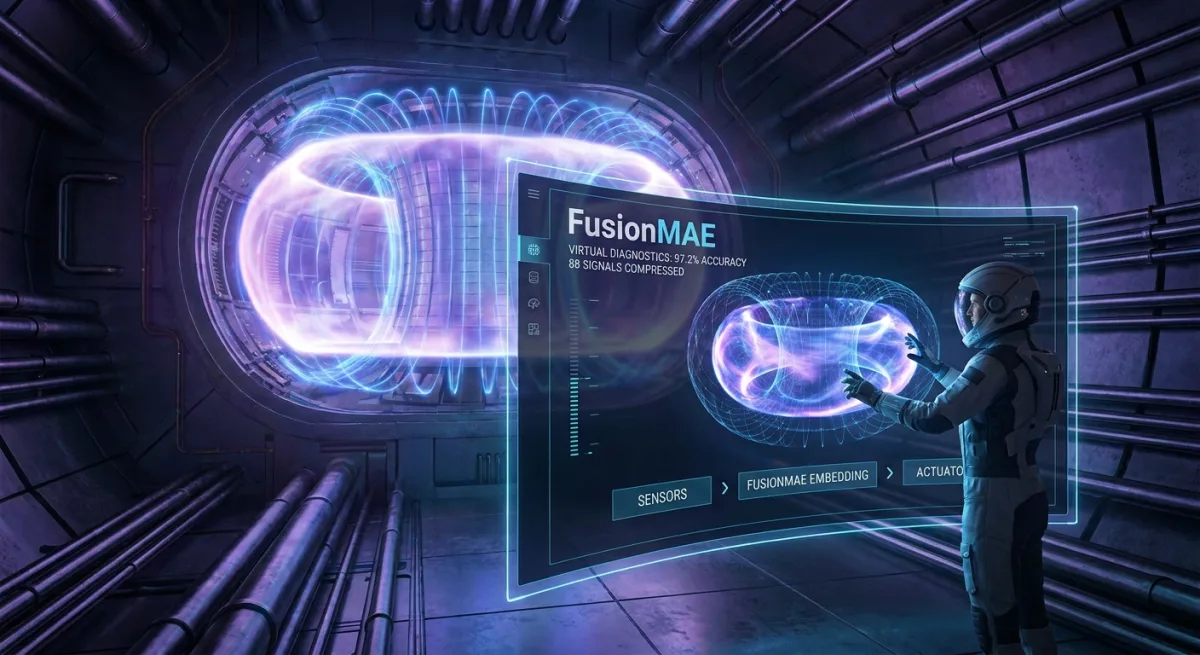
Traditional fusion reactors rely on extensive, highly complex diagnostic systems to monitor plasma behavior, which often leads to overwhelming data uncertainty. FusionMAE tackles this by compressing the information from 88 distinct diagnostic signals into a single, concise embedding.
The model relies on two core mechanisms to ensure the data remains accurate and meaningful: compression-reconstruction and missing-signal reconstruction. This approach allows the AI to process massive amounts of nonlinear data in real-time, creating a streamlined pathway between the reactor's sensors and its control mechanisms.
Achieving 97.2% Accuracy in Virtual Diagnostics
One of the most critical features of the FusionMAE model is its ability to perform virtual backup diagnosis. During operations, sensor failures or missing data can jeopardize plasma stability and trigger safety shutdowns.
Upon completing its pre-training, the model demonstrated the ability to infer missing diagnostic data with an impressive 97.2% accuracy. Beyond filling in missing data, the model has proven effective in multiple downstream applications, including automatic data analysis and actively enhancing control performance across various operational tasks.
The Shift Toward AI-Driven Nuclear Fusion
The integration of large-scale artificial intelligence models into the field of fusion energy represents a fundamental shift in how we approach nuclear reactor design. Relying purely on traditional, hard-coded diagnostic systems is no longer viable for the sheer volume of data generated by magnetically confined plasmas.
By proving that pre-trained embeddings can successfully reduce diagnostic redundancy and optimize operational performance, FusionMAE sets a new standard for reactor control. As international efforts to commercialize fusion energy accelerate, AI-driven interfaces like this will likely become mandatory components in the architecture of future high-performance fusion reactors.