

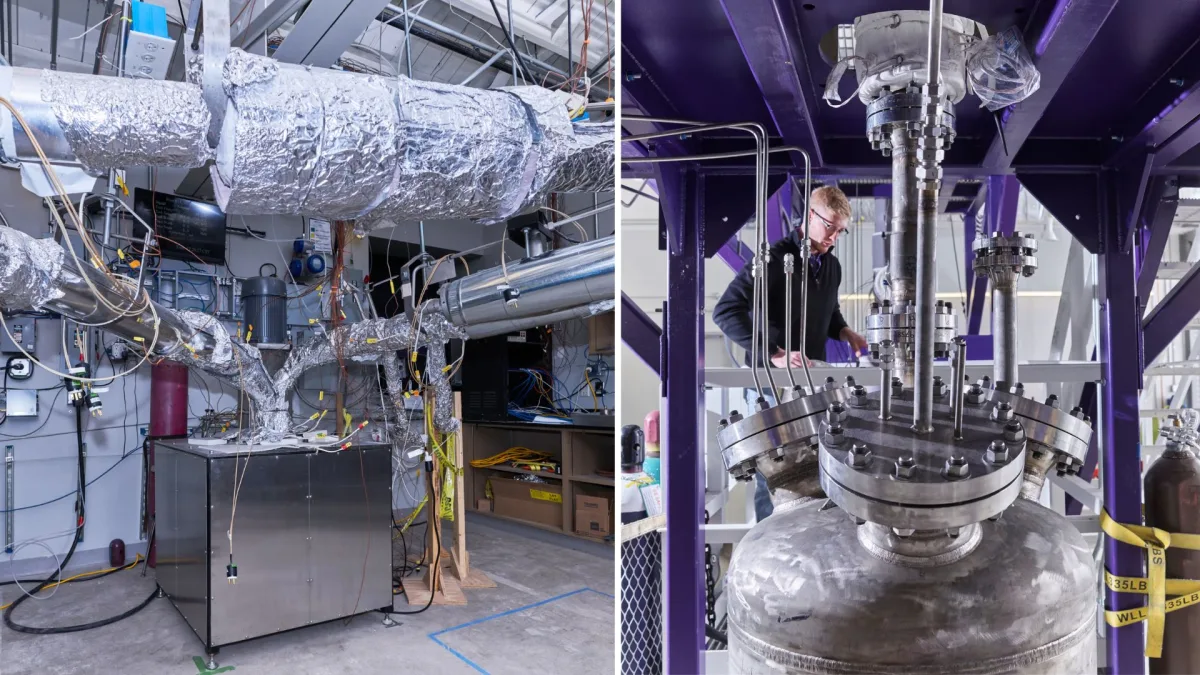
The US Department of Energy has officially approved a Nuclear Safety Design Agreement for the nation's first advanced molten salt reactor. Managed by Natura Resources and under construction at Abilene Christian University, this 1-megawatt thermal demonstration unit establishes the regulatory baseline required for federal construction authorization. This milestone validates a liquid-fueled architecture that fundamentally alters how nuclear facilities manage heat and prevent meltdowns.
Unlike traditional light water reactors that rely on solid enriched uranium fuel pellets contained inside metal rods, this design utilizes uranium tetrafluoride dissolved directly within a molten fluoride salt matrix. The liquid salt serves simultaneously as the fuel medium and the primary core coolant. As the salt mixture flows through a central graphite core structure, controlled nuclear fission generates operating temperatures exceeding 600 degrees Celsius.
Operating thermodynamics present safety and mechanical characteristics distinct from solid-fuel water reactors. Conventional light water reactors require liquid coolant to remain under high pressures, often near 2,250 pounds per square inch, to prevent boiling at operational temperatures. In contrast, molten fluoride salt mixtures remain liquid at ambient pressure conditions, typically operating between 15 and 20 pounds per square inch, while maintaining a high boiling threshold above 1,400 degrees Celsius.
Passive Safety and Core Reactivity Control
Operating near atmospheric pressure reduces mechanical stress on containment vessels, heat exchangers, and primary piping, eliminating the physical driver for pressure-driven loss-of-coolant accidents. Core reactivity control and emergency shutdown systems rely entirely on passive physics rather than mechanical pumps or active electrical systems. The primary reactor vessel connects to a dedicated drain tank located directly below the core.
During an unexpected temperature rise or power failure, passive freeze valves thaw, causing the liquid fuel salt to drain into the lower tank through gravity. The geometry of the holding tank separates the fuel salt to stop the chain reaction without human intervention or backup power supply. Decay heat escapes passively through the tank walls, allowing the fuel salt to cool and solidify below 450 degrees Celsius.
Natura Resources is using a two-track regulatory strategy to validate these engineering models before commercial deployment. The company is conducting pre-application activities with the US Nuclear Regulatory Commission to license larger commercial units. Operating the initial research loop, designated as the MSR-1, collects empirical data on salt purification, thermal corrosion rates, and material endurance under neutron irradiation.
The Industrial Shift Beyond the Grid
The approval of Natura's molten salt reactor signals a critical pivot in nuclear energy strategy: moving beyond mere electricity generation to direct industrial decarbonization. Commercial deployment plans prioritize high-temperature thermal energy applications, utilizing a secondary coolant loop to transfer heat to external industrial processes through isolated heat exchangers.
Earlier this year, Natura established an agreement with NGL Energy to evaluate coupling a 100-megawatt thermal molten salt design with water treatment infrastructure in the Permian Basin. By targeting the purification of mineral-heavy wastewater produced during oil and gas extraction, Natura is proving that advanced reactors can solve localized, energy-intensive industrial bottlenecks.
Operating at near atmospheric pressure removes the need for the massive containment domes associated with legacy nuclear plants, making these systems viable for co-location with agricultural and computing facilities. If the MSR-1 demonstration succeeds, it will establish a regulatory blueprint that could rapidly accelerate the deployment of liquid-fueled reactors across heavy industry.
