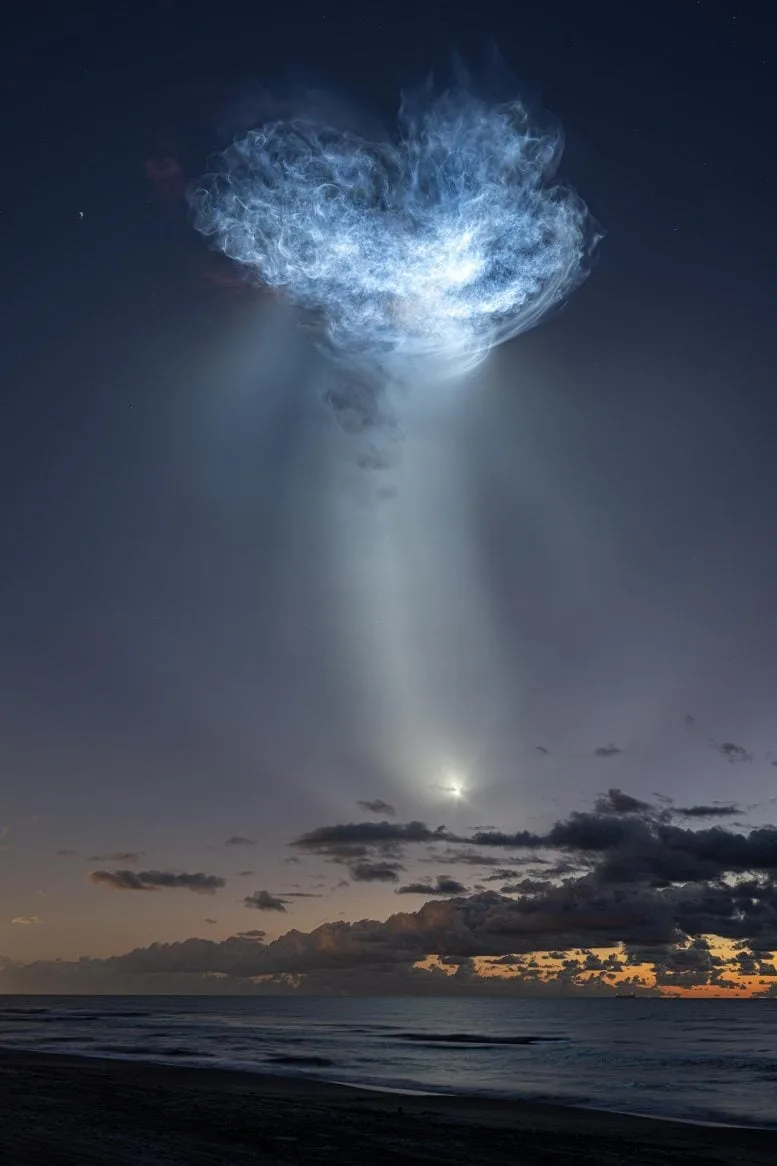
A SpaceX Falcon 9 launch produced a glowing “jellyfish” cloud across the eastern United States during an early morning liftoff on October 13, 2026. According to SciTechDaily, the rocket carried the company's Dragon spacecraft toward the International Space Station with supplies and medical experiments.
This visual effect, known as a “jellyfish,” forms when a rocket launches close to sunrise or sunset. High above Earth, sunlight hits the expanding exhaust plumes and creates a bright, glowing cloud shaped like a jellyfish.
Details of the 35th NASA Resupply Mission
The rocket lifted off at 6:33 a.m. EDT from Space Launch Complex 40 at Cape Canaveral Space Force Station in Florida. The flight represents the 35th commercial resupply mission SpaceX has flown for NASA, bringing scientific investigations, equipment, and essential supplies to the orbital outpost.
SciTechDaily notes that while the illuminated exhaust put on a show across the eastern United States, the payload onboard could support advances in medical research and space technology.
Final Roll-Out Solar Arrays and Medical Research
Inside the Dragon capsule is the last set of International Space Station Roll-Out Solar Arrays (IROSAs). Crew members are scheduled to install these panels later in the fall of 2026 to help boost the station's power generation capacity.
Alongside the station hardware, the spacecraft is delivering four scientific investigations to conduct in microgravity:
- Artificial retinas: Equipment designed to manufacture artificial retinas in microgravity, which could eventually support treatments to restore vision for patients on Earth.
- 3D heart tissue models: An investigation aimed at helping scientists develop ways to run larger-scale drug testing during future spaceflights.
- Space-formed glass: Experiments examining how a new kind of glass forms in near-weightless conditions.
- Brain organoids: Miniature brain tissue models that researchers will study to help find potential treatment targets for neurological conditions such as Alzheimer's, Parkinson's, and multiple sclerosis.
This article was written by AI from reporting by scitechdaily.com.