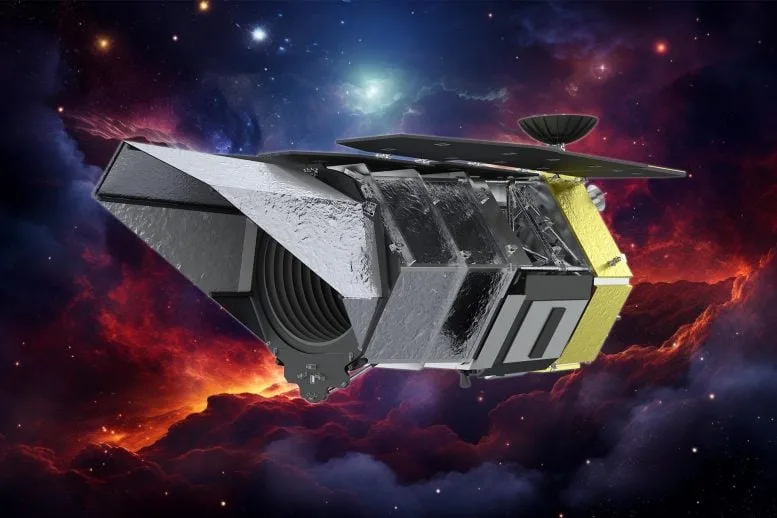
NASA’s Nancy Grace Roman Space Telescope is poised to more than double its original 10-year mission timeline, securing enough propellant for at least 22 years of scientific operations. This dramatic extension stems from a combination of a lighter-than-expected spacecraft, a highly precise launch by SpaceX, and an exceptionally efficient mid-course correction. Astronomers relying on the observatory to study dark energy and exoplanets will now have over two decades of data collection ahead of them.
On August 31 at 12:02 p.m. EDT, the spacecraft executed a 3-minute mid-course correction burn to adjust its trajectory toward its final orbit. The maneuver achieved over 99% accuracy and consumed less than 10% of its allocated fuel budget.
Specifically, the Roman Space Telescope burned only 40 pounds (18 kilograms) of propellant, bypassing the 441 pounds (200 kilograms) originally set aside for the adjustment. This single maneuver effectively added four years to the observatory's operational life.
As a result of exquisite planning by our orbital dynamics team, brilliant execution by the operations team, and a precise launch from SpaceX, Roman has fuel for at least 22 years of potential science operations.
- Jamie Dunn, Center Director, Goddard Space Flight Center
Weight Reductions and Tank Capacity
The spacecraft began its journey significantly lighter than initial projections, which directly influenced its fuel reserves. Engineers originally calculated the propellant budget based on a conservative maximum weight of 21,605 pounds (9,800 kilograms). However, the final launch mass came in at just 17,760 pounds (8,056 kilograms).
This lower mass reduced the energy required for course corrections and allowed the team to fill the fuel tanks to their absolute maximum capacity. "A spacecraft’s mass changes throughout the design and build process, so we base the propellant budget on a set maximum value so we won’t come up short," explained Alison Rao, the propulsion lead at NASA Goddard.
She noted that because the final mass was lower than budgeted, the team could fill the tanks completely rather than just meeting the 10-year requirement. This surplus alone accounts for roughly another four years of potential science operations.
The Path to L2 and Future Maneuvers
Because the initial trajectory was so accurate, the second mid-course correction planned for later this month will require minimal fuel. The observatory is scheduled to reach its final orbit around the second Lagrange point (L2) approximately 100 days after launch, arriving in early December.
Once positioned at L2, the spacecraft will only require small station-keeping maneuvers roughly once every 28 days to maintain its orbit. Current projections indicate that both the second course correction and orbital insertion should use less fuel than originally budgeted, potentially adding another four years of operation.
The Compounding Value of Deep Space Longevity
The extension of the Roman Space Telescope from a 10-year baseline to a 22-year operational window fundamentally alters the economics of flagship astrophysics missions. When a multi-billion-dollar observatory doubles its lifespan purely through operational efficiency and mass management, the return on investment for the scientific community scales exponentially. This longevity allows Roman to overlap with future observatories that are currently only in the conceptual phase, enabling simultaneous multi-wavelength observations that were never part of the original mission architecture.
Furthermore, the 22-year timeline provides a critical buffer for the study of transient cosmic events and long-term exoplanet orbits. A decade is often too short to observe the full orbital period of distant exoplanets, but a two-decade window allows astronomers to confirm long-period planetary candidates that would otherwise remain unverified. By saving 401 pounds of fuel on a single maneuver, NASA has effectively bought an entire generation of astronomers the time needed to map the universe's expansion with unprecedented statistical certainty.