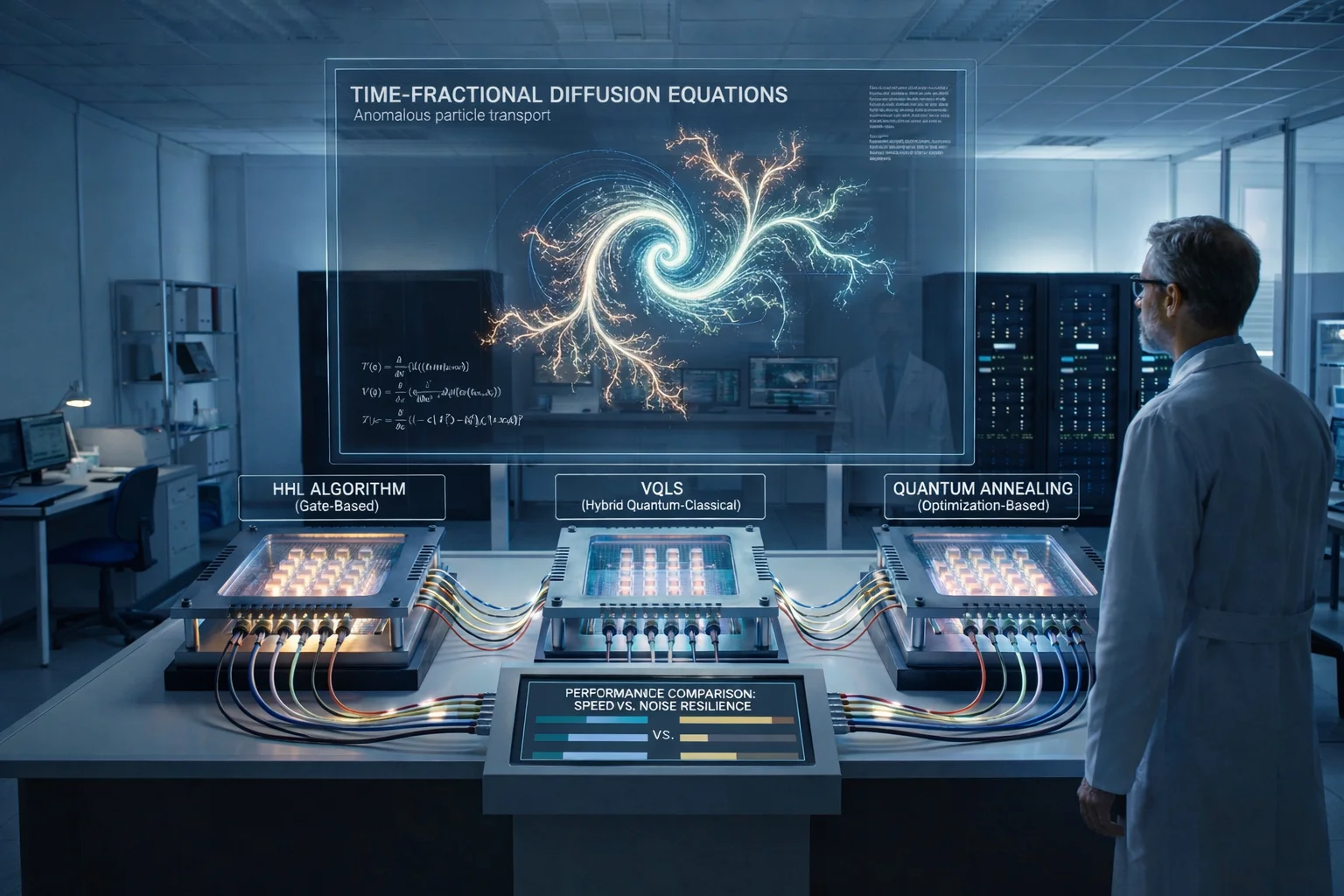
Quantum linear solvers are rapidly evolving from theoretical constructs to practical tools for scientific computing, specifically in addressing the complex challenge of time-fractional diffusion equations. A groundbreaking study published in Nature Scientific Reports has provided a critical performance comparison between three dominant quantum approaches: Variational Quantum Linear Solvers (VQLS), the Harrow-Hassidim-Lloyd (HHL) algorithm, and Quantum Annealing. These mathematical models are essential for describing anomalous transport phenomena found in biological protein transport, groundwater flow in porous media, and turbulent plasma physics, areas where classical computing architectures often hit performance bottlenecks due to the non-local nature of the calculations.
The Challenge of Anomalous Transport
Time-fractional diffusion equations differ significantly from standard diffusion models because they account for memory effects in the system, meaning the future state of a particle depends on its entire history rather than just its current state. Solving these equations on classical supercomputers requires immense memory and processing power to track these historical correlations over time. The study highlights that quantum algorithms offer a potential exponential speedup by encoding these linear systems into quantum states. However, the implementation varies drastically between the gate-based approaches of VQLS and HHL versus the optimization-based approach of Quantum Annealing, creating a divergent landscape for researchers attempting to simulate complex physical systems.
Analyzing the Quantum Contenders
The Harrow-Hassidim-Lloyd (HHL) algorithm has long been considered the gold standard for theoretical exponential speedup in solving linear systems of equations. However, the study points out that HHL requires deep quantum circuits and complex state preparation that challenge the limits of current Noisy Intermediate-Scale Quantum (NISQ) hardware. In contrast, the Variational Quantum Linear Solver (VQLS) utilizes a hybrid quantum-classical loop, where a classical optimizer adjusts the parameters of a shallow quantum circuit to minimize a cost function. This approach proves far more resilient to noise, making it a pragmatic choice for near-term devices. Meanwhile, Quantum Annealing approaches the problem differently by mapping the linear equation to an energy minimization problem (Ising model), which can be solved on specialized annealers like those from D-Wave, offering a distinct advantage in specific optimization-heavy formulations of the diffusion problem.
| Algorithm Type | Primary Mechanism | Hardware Suitability | Key Advantage |
|---|---|---|---|
| HHL Algorithm | Quantum Phase Estimation | Fault-Tolerant Quantum Computers | Theoretical exponential speedup over classical methods. |
| VQLS | Hybrid Quantum-Classical Optimization | NISQ (Noisy Intermediate-Scale) | High resilience to noise; feasible on current hardware. |
| Quantum Annealing | Energy Minimization (Ising Model) | Quantum Annealers (e.g., D-Wave) | Efficient for optimization-mapped linear problems. |
Benchmarking Performance and Accuracy
The research indicates that while HHL offers the most significant theoretical advantage, its implementation is currently hampered by the depth of circuits required for accurate phase estimation. VQLS emerged as a robust alternative for the specific task of time-fractional diffusion, balancing accuracy with the constraints of modern gate-based processors. The hybrid nature allows researchers to offload the optimization workload to classical CPUs while leveraging the quantum processor unit (QPU) for the exponentially large vector spaces. Quantum Annealing showed promise in stability but faced challenges in precision when scaling to larger grid sizes required for high-fidelity scientific simulations. The findings suggest that for the immediate future, hybrid variational approaches provide the most viable path for integrating quantum computing into engineering workflows involving anomalous diffusion.
Frequently Asked Questions
What are time-fractional diffusion equations used for?
They model "anomalous" transport where particles do not spread normally, such as pollutants seeping through complex soil structures or proteins moving inside a crowded cell.
Why is VQLS considered better than HHL for current computers?
VQLS uses shorter quantum circuits and relies on classical computers for optimization, making it less susceptible to the errors (noise) that plague current quantum hardware, whereas HHL requires deep, error-corrected circuits.
Can Quantum Annealing solve general linear equations?
Yes, but indirectly. It solves linear equations by converting them into an optimization problem where the solution corresponds to the lowest energy state of the system, though precision can be limited by hardware connectivity.
My Take
This study marks a pivotal transition in quantum scientific computing from "what is theoretically possible" to "what is architecturally viable." While HHL remains the theoretical north star, the industry's shift toward VQLS for complex differential equations demonstrates a maturity in utilizing NISQ devices. For researchers in fluid dynamics and materials science, mastering variational algorithms is no longer optionalit is the gateway to next-generation simulation capabilities.
This article was written by AI from reporting by nature.com.