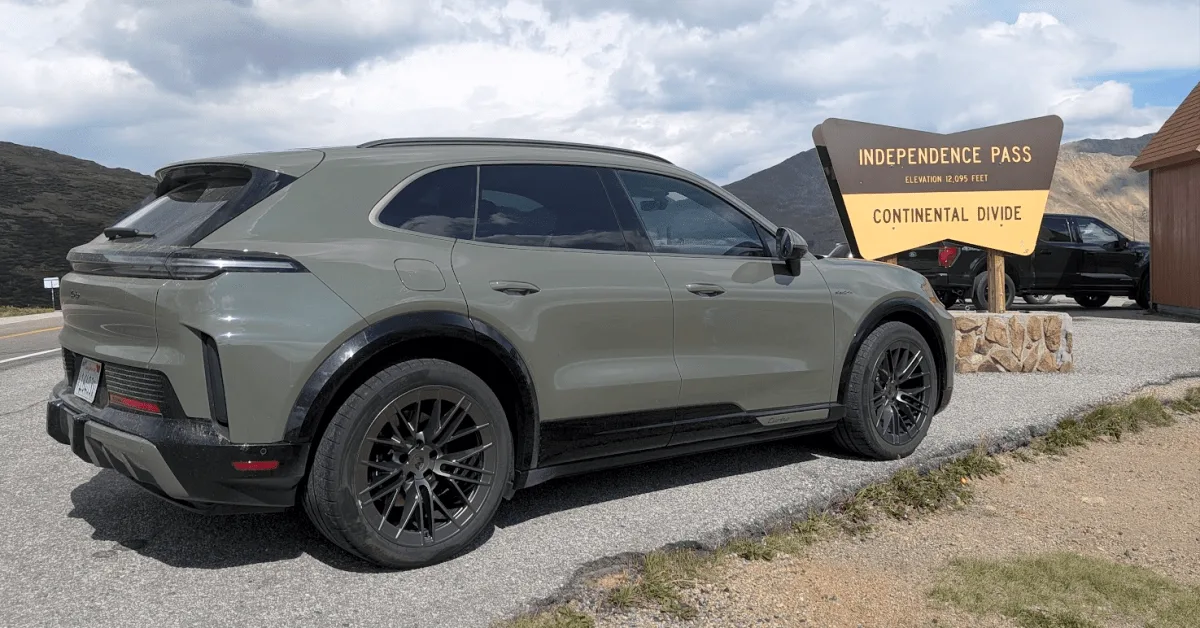
The Porsche Cayenne Turbo EV is redefining what a family SUV can do, packing hypercar acceleration into a daily driver. With a staggering 1,139 horsepower available via its launch system, this $163,000 electric monster proves that legacy automakers can still dominate the EV performance space. Porsche recently showcased the flagship SUV on a 250-mile mountain and off-road course in Aspen, Colorado, revealing a vehicle that excels in acceleration, air-supported suspension comfort, and ultra-fast charging capabilities.
Unleashing 1,139 Horsepower on the Road
Porsche is heavily marketing this as the "most powerful Porsche ever," and technically, the numbers back it up. In everyday driving conditions, the dual-motor setup delivers a highly capable 844 hp, which is more than enough to pass a semi-truck at 80 mph. However, engaging the launch system unlocks a jarring 1,139 hp and 1,106 lb-ft of torque for a few seconds. Drivers can also trigger a 176-hp overboost for 10-second bursts directly from the steering wheel.
60 mph in just 2.1 seconds and completing the quarter-mile in 9.5 seconds. The braking performance is also the best among SUVs, matching the result of a Corvette ZR1 by stopping from 70 mph in just 140 feet. The Cayenne Turbo Electric also posted the best roadholding figure for an SUV in Car and Driver history at 1.05 g on the skidpad.
- Car and Driver
To put this into perspective, if you traveled back to 1990, telling a Lamborghini Countach owner that a family SUV would hit 60 mph in half the time 35 years later would sound absurd. Even today, the Cayenne Turbo outpaces current supercars like the Lamborghini Revuelto and the 1064-hp Chevy Corvette ZR1. The vehicle also boasts a 162-mph top speed, paired with an agile air suspension system that makes off-road dirt trails feel effortless.
800V Architecture and 400kW Fast Charging
Porsche continues to lead the industry in charging technology. The Cayenne Turbo EV utilizes an 800V system capable of charging at over 400kW on supported stations. According to Porsche, this aggressive charging curve allows the battery to go from 10% to 80% in under 16 minutes. While real-world testing was limited to 400V 200kW chargers during the Aspen drive, the theoretical peak performance places it among the fastest-charging EVs globally.
The SUV is highly versatile when it comes to connectivity. It features a NACS port (with a CCS adapter) on one side and a J-1772 port on the other. It intelligently splits Level 3 DC fast charging to the NACS side and Level 1/2 AC charging to the J-1772 adapter. For home use, the Cayenne includes a massive 19.2 kW on-board AC-to-DC inverter, enabling charging speeds near 20kW. Porsche also offers an 11kW inductive charging option that operates at up to 90% efficiency.
The $163,000 Compromise: Design and UI
Despite its engineering marvels, the Cayenne Turbo EV has a few drawbacks, starting with its steep $163,000 base price. The instrument cluster can feel overwhelming, requiring unnecessary hunting for basic controls. While adopting Google's Android Automotive OS alongside Apple CarPlay is a smart move, managing the built-in interface versus the projection stack can cause initial confusion.
Aesthetically, the design feels somewhat subdued for a vehicle that costs as much as a median home in the Rust Belt. While it features colored brake calipers and subtle winglets, it lacks the aggressive visual flair expected at this price point. Furthermore, the sheer violence of the acceleration is physically taxing; passengers risk genuine whiplash if the driver decides to overtake without warning, raising questions about the necessity of locking peak power behind steering wheel controls rather than simple pedal response.
Engineering Beyond the Press Release
The engineering behind the Cayenne Turbo EV is undeniably real. The sophisticated chassis work, the thermal management required for repeated high-speed launches, and the sustained charging curve separate Porsche from automakers who build EVs purely for press releases. However, the "most powerful Porsche ever" tagline is doing heavy lifting for a 10-second overboost window that most owners will rarely use, especially when the standard 844-hp mode is already absurd overkill.
When fully loaded with Active Ride suspension, ceramic brakes, and other premium options, the price comfortably exceeds $250,000. At that tier, this is not a vehicle competing on EV-specific merits like range-per-dollar or efficiency. The Lucid Gravity offers better range for less money, and the Rivian R1S provides vastly superior value. Ultimately, buyers are paying a massive premium for one specific trait: it drives exactly like a Porsche.
This article was written by AI from reporting by electrek.co.