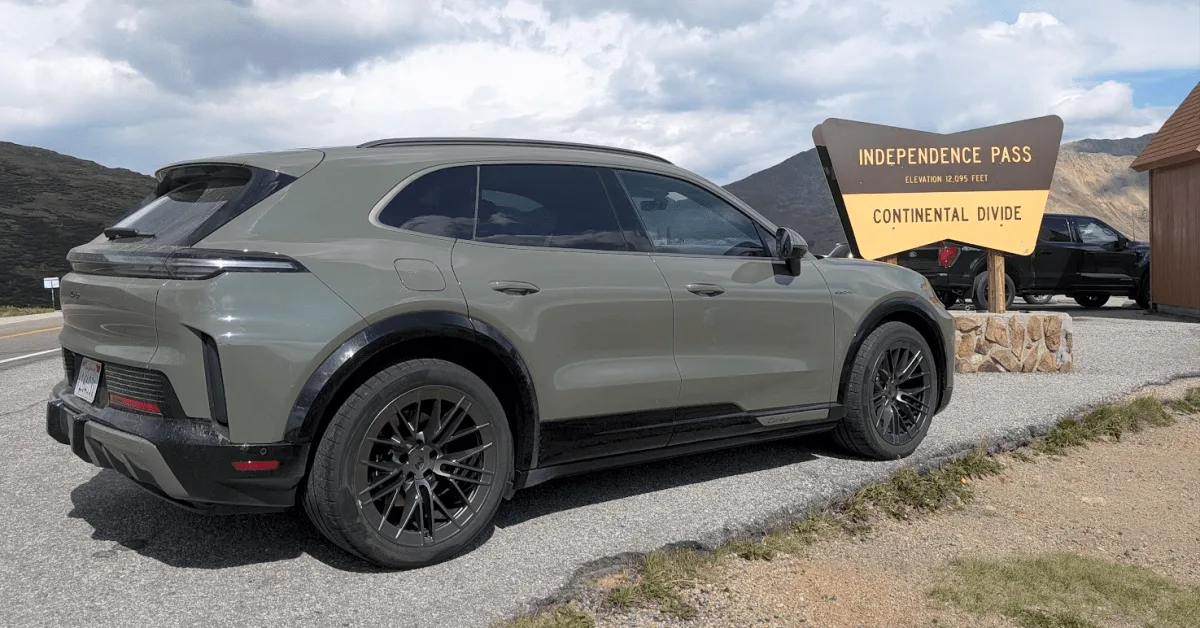
If you are dropping over $160,000 on an electric SUV, you expect hypercar performance without sacrificing family-hauling practicality. The new Porsche Cayenne Turbo EV delivers exactly that, masking a staggering 1,139 horsepower beneath a surprisingly subdued exterior. Aimed squarely at deep-pocketed driving enthusiasts who refuse to compromise between a track toy and a daily driver, this flagship EV proves that legacy automakers can still out-engineer pure EV startups in chassis dynamics and thermal management.
While competitors like the Rivian R1S or Lucid Gravity offer better range-per-dollar, Porsche's entry is about raw, unadulterated driving feel. It pushes the boundaries of 800-volt charging architecture while delivering acceleration that physically challenges its occupants.
The "Most Powerful Porsche" Caveat
Porsche is leaning heavily into marketing the Cayenne Turbo EV as its most powerful vehicle ever, but that claim requires reading the fine print. In everyday driving scenarios, the dual-motor setup produces a highly capable 844 horsepower. To unlock the headline-grabbing 1,139 hp and 1,106 lb-ft of torque, drivers must engage Launch Control, which delivers the peak output for only a matter of seconds.
Additionally, the steering wheel features a Push-to-Pass button that triggers a 176-hp overboost for 10-second bursts. Despite these electronic gates, the everyday 844 hp is more than enough to effortlessly overtake highway traffic. Independent testing reveals that Porsche is actually understating the vehicle's true capabilities.
60 mph in just 2.1 seconds and completing the quarter-mile in 9.5 seconds. The braking performance is also the best among SUVs, matching the result of a Corvette ZR1 by stopping from 70 mph in just 140 feet.
- Car and Driver
On the road, the combination of limitless power and an agile air suspension system makes the heavy SUV feel remarkably nimble. Even with massive motors, huge tires, and a 108kWh battery pack, the Cayenne Turbo EV still manages to deliver around 300 miles of range, alongside a theoretical top speed of 162 mph.
Next-Generation Charging Architecture
Porsche continues to lead the industry in charging speeds with its advanced 800V system. The Cayenne Turbo EV can accept over 400kW on compatible DC fast chargers. Thanks to an optimized charging curve, the battery can go from a 10% to 80% state of charge in under 16 minutes, adding roughly 210 miles of range in that short window.
The vehicle is also highly versatile when it comes to port standards. It features a NACS port (with a CCS adapter) on one side and a standard J-1772 port on the other. It seamlessly supports Plug and Charge at Tesla Superchargers and Electrify America stations.
For home charging, the Cayenne is equipped with a robust 19.2 kW on-board AC-to-DC inverter, allowing for near 20kW charging speeds. Porsche is even offering an 11kW inductive charging option that promises up to 90% efficiency, making it one of the most flexible EVs on the market.
The Drawbacks of a $163,000 Super-SUV
Despite the engineering marvels, the Cayenne Turbo EV is not without its flaws. The instrument cluster can feel overwhelming, and the integration of Google's Android Automotive alongside Apple CarPlay creates occasional confusion between the built-in interface and the projected smartphone stack.
Aesthetically, the design feels a bit too restrained for a vehicle with a $163,000 starting price. Aside from colored brake calipers and subtle winglets, the exterior lacks the aggressive visual cues you would expect from a vehicle that out-accelerates a Lamborghini Revuelto. Furthermore, the sheer violence of the acceleration requires drivers to actively warn passengers before overtaking, as the instant torque can easily cause neck strain.
The True Cost of Porsche's EV Engineering
The engineering beneath the Cayenne Turbo EV is undeniably real. The sophisticated thermal management required for repeated launches and the sustained charging curve separate Porsche from automakers who build EVs purely for compliance. However, the "most powerful" marketing angle masks the reality that buyers are paying a massive premium for a 10-second overboost window they will rarely use.
With a base price of $163,000 - which easily eclipses $250,000 once options like Active Ride suspension and ceramic brakes are added - this is not a vehicle competing on EV-specific merits like efficiency. Instead, Porsche is selling its legendary driving dynamics. Buyers are paying for a chassis that defies physics and a badge that carries decades of motorsport heritage, proving that the transition to electric power hasn't diluted the core Porsche experience.
This article was written by AI from reporting by electrek.co.