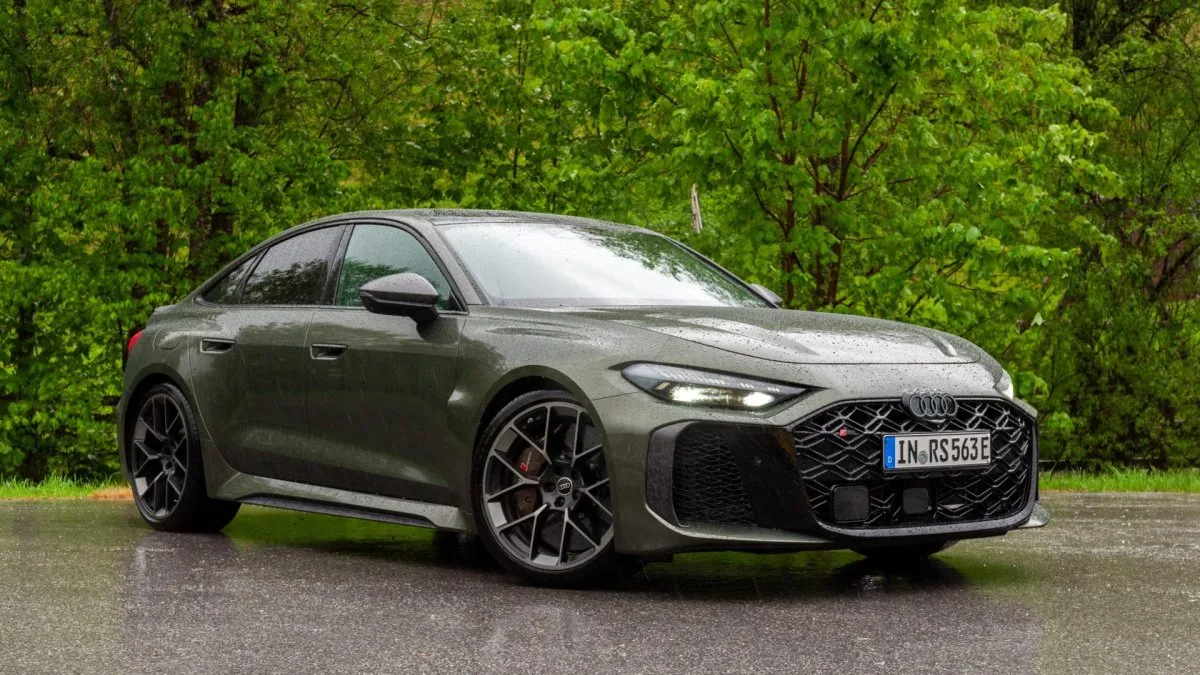
The 2027 Audi RS5 weighs a staggering 5,192 pounds, a figure that should instantly disqualify it as a serious track contender. Yet, by pairing a 630-horsepower plug-in hybrid powertrain with the most over-engineered all-wheel-drive system Audi has ever built, this flared widebody defies physics to deliver an exhilarating driving experience. While modern automakers often chase raw horsepower figures and Nürburgring lap times, the Audi Sport division has pivoted toward complex, torque-vectoring agility to mask the immense weight of its new electrified era.
A Plug-In Hybrid Powertrain Built for Power
The heart of the new RS5 is a complicated but highly effective plug-in hybrid system. It combines a twin-turbocharged 2.9-liter V6 engine with a rear-mounted electric motor, feeding power through a ZF-sourced eight-speed automatic transmission. The electric motor draws from a 22-kWh lithium-ion battery pack integrated beneath the cargo floor, operating on a robust 400-volt electrical architecture. This setup generates a combined system output of 630 horsepower and 609 lb-ft of torque, launching the heavy sedan from 0 to 60 mph in just 3.6 seconds.
When operating in electric-only mode, output drops to a modest 175 horsepower and 339 lb-ft of torque. Audi claims the battery provides roughly 52 to 54 miles of electric driving range on the European WLTP cycle. Recharging the pack from 0 to 80 percent takes approximately 2.5 hours when connected to a 240-volt Level 2 charger. However, during aggressive driving, the system prioritizes performance over efficiency, instantly firing up the V6 engine the moment the accelerator is pushed past the three-quarter mark.
The Most Over-Engineered Quattro System Yet
To manage the immense weight and power, Audi completely redesigned its patented quattro all-wheel-drive system, outsourcing production to BorgWarner. The setup utilizes a Torsen center differential with a default 40:60 front-to-rear power split, which can dynamically shift up to 15:85 or 70:30 at its limits. The most significant upgrade is the abandonment of the previous mechanical clutch-based system in favor of an electro-mechanical design for side-to-side torque vectoring.
According to Audi Sport RS5 Development Vehicle Dynamics engineer Andreas Sticht, the old mechanical system simply could not shift power quickly enough. The new architecture leverages the 400-volt system to power a dedicated electric motor on the rear axle. Using two planetary gearsets, a fixed sun gear, and a ring gear, it can shift twice as much power to each side as the outgoing model. This allows the RS5 to vector torque instantaneously, even when the driver is off the throttle, resulting in razor-sharp turn-in and controlled oversteer.
Track Performance and a Glaring Transmission Flaw
On the track, the RS5 manages to hide the extra 1,376 pounds it carries over its predecessor, largely thanks to its two-valve fully adjustable dampers. Riding on Bridgestone summer tires (2845/30R21), the car exhibits remarkable agility. In Dynamic mode, the system intentionally overloads the outside wheel to induce controlled slides, while RS Sport mode optimizes the front-to-rear power split for maximum exit speed and lower lap times.
However, the driving experience is marred by a significant flaw in the ZF eight-speed automatic transmission. While it performs admirably in automatic mode, switching to manual mode reveals a glaring issue. If a driver runs the engine to the redline and pulls the upshift paddle, there is a full two-second delay before the gear engages, accompanied by a massive, jarring thunk. Sticht acknowledged this as a known tuning shortcoming caused by the system being fully under load during the shift request, noting it could theoretically be resolved with further software calibration before the car's U.S. launch.
Interior Tech and European Pricing
Inside, the RS5 adopts the triple-screen dashboard layout seen in the standard A5, nearly devoid of physical buttons aside from a volume knob. The cabin features an RS-specific squircle steering wheel and highback sport bucket front seats equipped with heating, cooling, and massage functions. While the passenger display proves useful for independent navigation control, the door panel - which consolidates mirror, headlight, and seat memory controls onto a single piece of plastic - feels like a step backward in tactile quality.
The RS5 is currently on sale in Europe, where the sedan commands a steep €106,200 (approximately $123,183). This pricing places it significantly higher than a base BMW M3, which starts around $80,000, and positions it above the $90,000 plug-in hybrid Mercedes-Benz C63. The RS5 is not expected to arrive in the U.S. market until sometime in 2027.
| Specification | 2027 Audi RS5 Details |
|---|---|
| Powertrain | 2.9L twin-turbo V6 PHEV |
| Horsepower | 630 hp |
| Torque | 609 lb-ft |
| Transmission | 8-speed automatic |
| Curb Weight | 5,192 pounds |
| 0-60 mph | 3.6 seconds |
| Top Speed | 155 mph (177 mph with Sport Package) |
The Heavyweight Gamble That Actually Pays Off
Audi’s approach with the 2027 RS5 represents a massive philosophical shift in the performance segment. While competitors like BMW have struggled to mask the sheer mass of their electrified M cars - the 5,530-pound M5 wagon feels heavy at every corner - Audi has used technology to actively subvert physics. By investing heavily in an electro-mechanical torque-vectoring rear axle rather than just adding stiffer springs, Audi has ensured the RS5 remains a genuinely fun, tail-happy driver's car despite weighing over two and a half tons.
However, the transmission delay is a critical vulnerability that Audi must patch before the 2027 U.S. release. A two-second shift delay at redline is unacceptable in a $120,000+ performance vehicle, regardless of how well the chassis dances. If Audi Sport can refine the ZF gearbox software to match the brilliance of the new quattro system, the RS5 will prove that the inevitable transition to heavy plug-in hybrids doesn't have to mean the death of driving engagement.
This article was written by AI from reporting by thedrive.com.