Physicists have developed a groundbreaking dual-frequency Paul trap capable of confining particles with drastically different behavioral needs, solving a decades-old bottleneck in antimatter research. This new radiofrequency device successfully manages the conflicting requirements of positrons and antiprotons, paving the way for stable antihydrogen production outside specialized facilities like the CERN Antimatter Factory. By allowing researchers to trap both particle types simultaneously, this hardware shift could soon enable laboratories worldwide to assemble and study antimatter independently.
According to a new study published in the journal Physical Review A, the core challenge in creating antihydrogen has always been confinement. Light particles like positrons require extremely fast gigahertz (GHz) oscillations to remain trapped, while heavier particles like antiprotons demand much slower megahertz (MHz) fields. Traditional traps force scientists to choose one frequency, making simultaneous confinement nearly impossible.
The Dual-Frequency Engineering Breakthrough
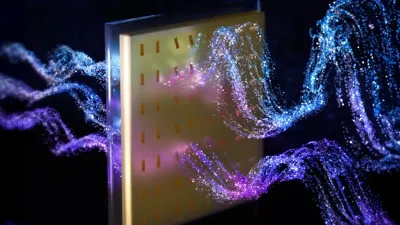
To bypass this limitation, the research team engineered a device that integrates both frequencies into a single unified system. The trap's architecture consists of three printed circuit boards separated by ceramic spacers. The middle layer features a coplanar waveguide resonator designed to generate the high-frequency GHz field necessary for trapping electrons or positrons.
Meanwhile, the top and bottom layers contain electrodes that produce the lower-frequency MHz field required for heavier ions or antiprotons. To validate the hardware, the team used electrons and calcium ions as proxies for the actual antimatter particles. Using a two-step laser process with 423 nm and 390 nm light, they created charged particles from neutral calcium atoms and fed them into the trap.
The initial results proved that the system could successfully store either electrons or ions in separate runs. The researchers noted that tens of electrons or ions could be trapped for up to ten milliseconds, with a small fraction remaining confined even after hundreds of milliseconds.
Current Limitations and Hardware Challenges
Despite the structural success, keeping both particle types confined together simultaneously remains a significant hurdle. During dual-frequency operation, the electrons proved highly sensitive to the low-frequency field intended for the ions. If the amplitude of the MHz field is increased too much, the electrons rapidly escape the trap, whereas the ions remain completely unaffected by the high-frequency GHz field.
The hardware also faces strict engineering tolerances that must be addressed in future iterations. Tiny imperfections, such as surface roughness, slight misalignments, and stray electrical charges, can easily destabilize the confinement fields. The team is currently developing next-generation versions utilizing smoother, laser-etched components and enhanced thermal stability to mitigate these disruptions.
My Take: The Democratization of Antimatter Physics
The development of this dual-frequency Paul trap represents a critical turning point for the broader physics community. Historically, the study of antihydrogen - the cleanest system for testing why the universe favors matter over antimatter - has been bottlenecked by the exclusive supply of antiprotons at the CERN Antimatter Factory. This exclusivity has severely limited the number of independent teams capable of running these fundamental experiments.
However, as study author Dmitry Budker pointed out, recent successes in transporting antiprotons via truck have proven that delivering these particles to remote researchers is now logistically feasible. When paired with this new localized trapping technology, the barrier to entry for antimatter research drops dramatically.
While the simultaneous confinement stability still requires refinement, the trajectory is clear. We are moving toward a decentralized model of particle physics where university labs can assemble antihydrogen on-site, accelerating our understanding of the universe's most fundamental asymmetries.
This article was written by AI from reporting by interestingengineering.com.