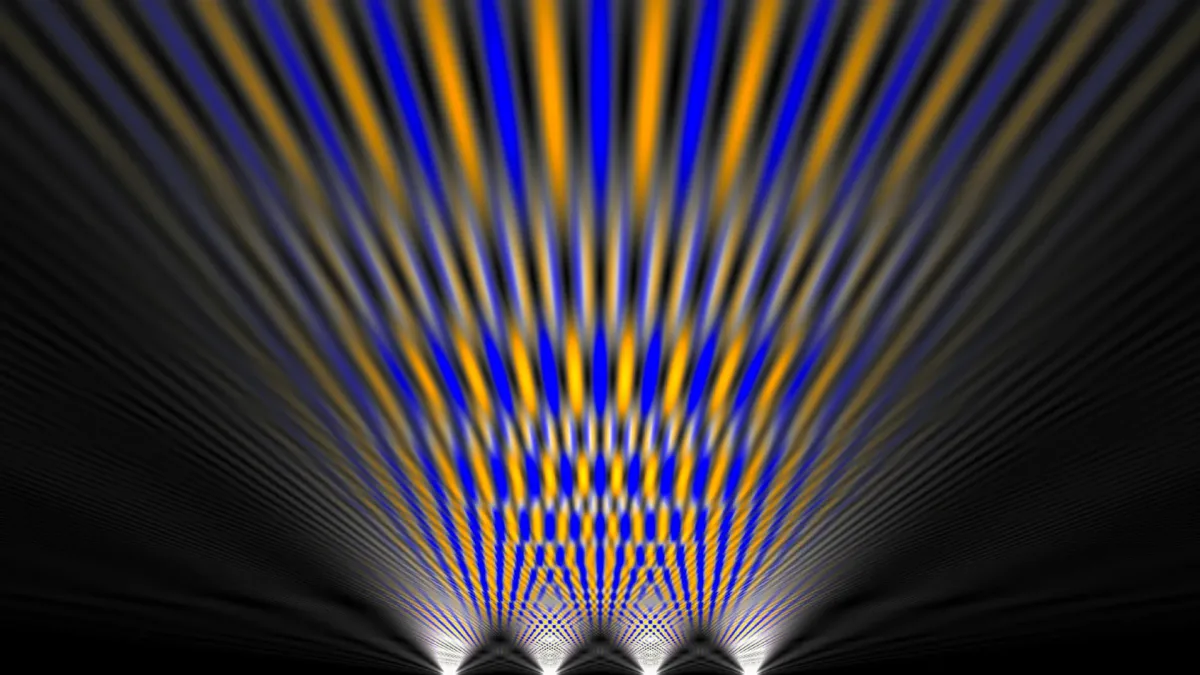
For cybersecurity professionals and network engineers, securing data against future quantum threats just became significantly cheaper and less complex. Researchers at the University of Warsaw have successfully deployed a new quantum key distribution (QKD) system over existing city fiber networks by leveraging a 200-year-old optical trick known as the Talbot effect. This breakthrough eliminates the need for fragile, expensive multi-interferometer setups, paving the way for highly efficient multidimensional quantum encryption.
Traditional quantum cryptography relies on qubits - the simplest units of quantum information - to establish secure cryptographic keys. However, as Dr. Michał Karpiński, head of the Quantum Photonics Laboratory at the University of Warsaw, notes, this binary approach struggles to meet the efficiency demands of modern, high-capacity networks. Conventional systems require complex multi-interferometer setups to detect phase differences between light pulses. These traditional receivers suffer from dropping efficiency as pulse numbers increase and demand constant, precise calibration to remain stable.
To bypass these hardware limitations, the research team turned to multidimensional encoding using time-bin superpositions. Instead of a photon simply arriving early or late, it exists as a combination of both possibilities across multiple time bins. The team applied the Talbot effect, a classical optics phenomenon discovered in 1836 where light passing through a diffraction grating repeats its image at regular intervals. Maciej Ogrodnik, a PhD student on the project, explains that this effect also occurs in time when a regular train of light pulses travels through a dispersive medium like an optical fiber.
By utilizing this space-time analogy, the sequence of light pulses acts as a temporal diffraction grating, allowing the signals to self-reconstruct as they travel through the fiber. The phase of these interfering pulses allows the system to identify different quantum states. Crucially, this method requires only a single commercially available photon detector to register superpositions of multiple pulses. Adam Widomski, another PhD student involved in the research, highlights that the system can detect both two-dimensional and four-dimensional superpositions without requiring hardware changes or receiver stabilization.
The team successfully tested the four-dimensional QKD system across several kilometers of the University of Warsaw's active fiber network. While the simplified experimental approach initially yielded relatively high measurement error rates, the overall information efficiency remained superior due to the high-dimensional encoding. Furthermore, during security analysis with experts in Italy and Germany, the team identified and patched a theoretical vulnerability in standard QKD protocols. By modifying the receiver to collect more data, they eliminated the exploit, publishing their security proof in Physical Review Applied.
The Future of Scalable Quantum Networks
The integration of the Talbot effect into quantum key distribution represents a critical pivot from theoretical physics to practical, scalable cybersecurity infrastructure. By proving that multidimensional quantum states can be transmitted and decoded using a single photon detector over existing commercial fiber lines, the University of Warsaw team has drastically lowered the financial barrier to entry for quantum-secure networks.
As enterprise networks prepare for the post-quantum cryptography era, hardware simplicity will dictate adoption rates. Systems that avoid the fragility of multi-interferometer arrays while maximizing the utility of every photon detection event will likely become the foundational architecture for next-generation secure communications. This research proves that sometimes the key to future-proofing our digital infrastructure lies in centuries-old classical physics.
This article was written by AI from reporting by sciencedaily.com.