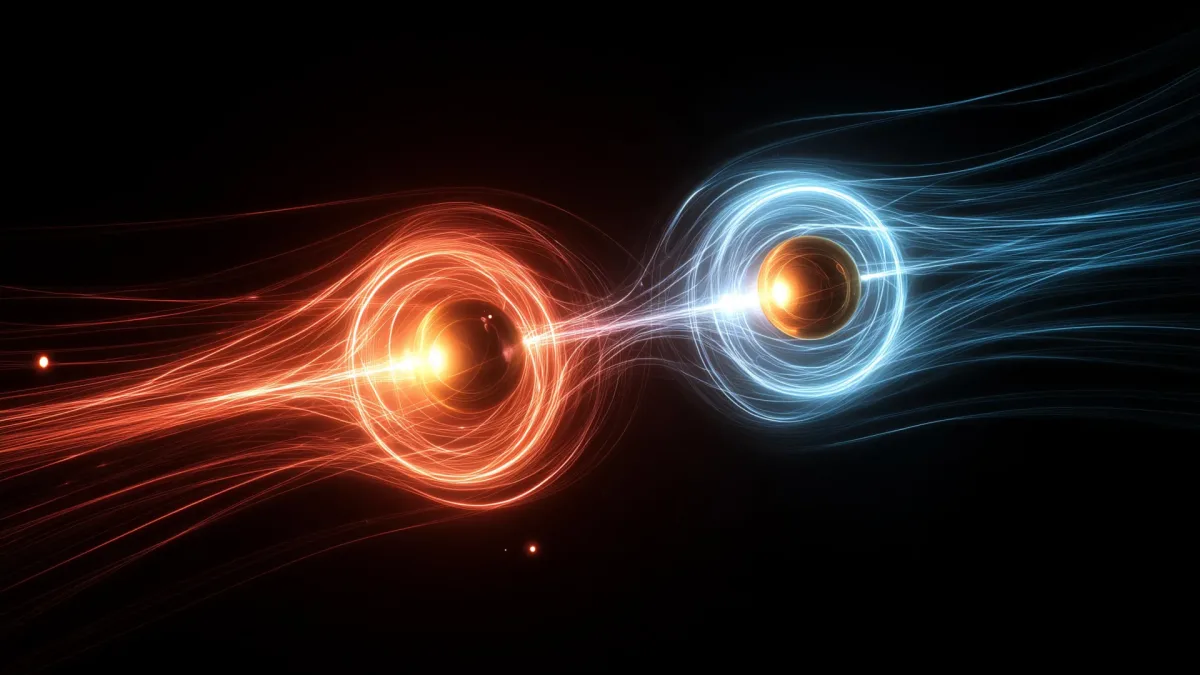
Artificial intelligence has officially moved beyond simple data analysis, as physicists have successfully used a custom neural network to discover entirely new physical laws. In a groundbreaking study published in the journal PNAS, researchers from Emory University revealed unexpected details about how particles interact within dusty plasma. This breakthrough demonstrates that AI can uncover fundamental mechanics in complex systems, specifically focusing on non-reciprocal forces where particles influence each other asymmetrically.
For researchers and physicists, this development provides a highly accurate framework for understanding the fourth state of matter. Plasma makes up approximately 99.9% of the visible universe, and dusty plasma specifically contains interacting charged particles and tiny grains of dust. By understanding these dynamics, scientists can better predict phenomena ranging from radio signal disruptions during Earth-based wildfires to the behavior of hovering dust on the Moon.
Tracking Non-Reciprocal Forces in 3D
To capture these elusive interactions, the research team developed a specialized tomographic imaging method. A laser sheet was moved through a vacuum chamber filled with suspended plastic particles, while a high-speed camera recorded the activity. This allowed the team to reconstruct the three-dimensional motion of dozens of particles over time.
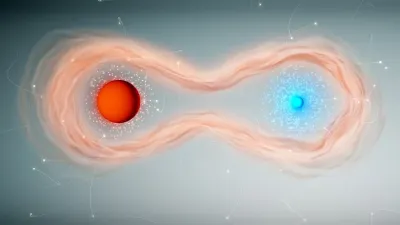
Using their AI model, the researchers described the non-reciprocal forces with an accuracy exceeding 99%. They observed that in a dusty plasma environment, a leading particle attracts the trailing particle, but the trailing particle consistently repels the leading one. This precise approximation of asymmetrical forces provides a mathematical foundation that did not previously exist.
Correcting Long-Standing Scientific Assumptions
The AI system successfully challenged and corrected previous theoretical assumptions about particle behavior. One long-standing idea suggested that a particle's electric charge increases in direct proportion to its size. However, the neural network revealed that the relationship is far more complex, depending heavily on plasma density and temperature.
Additionally, the AI model proved that particle size directly affects how quickly forces between particles weaken over distance. This finding explicitly disproves the older assumption that these forces decrease exponentially in a way that is entirely independent of particle size. The team subsequently confirmed these AI-generated conclusions through additional laboratory experiments.
Designing a Neural Network for Limited Data
Building the AI model required a unique approach, as the team had limited experimental data compared to traditional massive datasets. Emory professors Justin Burton and Ilya Nemenman, alongside researchers Wentao Yu and Eslam Abdelaleem, spent over a year refining the architecture. They structured the physics-tailored machine learning network to follow necessary physical rules while retaining the freedom to infer unknown physics.
The final model successfully separated particle motion into three distinct influences: velocity drag, environmental forces like gravity, and inter-particle forces. Because the AI method is not a black box, the researchers fully understand how and why it works, making it a universal framework that can be applied to other many-body systems.
The Shift Toward AI-Driven Scientific Discovery
The success of this project, supported by the National Science Foundation and the Simons Foundation, marks a critical turning point in how we approach complex systems. While generative AI has dominated consumer headlines, the application of physics-based neural networks proves that machine learning can extract fundamental truths from limited, highly specific datasets. This methodology will clearly not remain confined to plasma physics.
As Nemenman prepares to take this framework to the Konstanz School of Collective Behavior in Germany, the potential applications are expanding rapidly. By applying these AI models to living systems, researchers could soon decode the collective motion of biological cells, potentially offering new insights into how cancer cells metastasize. Ultimately, this proves that AI is most powerful when paired with rigorous human experimental design, acting as a tool to explore uncharted scientific territories rather than a replacement for critical thinking.