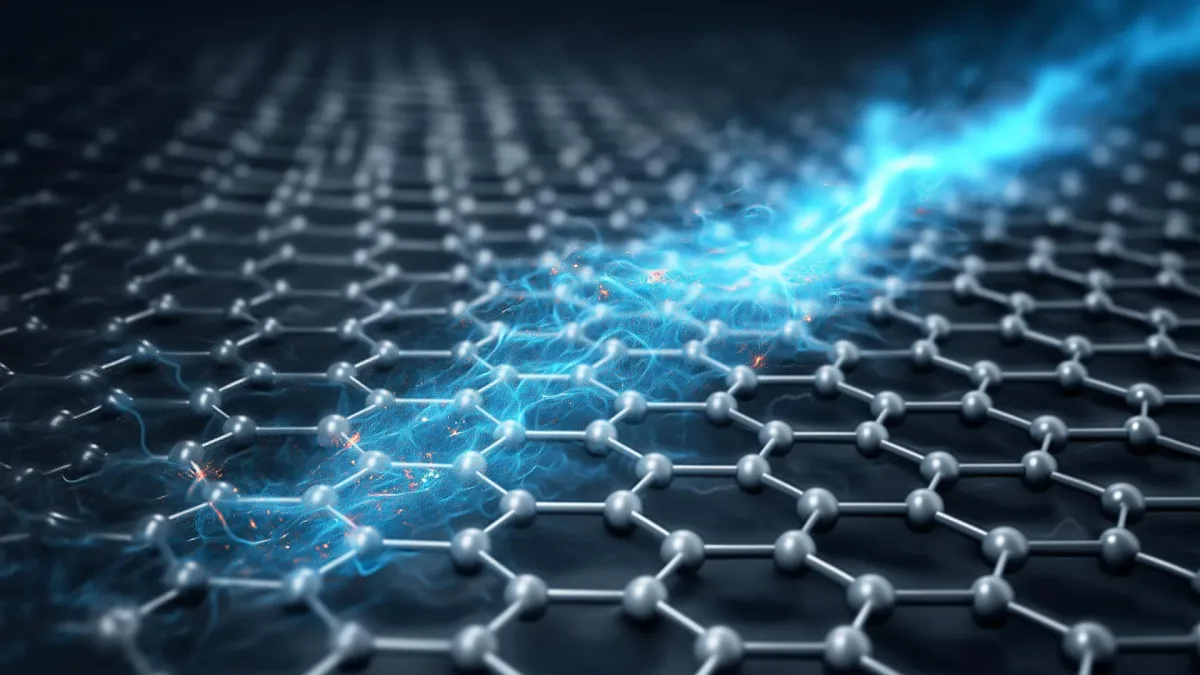
The discovery of a graphene Dirac fluid has officially shattered a fundamental law of physics, revealing that electrons can flow like a nearly frictionless liquid. Researchers at the Indian Institute of Science (IISc), in collaboration with Japan's National Institute for Materials Science, have successfully observed this elusive quantum state in a single layer of carbon atoms. This breakthrough, published in Nature Physics, provides a revolutionary platform for exploring extreme quantum phenomena right inside a laboratory.
Breaking the Wiedemann-Franz Law
For decades, the Wiedemann-Franz law has dictated that heat and electrical conduction in metals must remain proportional. However, testing exceptionally clean graphene samples at low temperatures revealed a stark contradiction to this established principle. As the electrical conductivity of the graphene increased, its thermal conductivity unexpectedly dropped.
The research team observed deviations from the traditional law by a staggering factor of more than 200 times. This massive divergence highlights a striking separation between how charge and heat move through the ultraclean carbon material. Both types of conduction appear to follow a universal quantum constant that is entirely independent of the material itself.
The Dirac Fluid State
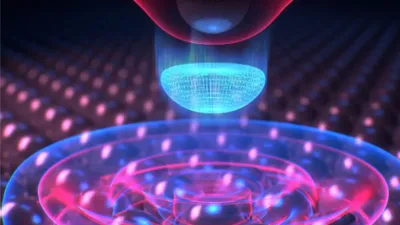
This unprecedented behavior occurs at a highly specific boundary known as the Dirac point, where graphene transitions between acting as a metal and an insulator. By precisely adjusting the electron count, scientists forced the particles to stop behaving individually and instead move collectively. This collective motion forms the Dirac fluid, an exotic state of matter characterized by extremely low viscosity.
According to Aniket Majumdar, the study's first author, this water-like behavior mimics the quark-gluon plasma typically only observed in high-energy particle accelerators like those at CERN. The team measured how easily this fluid flows and confirmed it is one of the closest realizations of a perfect fluid ever observed in nature.
Future Applications in Quantum Technology
Beyond rewriting physics textbooks, this discovery unlocks highly practical applications for next-generation electronics. The unique properties of the Dirac fluid make graphene an ideal foundation for developing ultra-sensitive quantum sensors. These advanced devices could theoretically amplify incredibly weak electrical signals that current technology misses.
Furthermore, they hold the potential to detect faint magnetic fields with unprecedented accuracy. This capability paves the way for revolutionary advancements in medical imaging, navigation systems, and the foundational hardware required for scalable quantum computing.
My Take: The Laboratory as a Universe
The confirmation of the graphene Dirac fluid is a monumental shift for both theoretical physics and commercial quantum technology. By proving that electrons can mimic the frictionless flow of a quark-gluon plasma, the IISc team has effectively turned a simple sheet of carbon into a desktop simulator for astrophysics. Scientists no longer need billion-dollar particle accelerators to study extreme thermodynamic entanglement; they can observe these mechanics directly within graphene.
Looking ahead, the commercial implications are equally massive. As the demand for quantum computing and ultra-precise magnetic sensors grows, leveraging this fluid-like electron flow could drastically reduce the thermal noise that currently bottlenecks quantum hardware. This discovery is not just a fascinating anomaly; it is a foundational stepping stone toward making quantum technologies more stable and commercially viable.