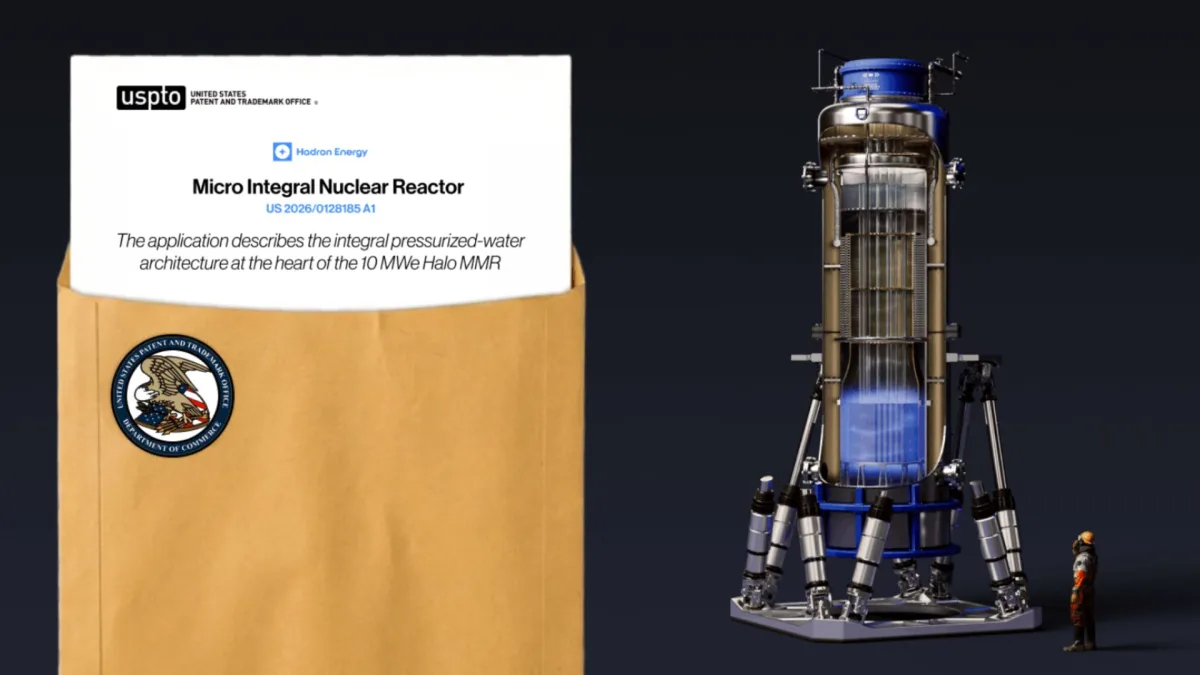
Remote industrial sites and off-grid locations have long struggled with reliable, carbon-free power, but a newly patented nuclear design could fundamentally change that equation. Hadron Energy has officially unveiled the engineering framework for its Halo Micro-Modular Reactor, detailing a system that compresses critical nuclear components into a single, transportable pressure vessel. The U.S. Patent and Trademark Office published the application, marking a major milestone in the company's push to commercialize small-scale nuclear power.
This development is critical for industrial operators, remote communities, and energy infrastructure planners who require continuous power without the logistical nightmare of fossil fuel deliveries. By eliminating the sprawling external piping of traditional plants, the Halo reactor promises a plug-and-play approach to nuclear energy. This streamlined architecture is specifically designed to drastically cut deployment time, reduce on-site construction risks, and lower overall capital costs.
The Single-Vessel Engineering Approach
Traditional nuclear facilities rely on a complex web of large external pipes to connect various reactor systems, which complicates both manufacturing and maintenance. The newly published patent outlines an integral pressurized-water reactor that houses all key systems within one unified structure. Engineers designed the reactor vessel in modular sections connected through circumferential flanges, allowing the entire unit to be assembled and rigorously tested at a factory before ever reaching the project site.
The flagship Halo configuration is engineered to deliver 10 megawatts of electricity, though the patent covers scalable configurations capable of producing between 6 and 60 megawatts of thermal energy, translating to 2 to 20 megawatts of electrical output. To sustain long-term operations, the reactor utilizes Low-Enriched Uranium Plus fuel. This specific fuel choice supports multi-year operating cycles while leveraging the existing domestic fuel supply infrastructure.
Safety mechanisms are also heavily integrated into the single-vessel design. The filing details passive safety features engineered to keep the reactor core cooled for extended periods without the need for alternating-current power under design-basis conditions. Furthermore, the compact nature of the vessel means it can be transported via conventional road networks and, according to the company, even certain air transport systems.
Navigating the Regulatory Pipeline
Bringing a new nuclear technology to market requires clearing immense regulatory hurdles, and Hadron is actively advancing its licensing process. The company recently saw its Quality Assurance Program Description accepted by the U.S. Nuclear Regulatory Commission staff. Additionally, Hadron has submitted its Principal Design Criteria white paper to regulators, laying the groundwork for formal design approval.
The patent application lists company founder and CEO Samuel Gibson, Chief Nuclear Officer Ross Ridenoure, Christopher R. Neal, and Andrew M. Ward as the primary inventors. Gibson noted that the patent publication establishes the technical foundation of the Halo reactor and begins what the company expects to become a broader intellectual property portfolio. He emphasized that the filing reflects years of engineering work aimed at making Hadron the first developer to bring a licensed light-water microreactor to the U.S. market.
The Logistics Hurdle Beyond the Patent
While the single-vessel design brilliantly solves the on-site construction bottleneck, the true test for the Halo microreactor lies in the logistics of its deployment and fueling. The reliance on Low-Enriched Uranium Plus is a strategic move to use existing infrastructure, but the domestic supply chain for advanced nuclear fuels remains tight and heavily dependent on federal support. If the broader industry scales up microreactors simultaneously, fuel availability could become a significant choke point for Hadron's multi-year operating cycles.
Furthermore, the concept of air-transportable nuclear reactors introduces unprecedented regulatory challenges. While flying a pre-assembled reactor to a remote mining site or disaster zone sounds revolutionary on paper, the aviation and environmental regulatory frameworks for transporting nuclear systems over civilian airspace do not currently exist. Hadron will likely need to pioneer not just nuclear design regulations with the NRC, but also entirely new transport protocols with federal aviation and transportation authorities before the Halo reactor can truly take flight.