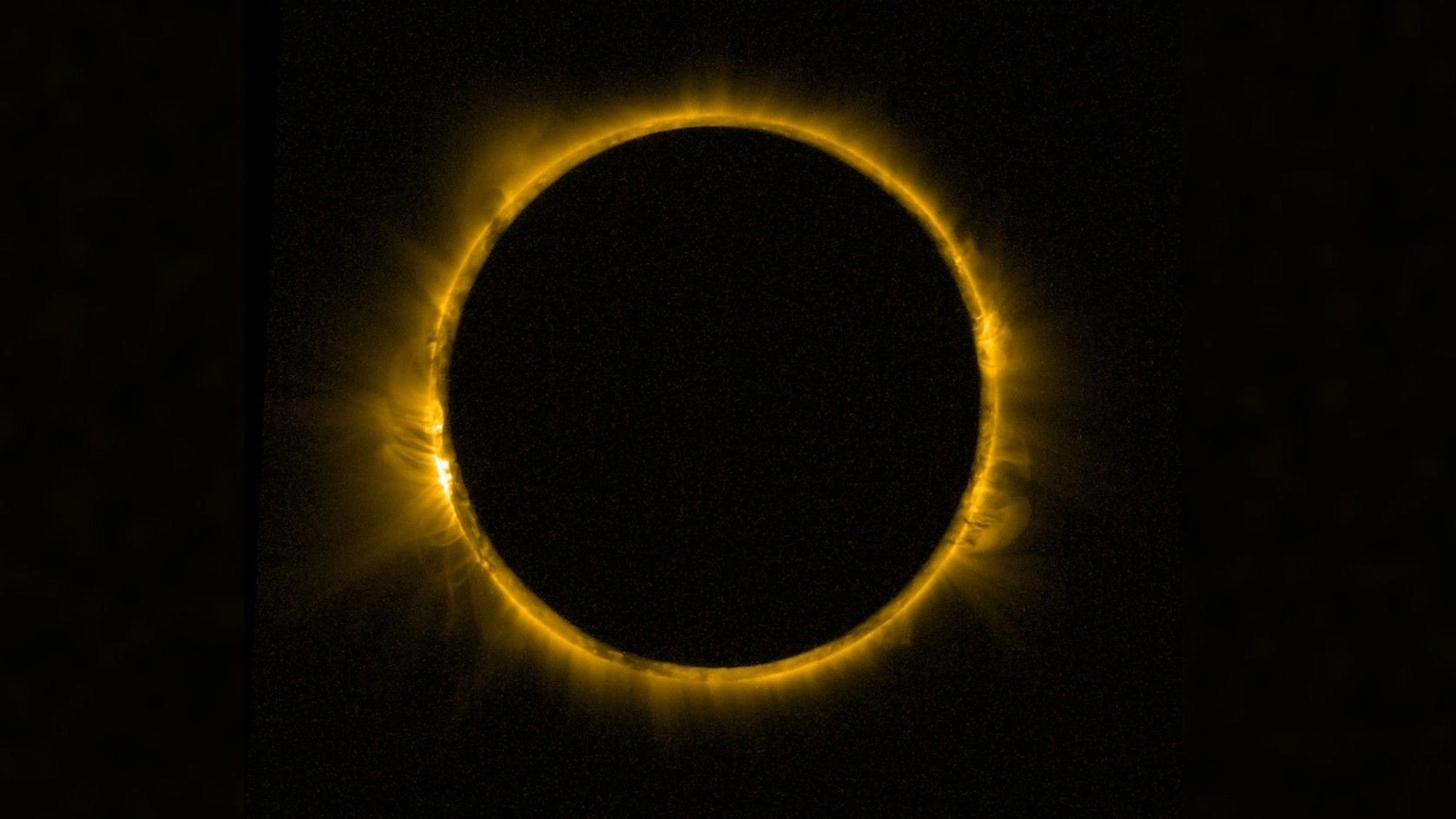
The European Space Agency (ESA) has released extraordinary imagery from its Proba-2 satellite, capturing the annular solar eclipse of February 17, 2026, from a unique orbital vantage point. While observers in parts of Antarctica and the southern Indian Ocean witnessed the Moon passing centrally in front of the Sun to create a classic "ring of fire," the Proba-2 spacecraft utilized its specialized instrumentation to observe the event in extreme ultraviolet (EUV) light. This observation provides more than just a visual spectacle; it offers heliophysicists a rare opportunity to calibrate instruments and study the solar corona's behavior when partially occulted by the lunar disk.
The Mechanics of an Annular Eclipse in Orbit
An annular eclipse occurs when the Moon is near its apogeethe point in its orbit farthest from Earthmaking it appear smaller in the sky than the Sun. Unlike a total eclipse where the Sun is completely blocked, an annular eclipse leaves a bright ring, or annulus, of the Sun visible around the Moon's silhouette. For the Proba-2 satellite, which orbits Earth at an altitude of approximately 700 kilometers, this alignment presents a dynamic observation scenario. As the satellite moves through its sun-synchronous orbit, it may pass through the Moon's shadow multiple times, capturing different phases of the eclipse that ground-based observers cannot see continuously.
The specific geometry of this event allowed Proba-2 to image the Moon crossing the solar disk while the surrounding solar atmosphere remained visible. In the extreme ultraviolet wavelengths monitored by the satellite, the "surface" of the Sun appears dark, while the hot, turbulent gases of the corona glow brightly. The Moon appears as a stark, black circle, providing a perfect occulting disk that helps scientists isolate and analyze the faint structures of the inner corona that are usually outshined by the Sun's intense glare.
Inside the Tech: The SWAP Instrument
The primary instrument responsible for these images is SWAP (Sun Watcher using Active Pixel System detector and Image Processing). Unlike traditional cameras, SWAP is designed to monitor the Sun in a very specific narrow band of the extreme ultraviolet spectrum (17.4 nanometers). This wavelength corresponds to temperatures of roughly one million degrees Celsius, making it ideal for observing the solar corona and solar flares.
SWAP's use of Active Pixel Sensor (APS) technology allows for high-speed imaging with low power consumption, a critical feature for a microsatellite like Proba-2. During the eclipse, SWAP continued its rapid cadence of image capture, recording the transit of the Moon with high precision. This data is vital for calibrating the instrument's stray light correction algorithms. Since the Moon emits no extreme ultraviolet light, any signal detected on the lunar disk during the eclipse can be identified as instrumental noise or stray light, allowing engineers to refine the accuracy of future solar observations.
Implications for Space Weather Monitoring
Events like this are crucial for the broader field of space weather monitoring. The solar corona is the source of the solar wind and coronal mass ejections (CMEs), which can disrupt satellite communications, GPS signals, and power grids on Earth. By observing how the corona behaves close to the solar surfaceregions often obscured or difficult to imagescientists can improve their models of solar eruptions.
The Proba-2 mission, originally launched in 2009 as a technology demonstrator, has far exceeded its expected lifespan, becoming a pillar of ESA's Space Situational Awareness program. Its ability to provide continuous, near-real-time data on solar activity complements newer missions like the Solar Orbiter, ensuring that we have a multi-layered view of our host star. The eclipse data will be cross-referenced with ground-based observations to build a 3D understanding of the active regions present on the Sun during the event.
| Feature | Specification / Detail |
|---|---|
| Satellite Name | Proba-2 (Project for On-Board Autonomy) |
| Primary Instrument | SWAP (EUV Imager at 17.4 nm) |
| Orbit Type | Sun-Synchronous Low Earth Orbit |
| Observation Target | Solar Corona & Space Weather |
| Eclipse Type | Annular (Ring of Fire) |
Frequently Asked Questions
Why does the eclipse look different from space?
Satellites like Proba-2 observe in ultraviolet wavelengths that are blocked by Earth's atmosphere. This reveals the hot solar corona rather than just the visible light surface seen from the ground.
How does this help scientific research?
The Moon acts as a perfect blocker (occulting disk). Since the Moon is pitch black in UV, any light detected on it is instrument error, allowing scientists to calibrate their cameras for perfect accuracy.
Is Proba-2 the only satellite watching the Sun?
No, it works alongside missions like NASA's SDO and ESA's Solar Orbiter. However, Proba-2's wide field of view and unique orbit provide essential context for these other high-resolution missions.
My Take
The longevity of the Proba-2 mission is a testament to robust engineering. Capturing an annular eclipse in 202617 years after launchdemonstrates that "legacy" hardware remains vital in the era of modern space exploration. While the visual of the "ring of fire" captures the public imagination, the calibration data gained from this transit is the real treasure. It ensures that our eyes on the Sun remain sharp, protecting our increasingly digital society from the unpredictable nature of space weather.
This article was written by AI from reporting by app.buzzsumo.com.