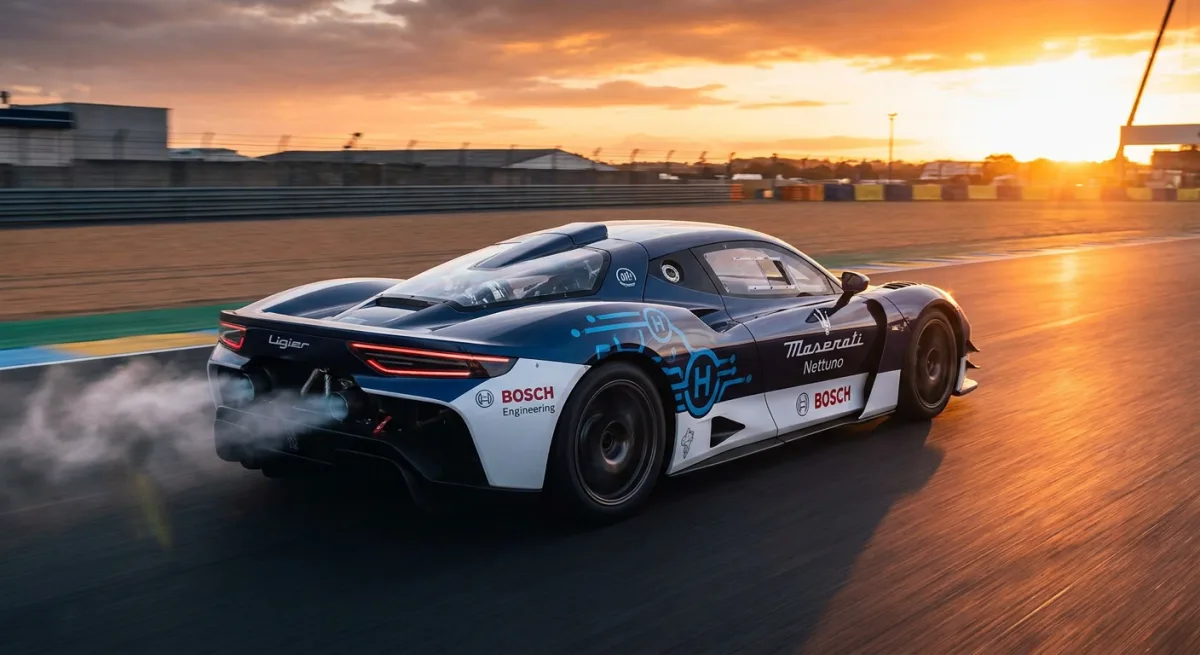
Bosch and Maserati are redefining sustainable motorsport with the development of a high-performance hydrogen combustion engine. The new powertrain, housed in the Ligier JS2 RH2 hypercar prototype, is set to demonstrate the viability of hydrogen at the upcoming 24 Hours of Le Mans. This development is crucial for motorsport engineers and automotive enthusiasts tracking the industry's shift away from fossil fuels.
By retaining the mechanical architecture of a traditional combustion engine, the project proves that zero-emission racing does not require sacrificing hypercar-level power or the visceral acoustic experience fans expect. The vehicle will complete a demonstration lap on the Le Mans circuit on Saturday, June 13, 2026, and will be showcased in the H2 Village throughout the race week.
Engineering the Hydrogen V6
The hydrogen unit developed by Bosch Engineering is fundamentally based on the Maserati Nettuno, a 3.0-liter six-cylinder gasoline engine featuring biturbo charging and dry sump lubrication. To convert the engine for hydrogen operation, engineers retained core components like the cylinder head and turbocharger from the original design. The most significant mechanical modifications were made to the pistons, which were reshaped to lower the compression ratio, allowing the engine to extract maximum power at high RPMs.
Beyond the pistons, the modifications heavily targeted the injection system, ignition system, and engine control unit. Instead of relying on combined direct and port fuel injection, the new iteration utilizes modern hydrogen direct injection powered by HIDI LCV injectors from Bosch. This advanced setup allows the 3.0-liter hydrogen engine to produce approximately 480 kilowatts (kW) and deliver a massive 880 Newton-meters (Nm) of torque.
Nettuno is a state-of-the-art engine that continues to demonstrate robustness, efficiency, and versatility. For this reason, it has proven to be particularly well-suited for conversion to hydrogen, thanks to its inherent strength, which allows it to withstand very high cylinder pressures.
- Davide Danesin, Head of Maserati Engineering
The Ligier JS2 RH2 Prototype
To translate this engine technology into a functional track vehicle, Bosch Engineering formed a strategic partnership with Ligier Automotive in 2021. The collaboration birthed the Ligier JS2 RH2, a hydrogen-powered race car prototype that first debuted at Le Mans in June 2023. Since its initial reveal, the vehicle has undergone rigorous track testing, completing nearly 8,000 test kilometers across various weather conditions without encountering any technical failures.
Continuous optimization over the past three years has allowed the engineering team to increase the drive's torque and power while simultaneously reducing emissions even further. Jacques Nicolet, President of Ligier Automotive, noted that the project echoes the legacy of the original Ligier JS2, which claimed victory at the Tour Auto in 1974 with a Maserati V6. Today, the team is not just building a demonstrator, Nicolet explained, but "opening the door to future applications, such as a decarbonized track-day car integrating Maserati engine technology and Bosch hydrogen systems."
The Hydrogen Combustion Loophole
While battery electric vehicles (BEVs) dominate the broader automotive conversation, hydrogen combustion offers a unique lifeline for the future of motorsport. Racing relies heavily on sensory engagement - the roar of the engine and the mechanical vibration of the chassis - elements that are entirely lost in silent electric racers. By adapting the Maserati Nettuno architecture, Bosch is proving that the soul of motorsport can survive the transition to zero emissions.
The achievement of 880 Nm of torque is particularly significant, as it demonstrates that hydrogen direct injection can match or even exceed the performance metrics of traditional high-octane gasoline. This technological milestone is likely to pave the way for niche, high-end track cars in the near term. Ultimately, the extreme stress-testing of these hydrogen injectors at Le Mans will accelerate the trickle-down of this technology to commercial heavy-duty transport, where batteries remain too heavy and slow to charge for continuous operation.
This article was written by AI from reporting by fuelcellsworks.com.