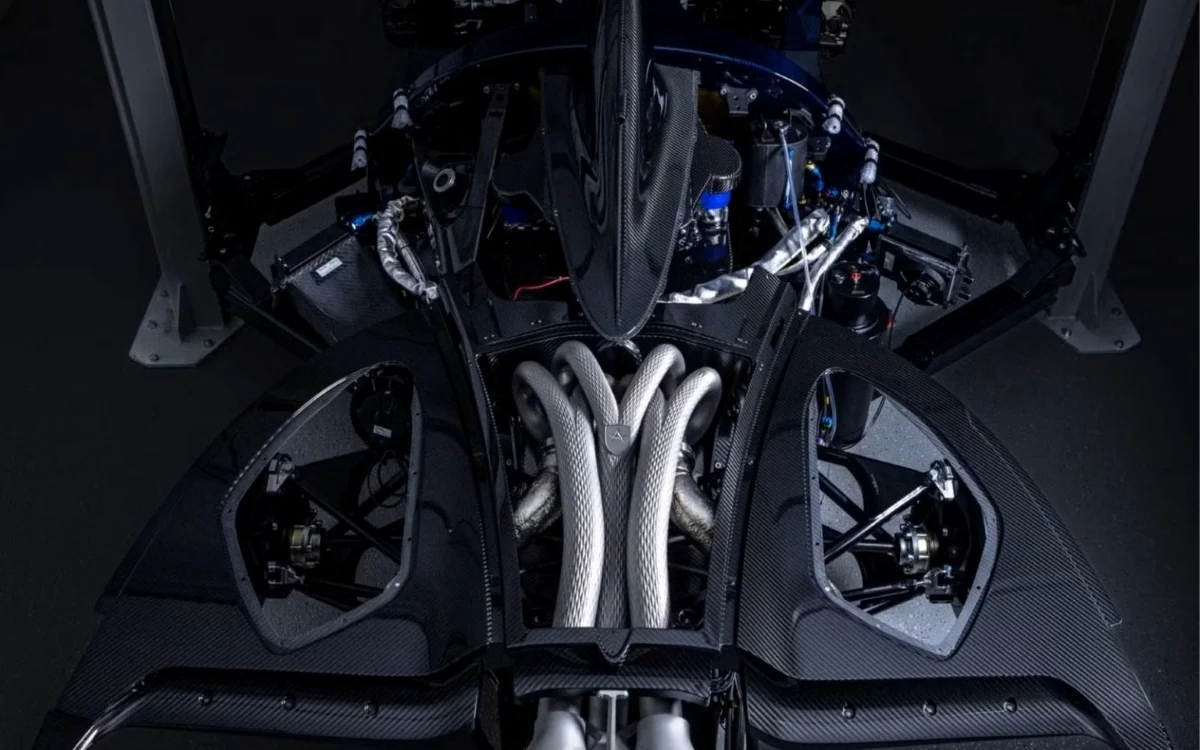
German hypercar manufacturer Apollo Automobil has engineered the largest single-piece 3D printed titanium exhaust ever created for its $4 million track-only EVO hypercar. Dubbed the Apollo EVO Dragon Skin exhaust, the component took 123 hours to print using aerospace-grade TA15 alloy and eliminates all traditional welds to drastically reduce weight and potential failure points.
For automotive engineers and hypercar enthusiasts, this development proves that additive manufacturing is no longer just for rapid prototyping. It has become a mandatory production method for complex geometries that conventional casting and tooling simply cannot achieve.
The exhaust system was produced using laser powder bed fusion, guided by Design for Additive Manufacturing (DfAM) principles. The "Dragon Skin" texture is not merely an aesthetic choice; it actively contributes to the car's thermal management by distributing heat across the structure rather than allowing it to concentrate at specific stress points.
To handle the extreme operating conditions generated by the EVO's Ferrari F140 V12 engine - which pushes over 800 horsepower through a six-speed sequential gearbox - the titanium substrate is treated with a high-temperature ceramic coating rated to 1,000°C.
It seamlessly merges art, storytelling and extreme engineering into a single functional component. Sculpted to evoke awe, it represents the next stage of design evolution from Apollo Automobil.
- Official Statement, Apollo Automobil
"To extract the fullest potential from the platform, we have fine-tuned an already exceptional design while applying the latest in cutting-edge technologies and processes to truly take the Evo to another level," Niko Konta, Chief Executive Officer at Apollo Automobil, explained.
Additive Manufacturing Takes Over the Hypercar Segment
The EVO is strictly limited to ten units, with the first customer deliveries expected before mid-2026. The vehicle's $4 million price tag represents a significant jump from the $2.5 million of its predecessor, the Intensa Emozione, reflecting the heavy integration of bespoke, aerospace-grade manufacturing techniques.
Apollo's strategy aligns with a rapidly emerging pattern across the elite automotive sector. Additive manufacturing is increasingly chosen because no other process can deliver the same structural integrity within the same weight envelope.
For example, the McLaren W1 utilizes titanium 3D printed front uprights and wishbones produced by Divergent Technologies to achieve its record-breaking power-to-weight ratio. Similarly, Honda has integrated metal additive manufacturing directly into its engine production, fabricating pistons and turbine housings for Oracle Red Bull Racing's Formula 1 cars to achieve lighter, more complex geometries than forging allows.
The End of Traditional Welding in Track Cars
The $4 million price tag of the EVO easily absorbs the massive R&D costs and the 123-hour print time required for the Apollo EVO Dragon Skin exhaust, but the real engineering triumph is the complete elimination of assembly joints. In high-vibration environments like a track car housing an 800-horsepower V12, welds are historically the first point of structural failure.
By moving to a single-piece 3D printed structure, Apollo isn't just shaving off a few pounds; they are fundamentally changing how thermal and mechanical stress is managed at the rear of the vehicle. This signals a definitive shift in the industry: within the next five years, multi-part welded exhausts on seven-figure track cars will likely be viewed as obsolete engineering. As 3D printing scales, we can expect this weld-free philosophy to trickle down from multi-million dollar hypercars into high-end consumer sports cars.