A newly developed superconducting quantum heat engine has successfully converted heat near absolute zero into measurable work, marking a historic milestone in quantum thermodynamics. Built by researchers at Aalto University, this cyclic engine bridges the microscopic rules of quantum mechanics with the macroscopic laws of energy transfer. For the quantum computing industry, this breakthrough offers a viable path to scaling systems to hundreds of thousands of qubits without being bottlenecked by the immense cost and thermal noise of traditional microwave cabling.
Recreating the Otto Cycle at Absolute Zero
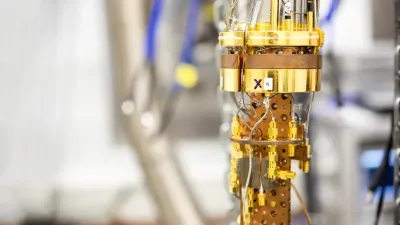
The device relies on a transmon qubit - a foundational building block of modern quantum processors - paired with a resonator and a quantum circuit refrigerator. Unlike conventional engines that require separate hot and cold environments, this microscopic system uses a single tunable quantum refrigerator to supply both heating and cooling on demand. "In our experiment, we built a nanofabricated heat engine using superconducting circuits and operated it in a cryostat near absolute zero," explained Tuomas Uusnäkki, the study's first author.
By applying carefully timed control pulses, the team successfully drove the engine through an Otto cycle, the same thermodynamic process that powers traditional car engines. "Using a single controllable quantum refrigerator as both the hot and cold environment of the engine makes it simpler and more versatile," Uusnäkki added, noting that measurements confirmed the heat passing through the qubit produced positive work. The findings were officially published in the journal Nature Communications.
Solving the Quantum Scaling Bottleneck
The immediate goal for the Aalto University team is to refine this design into a fully autonomous heat engine integrated directly into superconducting circuits. This autonomous hardware could be used to read out qubit states locally, eliminating the need to route microwave pulses from millikelvin environments all the way to room temperature. As quantum computers expand, the physical infrastructure required to support them becomes a massive logistical and financial hurdle.
Finland's Quantum Technology Strategy envisions a quantum computer with one thousand logical qubits by 2035, which probably means hundreds of thousands of physical qubits. Doing that with current technology requires millions of microwave cables costing thousand euros each.
- Mikko Möttönen, Academy Professor, Aalto University
By replacing these expensive, noise-inducing cables with on-chip autonomous engines, engineers can address both the financial constraints and the unwanted thermal interference that currently limits quantum scaling. The pioneering experiment was conducted using OtaNano, Finland's national research infrastructure, with backing from the Research Council of Finland and the Finnish Cultural Foundation.
The End of the Microwave Cable Era
The successful demonstration of a superconducting quantum heat engine is far more than a physics novelty; it is a structural necessity for the future of quantum computing. The current brute-force approach to scaling - tethering every physical qubit to room-temperature control systems via expensive microwave cables - is economically and thermodynamically unsustainable.
At a thousand euros per cable, a machine with hundreds of thousands of physical qubits would face insurmountable hardware costs before even factoring in the cooling power required to offset the noise those cables introduce. By proving that thermodynamic work can be generated and managed autonomously at the quantum level, this research shifts the paradigm from external control to on-chip self-sufficiency.
If these engines can be reliably mass-produced, they will fundamentally alter the architecture of next-generation quantum data centers. This thermodynamic breakthrough makes the 2035 target of a thousand logical qubits a realistic engineering challenge rather than an impossible financial burden.