Long before parenting became a widespread biological norm, most animals simply laid eggs and abandoned their offspring to survive alone. Now, a groundbreaking study published in the journal Nature reveals that the evolution of caregiving did not require entirely new neural pathways. Instead, evolution repurposed ancient brain circuits originally designed to regulate hunger.
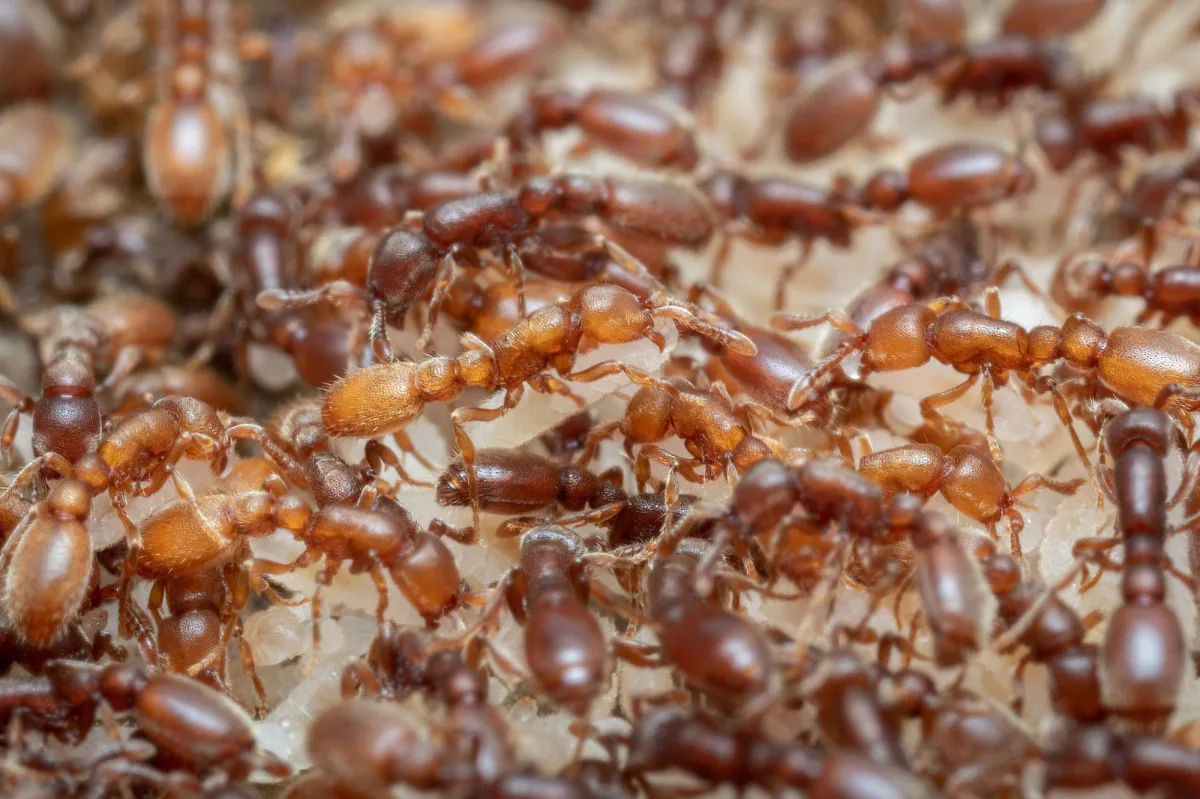
By examining the brain chemistry of clonal raider ants, researchers at The Rockefeller University discovered that the transition from abandoning young to nurturing them is controlled by a delicate balance of chemical signaling. Because the ant brain contains roughly 60,000 cells compared to the 100 million found in a mouse, it serves as a highly efficient model for mapping these complex social behaviors.
Our work is a prime example of how evolution seldom invents things from scratch. Evolution takes what it has and works with that, sometimes in very surprising ways.
- Daniel Kronauer, The Rockefeller University
To track these behavioral shifts, the scientific team developed a high-throughput assay to monitor hundreds of interactions between adult ants and larvae. They successfully annotated the complete set of 70 neuropeptides in the ant brain, isolating the specific molecules responsible for dictating colony roles.
The Chemical Drivers of Caregiving and Foraging
The research identified two primary signaling molecules that act in opposition to control an ant's lifecycle duties. These molecules directly link parental behaviors to fundamental feeding instincts:
- Neuropeptide F (NPF): High levels of this molecule encourage young ants to remain in the nest and care for larvae. Interestingly, starving ants naturally increase NPF production, driving them to act more like caregivers.
- Allatostatin A (AstA): As ants age, AstA levels rise while NPF drops, prompting older ants to abandon nursing duties and leave the nest to forage. When ants are well-fed, this balance shifts toward AstA, triggering the foraging instinct.
"Parental behaviors build on the neural circuitry for feeding, and that makes some sense," Kronauer explained. "Parental behavior is a lot about feeding, not just yourself, but your offspring."
The Blueprint for Healthy Aging
While the immediate discovery solves an evolutionary puzzle about insect behavior, its most significant impact lies in human neuroscience. The scientific community currently pours massive funding into late-stage neurodegenerative diseases, yet the baseline mechanics of how a healthy brain changes over a normal lifespan remain poorly understood. Because ants naturally transition from caregivers to foragers through predictable chemical shifts as they age, they provide a pristine, simplified model for studying healthy cognitive aging.
By mapping how these specific neuromodulators alter behavioral proclivities over time, researchers are laying the groundwork to understand similar age-dependent brain changes in humans. This could eventually shift how we study the natural progression of the human brain before neurodegeneration even begins.
Reference: "Ancient feeding-related neuropeptides regulate alloparenting in ants", 8 July 2026, Nature. DOI: 10.1038/s41586-026-10747-6
This article was written by AI from reporting by scitechdaily.com.