Researchers at Aalto University's Department of Applied Physics have achieved a historic milestone by successfully linking a time crystal to an external optomechanical system for the first time. This breakthrough, published in Nature Communications, transforms a theoretical quantum concept into a tangible component that could revolutionize highly precise sensors and memory systems for quantum computers.
First proposed by Nobel laureate Frank Wilczek in 2012, a time crystal is a unique quantum system that organizes itself into repeating patterns over time, rather than space. These structures exist in their lowest energy state while maintaining constant, perpetual motion without requiring any external energy input. Until now, observing or connecting them to outside systems was thought to disrupt their delicate quantum state.
Creating and Sustaining the Quantum State
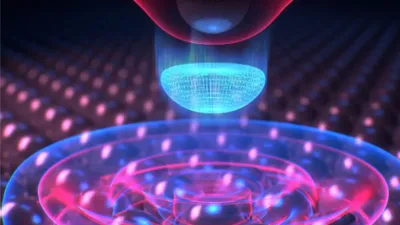
To build this system, the research team injected magnons - quasiparticles that behave as individual particles - into a Helium-3 superfluid cooled to near absolute zero using radio waves. Once the radio frequency was disabled, the magnons naturally organized into a time crystal. This state persisted for an unusually long duration, completing up to 108 cycles over several minutes before gradually fading.
As the time crystal weakened, it began interacting with a nearby mechanical oscillator. The research team, led by Academy Research Fellow Jere Mäkinen, discovered that they could adjust the crystal's properties based on the oscillator's frequency and amplitude. This marks the first time scientists have been able to tune the behavior of time crystals without destroying their perpetual motion.
The Optomechanical Connection
The observed changes in the time crystal's frequency perfectly mirror widely understood optomechanical phenomena. These are similar to the principles used by the Laser Interferometer Gravitational-Wave Observatory in the U.S. to detect gravitational waves. By minimizing energy loss and increasing the mechanical oscillator's frequency, the researchers believe the setup can be optimized to operate near the absolute border of the quantum realm.
The Future of Quantum Memory Systems
The successful integration of a time crystal with an external device represents a massive leap forward for quantum computing architecture. Because time crystals can sustain their state for orders of magnitude longer than the fragile qubits currently used in quantum processors, they are ideal candidates for powering next-generation quantum memory systems.
Furthermore, their highly stable, repeating nature makes them perfectly suited for use as frequency combs in ultra-sensitive measurement devices. As laboratories continue to refine this optomechanical linkage, we are likely to see a shift from purely theoretical quantum physics toward practical, scalable quantum hardware that leverages perpetual motion for unprecedented computational stability.