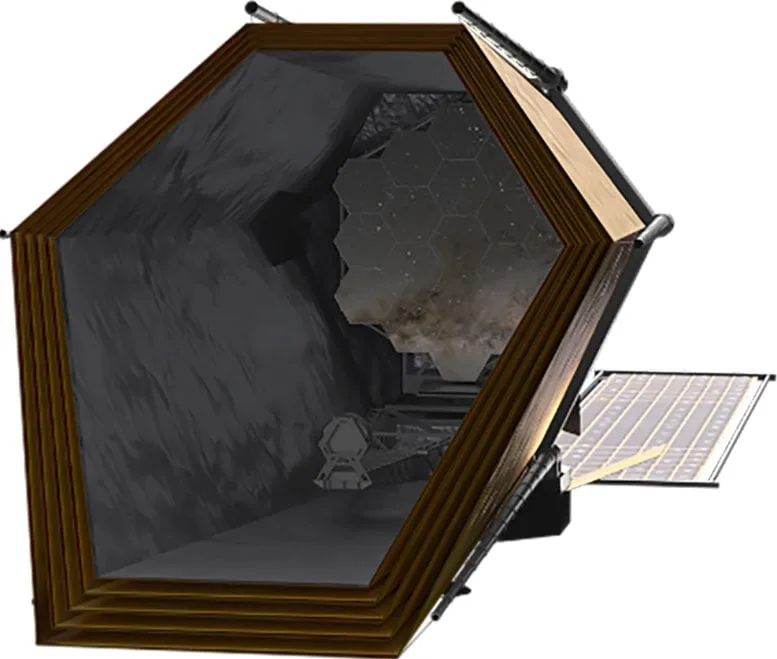
The UK Space Agency (UKSA) has injected £3 million into the development of NASA's upcoming Habitable Worlds Observatory (HWO), securing a critical role in the search for extraterrestrial life. Expected to launch in the 2040s, this flagship space telescope aims to detect Earth-like planets orbiting nearby stars and analyze their atmospheres for biological signatures. The mission will serve as NASA's next major observatory following the Nancy Grace Roman Space Telescope.
For astronomers and space enthusiasts, this mission represents the most ambitious attempt yet to answer whether we are alone in the universe. The observatory will focus on Earth's local cosmic neighborhood, directly examining potentially habitable worlds within a 30-light-year radius. "The Habitable Worlds Observatory is one of the most exciting space science missions now under development," Professor Martin Barstow of the University of Leicester explained, noting that it will tackle one of the biggest questions in modern science.
Engineering the High Resolution Imager
Directly imaging an Earth-like planet is an extreme optical challenge, as these worlds appear as dim points next to host stars that are up to 10 billion times brighter. To achieve this, the Habitable Worlds Observatory will utilize an 8-meter mirror that must remain stable to within roughly the width of an atom. This atomic precision is required to suppress the overwhelming starlight so the faint, reflected light of the planet can be detected - a challenge astronomers compare to photographing a moth fluttering beside a flamethrower.
It will be the first telescope designed to search for evidence of life on distant planets. Imagine for a moment it finds evidence of life out there. What an achievement that would be!
- Vincent Van Eylen, UCL's Mullard Space Science Laboratory
British researchers are currently leading the conceptual work on two proposed core components: the High Resolution Imager (HRI) and the Multi-Object Spectrograph (MOS). The new £3 million award allows the UK consortium to scale up its efforts, advancing the technologies required to turn these instrument designs into working hardware. This builds on a long history of UK contributions to NASA flagships, including the Hubble Space Telescope and the Mid-Infrared Instrument (MIRI) aboard the James Webb Space Telescope (JWST).
The collaborative effort brings together a massive coalition of British institutions. The partnership includes researchers from Durham University, The Open University, the University of Leicester, RAL Space, the University of Portsmouth, the University of Oxford, the UK's Astronomy Technology Centre (ATC), and UCL's Mullard Space Science Laboratory.
The Funding Paradox Threatening Future Discoveries
While the £3 million hardware investment guarantees the UK a seat at the engineering table, a looming domestic crisis threatens the mission's long-term scientific payoff. Because the Habitable Worlds Observatory will not begin operations for another two decades, the younger scientists currently working in British research will be the ones responsible for leading its discoveries in the 2040s. However, ongoing funding cuts affecting key institutes and scientific programs across the UK are creating severe uncertainty for this next generation of astronomers.
This creates a glaring strategic paradox: funding the physical instruments is effectively useless if the domestic scientific community is hollowed out before the data ever arrives. Professor Barstow explicitly warned that developing the hardware alone will not guarantee a meaningful British role in the mission's operational phase. If long-term support is not maintained to preserve both technical skills and scientific knowledge, Britain risks building a world-class telescope only to watch international partners reap the rewards of its discoveries.