For decades, the Heisenberg Uncertainty Principle has forced quantum physicists into a strict compromise: measuring one property with absolute precision means losing track of another. Now, researchers at the University of Oxford have shattered previous limitations by demonstrating quantum quadsqueezing, a fourth-order quantum interaction that reshapes this uncertainty at unprecedented speeds.
Published in Nature Physics, this breakthrough provides a radically new methodology for engineering complex interactions in quantum harmonic oscillators. These oscillators are foundational systems used to model everything from light waves to molecular vibrations. While standard second-order squeezing is already used in massive technologies like LIGO to detect gravitational waves, higher-order interactions have remained largely theoretical. Until now, third-order trisqueezing and fourth-order quadsqueezing interactions were considered too weak and highly susceptible to environmental noise.
How Spin-Mediated Interactions Work
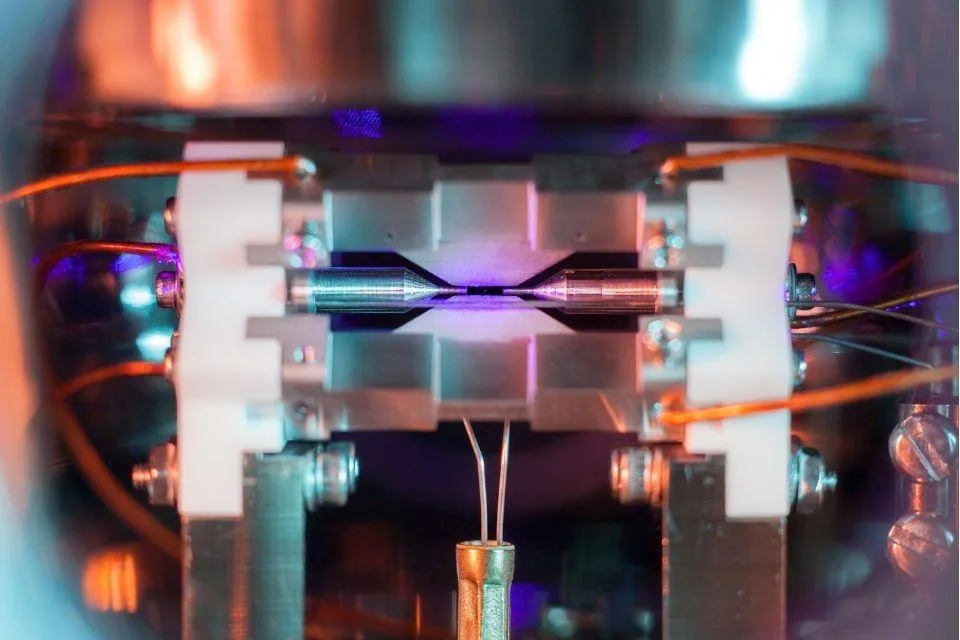
The Oxford team, led by Dr. Oana Băzăvan and Dr. Raghavendra Srinivas, bypassed the traditional limitations of quantum control by utilizing a hybrid oscillator-spin system. Instead of attempting to drive a weak higher-order interaction directly, the researchers trapped a single 88Sr+ ion and applied two non-commuting Spin-Dependent Forces (SDFs). This innovative approach yielded several critical advantages:
- Non-Commutativity: By combining two linear forces that directly influence each other's actions, the team successfully generated a new interaction that is significantly stronger than the sum of its individual parts.
- Unprecedented Speed: The fourth-order quadsqueezing interaction was generated 100 times faster than any conventional approach previously attempted.
- Hardware Versatility: Researchers can now seamlessly switch between standard squeezing, trisqueezing, and quadsqueezing on the exact same hardware simply by adjusting the frequencies and phases of the laser-driven forces.
Validating the Quantum Fingerprint
To prove the success of their experiment, the researchers reconstructed the Wigner functions, which provide a visual representation of the quantum state in phase space. The resulting measurements revealed highly distinctive, non-Gaussian shapes that act as a definitive fingerprint for second-, third-, and fourth-order squeezing. These higher-order, non-Gaussian states are not just academic curiosities; they are essential resources for continuous-variable quantum computation.
By successfully mapping these states, the team has proven that their method can reliably produce the non-Gaussian resources required for computational universality. This provides the necessary framework for robust error correction, a critical hurdle in the development of stable quantum systems.
The Path to Scalable Quantum Computing
The successful demonstration of quadsqueezing marks a pivotal transition from theoretical physics to practical quantum engineering. Because this spin-mediated method is entirely platform-agnostic, it is not limited to trapped ions. It can be directly applied to other leading quantum architectures, including superconducting circuits and diamond color centers.
By generating these complex interactions 100 times faster than previous methods, the Oxford team has effectively solved one of the major bottlenecks in quantum error correction. Moving forward, this capability will drastically enhance quantum sensing beyond the limits of standard Gaussian squeezing. More importantly, it lays the groundwork for implementing a universal gate set, bringing the industry one massive step closer to building robust, commercially scalable quantum computers.