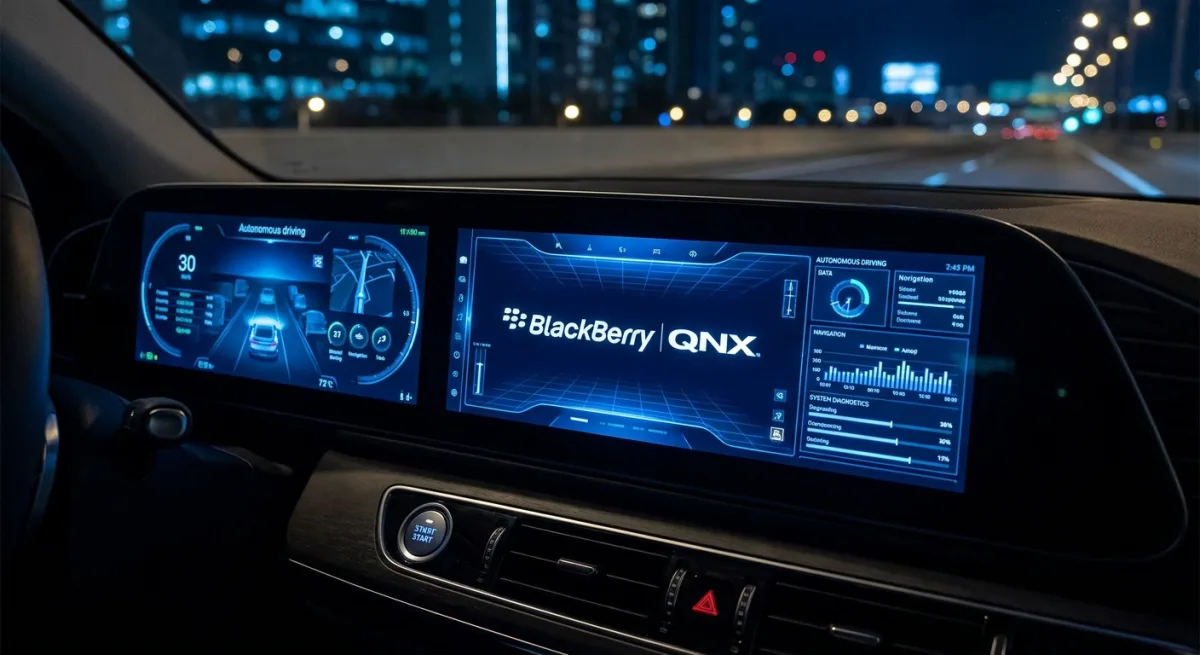
BlackBerry is no longer a relic of the smartphone era. The Canadian company has quietly orchestrated one of the most successful tech pivots in modern history, transforming into the invisible force powering 275 million vehicles worldwide. While its market capitalization once plummeted from $83 billion to roughly $3 billion following the rise of the iPhone and Android devices, BlackBerry has found its salvation in a previously overlooked acquisition: the QNX operating system.
Today, QNX is the undisputed leader in active safety systems for the automotive sector. According to a recent report by The Wall Street Journal, the number of vehicles relying on BlackBerry's software has surged from 100 million in 2020 to a staggering 275 million by the end of 2025. This massive adoption has fundamentally shifted the company's trajectory, turning a story of technological obsolescence into one of enterprise dominance.
The Backbone of Modern Automotive Tech
At its core, QNX is a real-time operating system (RTOS). Unlike traditional consumer operating systems that can occasionally lag or crash, QNX is designed to process data from mechanical sensors in fractions of a millisecond. This data is then routed to the vehicle's central processing unit to power both infotainment screens and critical active safety features, such as Advanced Driver-Assistance Systems (ADAS).
Because of its unparalleled efficiency, QNX serves as the foundational layer for a massive roster of global automakers. Industry giants including BMW, Mercedes, Geely, Honda, Hyundai, Volkswagen, and Volvo all rely on BlackBerry's architecture to bridge the gap between mechanical hardware and smart software. Regardless of how different the infotainment interfaces look across these brands, the underlying brain communicating with the car's mechanics remains QNX.
Beyond Cars: Unmatched Reliability
The primary reason automakers choose QNX over competitors like Android Automotive is its flawless reliability. In the realm of smart driving, a system failure lasting even a few seconds can result in catastrophic accidents. The robustness of QNX is so highly regarded that one user famously noted to The Wall Street Journal, "The only way to stop the system is to shoot the car's computer."
This zero-tolerance for failure has allowed BlackBerry to expand QNX far beyond the automotive industry. The operating system is now heavily utilized in critical enterprise environments, including hospitals and manufacturing plants. It currently manages operating rooms, surgical robots, and highly sensitive, expensive medical equipment where human lives are directly dependent on system stability.
A Financial Renaissance
This strategic shift has breathed new life into BlackBerry's financials. After years of teetering on the edge of irrelevance, the company reported a Q4 profit of $156 million, marking a 10% year-over-year growth. This strong performance has completely altered market sentiment, shifting analyst outlooks from pessimistic to highly optimistic.
The success of the QNX division has also triggered a massive resurgence in the stock market, with BlackBerry shares jumping nearly 50% over the past month. As CEO John Giamatteo recently declared during an investor meeting, the narrative surrounding BlackBerry is now definitively a "growth story."
The B2B Pivot Masterclass
BlackBerry's resurrection is a textbook example of how to survive a lost consumer hardware battle by pivoting to B2B enterprise software. By abandoning the smartphone market entirely and doubling down on a niche, highly technical asset, the company secured a monopoly in a sector where switching costs are astronomically high. Automakers cannot afford to gamble on unproven operating systems when safety is on the line.
Looking ahead, BlackBerry's position is only going to strengthen. As the automotive industry accelerates its transition toward electric vehicles (EVs) and full autonomous driving, the demand for hyper-reliable, real-time operating systems will skyrocket. BlackBerry is no longer a phone company; it is the foundational infrastructure of the next generation of global transportation.