Microwave quantum network performance up to 4 K is no longer just a lab curiosityit is now being demonstrated with measurable state-transfer and entanglement fidelities in a thermally challenging regime. In a Nature Electronics paper published 27 February 2026, Jiawei Qiu and colleagues report a thermal-noise-resilient microwave quantum network that coherently couples two superconducting qubits through a 4 K-thermalized niobiumtitanium transmission line.
This update matters most to quantum hardware teams building modular superconducting systems and to researchers trying to scale quantum processors into networked architectures. The core problem it addresses is straightforward but fundamental: microwave photons are highly susceptible to thermal noise, and that noise typically forces superconducting-qubit networking to remain deep in the millikelvin environment.
Microwave quantum network up to 4 K: what the team built
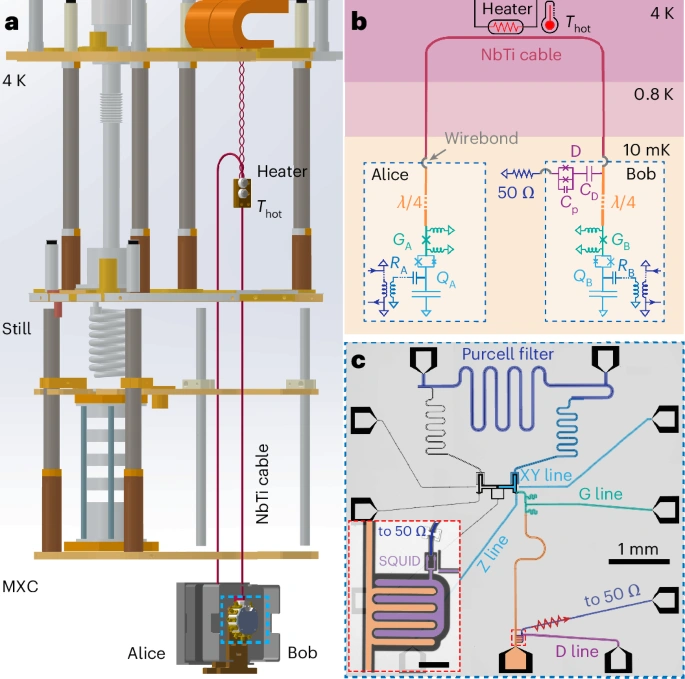
The authors report coherent coupling between two superconducting qubits through a niobiumtitanium transmission line that is thermalized at 4 K. In practical terms, the communication channel sits at a temperature where thermal photons would normally overwhelm fragile quantum states carried by microwave-frequency signals.
To counter that, the team uses radiative cooling by overcoupling the communication channel to a cold load at 10 mK. The paper reports that this suppresses the effective thermal occupancy of the channel to 0.06 photons, described as a reduction that is 2 orders of magnitude below ambient thermal noise. The operational sequence then matters: after cooling, they decouple the cold load and rapidly transfer microwave quantum states through the channel while it rethermalizes.
Why thermal photons are the bottleneck at microwave frequencies
Microwave quantum communication is attractive for superconducting qubits because it matches the native frequency domain of circuit quantum electrodynamics hardware. But the same low photon energy that makes microwave control convenient also makes the channel vulnerable: at elevated temperatures, thermal occupation rises and the channel effectively injects noise photons that scramble quantum information.
In the approach described here, the key idea is not to keep the entire link permanently at millikelvin temperatures, but to temporarily push the channel into a low-occupancy state via radiative cooling, then use a fast transfer window before rethermalization erases the advantage. A concrete scenario where this matters is a modular superconducting system where qubit chips remain at the coldest stage, but interconnects or routing components are constrained to warmer stages for engineering reasons; the reported method targets that mismatch directly.
Reported results: state transfer and entanglement at 4 K
Using the cool-then-transfer strategy, the authors report a 58.5% process fidelity for quantum state transfer and a 52.3% Bell entanglement fidelity at 4 K, both stated without correcting for readout errors. The paper notes that both exceed the classical communication threshold of 1/2, which is a commonly used dividing line indicating performance beyond what a purely classical strategy could reproduce for these tasks.
For readers evaluating near-term usefulness, the “without correcting for readout errors” detail is important: it frames these numbers as end-to-end experimental outcomes rather than post-processed best cases. In a lab workflow, that can translate into fewer hidden assumptions when comparing different network architectures or when budgeting error sources across a full stack.
Improved channel coherence at 1 K and a higher-fidelity entanglement benchmark
The team also reports a set-up with improved channel coherence at 1 K. With that configuration, they achieve a Bell entanglement fidelity of 93.6%, again reported without correcting for readout errors. As a benchmark, they demonstrate that Bell’s inequality is unambiguously violated with this remote entanglement, also without correcting for readout errors.
In practical terms, this 1 K result provides a clearer “network-grade” signal: it suggests that once channel coherence is improved (as the authors describe), the same general strategy can support remote entanglement strong enough to pass a foundational non-classicality test. For teams designing modular quantum processors, a plausible use case is distributing entanglement between separated superconducting nodes as a primitive for teleportation-style operations or networked protocolswhile noting that the paper excerpt provided here does not specify a particular application layer beyond state transfer and entanglement generation.
Major entities and technical ingredients
Superconducting qubits: The network links two superconducting qubits, using microwave photons as the information carrier. The excerpt does not specify the qubit modality beyond being superconducting, nor does it list device-level parameters.
Niobiumtitanium transmission line: The communication channel is a niobiumtitanium transmission line thermalized at 4 K. The excerpt does not provide its length, geometry, or loss figures, but it is central to the claim that the link can operate in a warmer environment than typical millikelvin-only interconnects.
Cold load at 10 mK and radiative cooling: Overcoupling the channel to a 10 mK cold load is used to suppress effective thermal occupancy to 0.06 photons. The authors then decouple the cold load and perform rapid transfer during rethermalization, implying a time-sensitive operational window (the excerpt does not provide the exact timing).
Frequently Asked Questions
What does “thermal occupancy of 0.06 photons” mean here?
It refers to the effective average number of thermal photons present in the communication channel after radiative cooling, as reported by the authors. Lower occupancy means less thermal noise contaminating microwave quantum states.
Are the reported fidelities corrected for measurement errors?
No. The paper explicitly reports the 58.5% process fidelity, 52.3% Bell entanglement fidelity at 4 K, and 93.6% Bell entanglement fidelity at 1 K without correcting for readout errors.
What is the exact timing of the “rapid transfer” window during rethermalization?
The excerpt provided does not disclose the exact timing parameters; it only states that transfer occurs while the channel rethermalizes after decoupling the cold load.
My Take
This work is a strong signal that microwave networking for superconducting qubits is starting to confront the “temperature reality” of scalable systems: not every interconnect, package element, or routing component will live forever at the coldest stage. The most compelling aspect is the operational framingactively preparing a low-noise channel state via radiative cooling, then exploiting a controlled window before rethermalizationbecause it reads like an engineering playbook rather than a one-off physics trick.
The next inflection point, based strictly on what’s visible in this excerpt, will be whether the community can turn this into repeatable, system-level procedures: predictable channel preparation, robust decoupling, and transfer protocols that remain stable as networks grow in node count and complexity. If that happens, “microwave quantum network up to 4 K” could become less of a headline and more of a design constraint engineers can plan around.
This article was written by AI from reporting by nature.com.