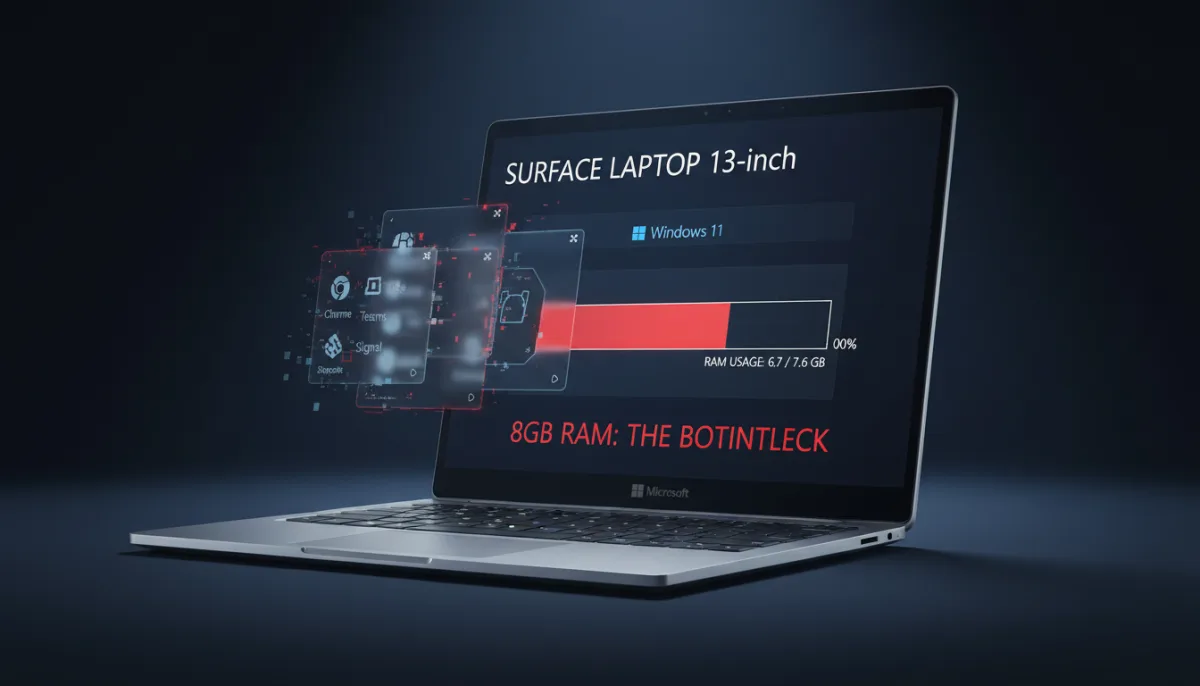
Microsoft’s new $950 Surface Laptop 13-inch proves that 8GB of RAM is no longer sufficient to run Windows 11 smoothly. As the global "RAMageddon" memory shortage drives up component costs, the 2026 entry-level model pairs excellent physical hardware with a restrictive memory bottleneck that severely compromises everyday multitasking.
This review is critical for students, professionals, and everyday consumers looking for a reliable thin-and-light Windows notebook. The key takeaway is clear: purchasing an 8GB Windows machine in 2026 is a risky investment that will likely lead to performance frustration, forcing buyers to either upgrade their budget or look toward alternative operating systems.
Great Hardware Bottlenecked by Memory
According to testing by The Verge, the physical hardware of the Surface Laptop remains exceptional. The device features a tactile keyboard, a sharp 1080p webcam, and a highly efficient battery that easily lasts 10 hours. It is powered by an eight-core Qualcomm Snapdragon X Plus processor (specifically the X1P-46-100), which boasts a slightly faster boost speed than last year's model.
However, while the 2025 version thrived with 16GB of RAM, the 2026 base model's reduction to 8GB severely limits the processor's potential. While the laptop handles basic web browsing and video streaming adequately, it struggles when pushed even slightly beyond single-task operations.
Real-World Multitasking Failures
Real-world testing reveals significant performance bottlenecks. The Verge noted that the laptop would hang for several seconds during basic Microsoft Teams calls, particularly when video was being streamed. This occurred with only about 10 Google Chrome tabs open across two virtual desktops, alongside background apps like Slack and Signal.
Keeping the Performance tab open in Task Manager showed the system consistently using around 6.7GB of the 7.6GB available memory during light multitasking. Even after a fresh reboot with minimal startup apps running, Windows 11 consumed 4.2GB of RAM. This matches the minimum Microsoft requires just to run Windows 11, highlighting exactly how little headroom remains for actual applications.
The RAMageddon Impact
The regression in specifications is largely driven by the ongoing RAM shortage, which has forced manufacturers to cut memory to maintain "entry-level" price points. Recent announcements from Dell, Acer, and Asus indicate that 8GB Windows laptops will continue to flood the market as the shortage persists.
Comparatively, macOS handles memory constraints more efficiently. The $699 Apple MacBook Neo, which also features 8GB of RAM, manages multitasking significantly better in testing and costs $250 less than the Surface Laptop. For Windows users, the most viable solution is to spend $1,150 for the 16GB Surface Laptop model, or explore refurbs and open-box alternatives.
2026 Surface Laptop 13-inch (8GB) Specifications
- Display: 13-inch (1920 x 1280) 60Hz touchscreen
- CPU: Qualcomm Snapdragon X Plus X1P-46-100
- RAM: 8GB LPDDR5X (non-replaceable)
- Storage: 256GB UFS
- Webcam: 1080p
- Connectivity: Wi-Fi 7, Bluetooth 5.4
- Ports: 1x USB-A 3.1, 2x USB-C 3.2, 3.5mm combo audio jack
- Biometrics: Fingerprint sensor in power button
- Weight: 2.7 pounds
- Dimensions: 11.25 x 8.43 x 0.61 inches / 285.8 x 214.1 x 15.5mm
- Battery: 50Wh
- Price: $949.99 at Microsoft
Benchmark Comparisons
| Device | CPU Cores | GPU | Geekbench 6 CPU (Multi) | Price as Tested |
|---|---|---|---|---|
| Surface Laptop 13 (2026) - 8GB | 8 | Adreno X1-45 | 9,421 | $949.99 |
| Surface Laptop 13 (2025) - 16GB | 10 | Adreno X1-45 | 11,142 | $1,249.99 |
| MacBook Neo - 8GB | 6 | A18 Pro | 7,850 | $699.00 |
| MacBook Air 15 - 16GB | 8 | M5 | 16,567 | $1,799.00 |
| Acer Aspire 14 AI - 16GB | 8 | Intel Arc 140V | 10,930 | $1,049.99 |
| Lenovo IdeaPad Slim 3x - 16GB | 8 | Adreno X1-26 | 9,728 | $749.99 |
The Unacceptable Cost of Entry-Level Computing
The release of the 8GB Surface Laptop exposes a glaring contradiction in Microsoft's current hardware strategy. The company is aggressively pushing AI features and demanding more processing power, yet it is shipping flagship hardware that chokes on a basic Microsoft Teams call. If the operating system itself consumes over half of the available memory on a fresh boot, selling an 8GB machine for nearly $1,000 borders on planned obsolescence.
This situation also highlights a critical divergence between Windows and macOS. While Apple has faced rightful criticism for clinging to 8GB base models, macOS's memory management allows the $699 MacBook Neo to remain functional under load. Windows 11 simply does not have that luxury. Until Microsoft drastically de-bloats its operating system, consumers must treat 16GB as the absolute minimum requirement for any new Windows PC, regardless of what the spec sheet claims.
This article was written by AI from reporting by theverge.com.