Discovery of Long-Chain Alkanes in Martian Mudstone
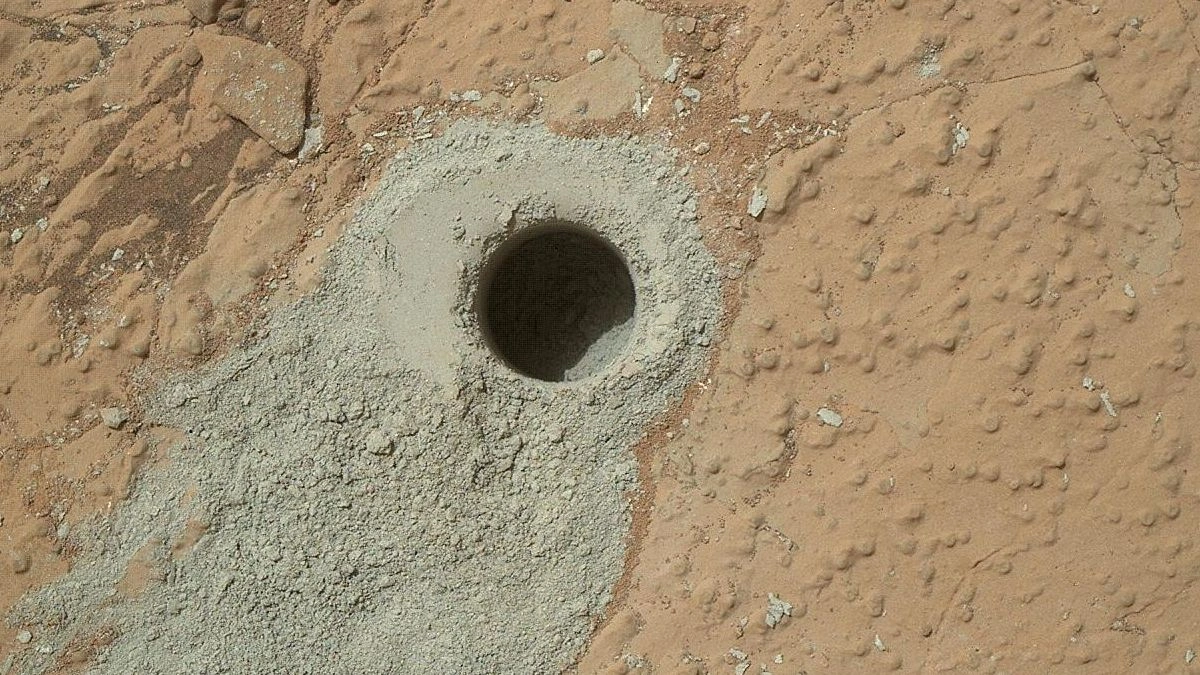
In March 2025, NASA's Curiosity rover detected decane, undecane, and dodecanelong-chain alkanes with 10, 11, and 12 carbon atomsin a pulverized sample from the Cumberland mudstone in Gale Crater. These represent the largest organic compounds identified on Mars to date. The Sample Analysis at Mars (SAM) instrument aboard Curiosity analyzed the ancient rock, hypothesizing the alkanes as fragments from fatty acids, which on Earth are primarily produced by living organisms, though abiotic processes can also generate them.
Current concentrations measure 30-50 parts per billion, modest levels. However, the Cumberland mudstone has endured about 80 million years of surface exposure to cosmic radiation on Mars, which lacks Earth's protective atmosphere and magnetic field. This radiation degrades organics over time.
Rewinding the Clock: Original Abundance Estimates
Led by Alexander Pavlov at NASA's Goddard Space Flight Center, researchers combined lab radiolysis experiments, mathematical modeling, and rover data to estimate pre-exposure levels. They calculated original concentrations of 120 to 7,700 parts per millionfar exceeding what known non-biological sources could supply. Non-biological mechanisms examined included interplanetary dust, meteorites, atmospheric haze, hydrothermal chemistry, and serpentinization, all falling short.
The study, published February 4, 2026, in Astrobiology, concludes non-biological processes alone cannot fully account for the abundance, making biological origins a reasonable hypothesis. Lead author Caroline Freissinet from the French National Centre for Scientific Research confirmed the fragility of these chain-shaped alkanes compared to previously detected aromatic molecules.
Why This Matters
This finding elevates the search for past Martian life, as alkanes resemble fatty acid byproducts essential to cell membranes on Earth. It challenges assumptions that Mars' organics stem solely from abiotic delivery or synthesis, prompting reevaluation of habitability in Gale Crater's ancient lakebed environment. For scientists and the public alike, it underscores Mars' potential as a former cradle for microbial life, fueling dreams of extraterrestrial biology.
Realistic Scenario: A Biologist's Perspective
Imagine a team of astrobiologists at NASA's Jet Propulsion Laboratory poring over Curiosity's data late into the night. One researcher, cross-referencing Earth analogs like lipid-rich microbial mats in arid deserts, realizes the alkane profiles match decayed fatty acids from ancient bacteria. This human moment of insight bridges billions of years, connecting lab benches on Earth to Martian rocks and reigniting passion for space exploration.
Forward-Looking Implications
Upcoming missions like ExoMars, launching in 2028, will drill two meters deep, accessing less radiation-altered samples to distinguish biotic from abiotic origins. Enhanced lab simulations replicating Martian conditions will refine degradation rates. If confirmed biotic, this could reshape astrobiology, prioritizing sample return missions like Mars Sample Return and expanding searches to subsurface ice or other craters. It also informs future human missions, assessing organic preservation for in-situ resource use.
Cautions and Next Steps
The study avoids claiming definitive life detection, noting unknown abiotic pathways or radiation effects may exist. Remaining Curiosity samples offer short-term testing opportunities with new methods. Long-term, interdisciplinary efforts will test hypotheses, potentially revealing Mars' chemical complexity exceeds current models.
- Key alkanes: Decane (C10), undecane (C11), dodecane (C12).
- Exposure duration: ~80 million years.
- Original estimate: Up to 7,700 ppm.
These organics, preserved in mudstone from a once-wet Mars, invite humanity to question: Did life once thrive on the Red Planet?
This article was written by AI from reporting by sciencealert.com.