A team of researchers has unveiled a revolutionary "click-locking strategy" that utilizes robotic automation to solve one of the biggest hurdles in chemical engineering: the scalable synthesis of single-atom catalysts (SACs). Published in Nature Synthesis on February 27, 2026, this method introduces molecular "clicking auxiliaries" that function like seat belts to anchor atoms precisely, preventing the instability that typically plagues these high-performance materials while ensuring industrial compatibility.
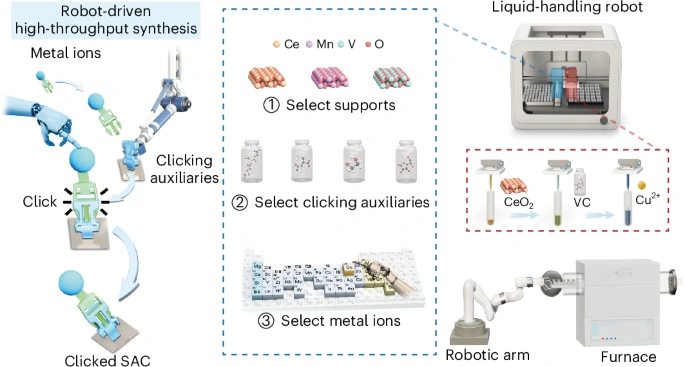
The core of this innovation lies in its inspiration from "click chemistry," a concept renowned for its reliability and specificity in molecular linking. The research team, including authors Weibin Chen and Ruqiang Zou, designed these auxiliaries to act as molecular "click-locking seat belts." This mechanism ensures that individual atoms are anchored securely to their supports, optimizing their electronic structures and significantly enhancing stability. Unlike traditional synthesis methods where raw material loss is high, this approach minimizes waste, making the process economically viable for large-scale applications.
Moving beyond theoretical chemistry, the study demonstrates a major leap in manufacturing technology by integrating this chemical strategy with a robotic platform. This automation allows for high-throughput synthesis, enabling the rapid generation and evaluation of extensive libraries of "clicking-SACs." The researchers successfully utilized this robotic system to screen for performance, accelerating the discovery of optimal catalysts for critical industrial processes, including electrocatalytic, photocatalytic, and thermocatalytic reactions.
The industrial relevance of this breakthrough is underscored by the team's achievement of kilogram-scale production. The study confirms that these mass-produced "clicking-SACs" retain exceptional catalytic activity and long-term stability, a feat often difficult to replicate when scaling up from laboratory milligrams to industrial kilograms. Specific experiments using a Cu1/CeO2 model system (Copper on Cerium Oxide) validated the mechanism, proving the broad applicability and reliability of the method for future energy and chemical applications.
My Take
The transition of single-atom catalysts from academic curiosities to industrial staples has long been hindered by the "scalability gap." This research effectively bridges that gap by combining precise molecular engineering with robotic automation. The ability to produce these materials at a kilogram scale without sacrificing their atomic-level precision suggests we are entering a new era of manufacturing where "atom-by-atom" design becomes a commercially viable reality for the energy and chemical sectors.
This article was written by AI from reporting by nature.com.