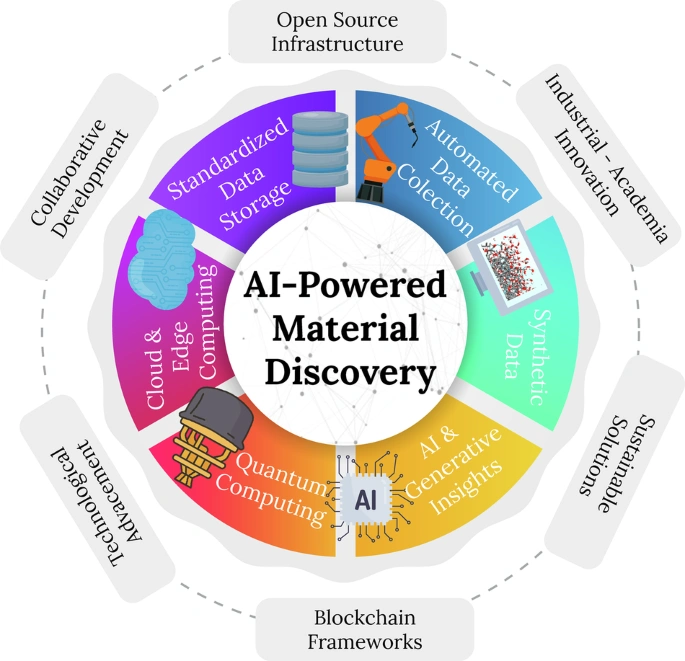
Artificial intelligence is fundamentally reshaping how scientists discover and characterize new materials, with open-source platforms now enabling researchers to compress weeks of analysis into minutes and accelerate the path from laboratory discovery to industrial application. This convergence of AI and materials science represents a watershed moment for industries ranging from energy storage to catalysis and sustainable manufacturing.
The transformation is already underway at major research institutions. At the Department of Energy's Lawrence Berkeley National Laboratory, researchers have developed the Digital Twin for Chemical Science (DTCS) platform, an AI-powered system that interprets complex chemical measurements in real time rather than requiring months of manual analysis. The platform identifies molecular compounds by their unique chemical "fingerprints" or spectra as they form on solid surfaces within operating devices such as batteries, leveraging advanced Ambient Pressure X-ray Photoelectron Spectroscopy (APXPS) techniques at the Advanced Light Source facility. When tested on a fundamental catalytic system involving a silver-water interface relevant to batteries and corrosion prevention, DTCS predicted how, when, and where oxygen-containing species would appear on the silver surface within minutesresults that matched established experiments and theory.
The Paradigm Shift in Chemical Characterization
For decades, chemical characterization has lagged behind other scientific disciplines in automation and digital integration. While chemistry has entered a new digital era marked by automated synthesis labs and voice-activated quantum calculations, the critical step of interpreting what chemical measurements reveal about materials and reactions remained a bottleneck requiring weeks or months of expert analysis. This gap between experimental capability and analytical speed has constrained the pace of materials discovery and optimization across energy storage, catalysis, and manufacturing sectors.
The DTCS platform addresses this fundamental constraint by partnering computational machine-learning constructs with experimental infrastructure. According to Ethan Crumlin, a staff scientist at Berkeley Lab's Advanced Light Source and program lead specializing in interface chemistry, this integration represents "the future for how science is done." The platform enables autonomous chemical characterization, where AI-guided experiments could accelerate the timeline for discovering and characterizing new materials and chemical processes for practical applications. By reducing interpretation cycles from months to minutes, researchers can iterate faster, test more hypotheses, and move promising discoveries toward industrial implementation with unprecedented speed.
Expanding the Scope: From Energy Storage to Sustainable Manufacturing
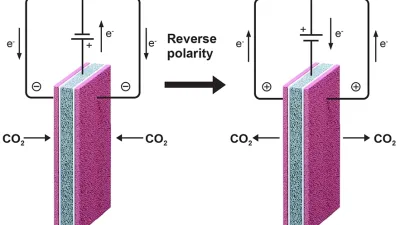
The implications extend far beyond laboratory efficiency. Materials science breakthroughs are cascading across multiple critical domains. Researchers at HKUST have unveiled major advances in calcium-ion battery technology, potentially opening pathways to safer, more sustainable energy storage for renewable power grids and electric vehicles. Simultaneously, scientists have discovered that manganese, an abundant and inexpensive metal, can efficiently convert carbon dioxide into formate, a potential hydrogen source for fuel cellsa breakthrough that hinges on clever catalyst redesign to extend operational lifespan. These discoveries underscore how accelerated characterization and AI-guided material optimization directly translate into solutions for climate change and energy independence.
Beyond batteries and catalysis, researchers at Sandia National Laboratories are developing porous liquids capable of selectively capturing methane from biogasa technology that could transform agricultural waste streams into supplemental domestic energy sources. The team has created dozens of different porous liquid formulations, with hundreds of thousands of potential combinations still unexplored. The liquid form of these materials offers a critical advantage: they can integrate into existing piping infrastructure, unlike solid porous materials that require specialized handling and setup. This practical consideration demonstrates how AI-accelerated discovery must be paired with engineering feasibility to drive real-world adoption.
Open-Source Infrastructure: Democratizing Discovery
The shift toward open-source AI infrastructure is particularly significant. By making these tools publicly available rather than proprietary, the research community accelerates collective progress and enables smaller institutions and companies to participate in materials discovery. Open-source platforms reduce barriers to entry, allowing researchers worldwide to leverage cutting-edge AI techniques without prohibitive licensing costs. This democratization of advanced computational tools mirrors successful models in software development and could catalyze a wave of distributed innovation across academia, national laboratories, and industry.
The integration of AI into materials science also addresses a fundamental challenge: the vast combinatorial space of possible materials. With hundreds of thousands of porous materials and tens of thousands of solvents available, the number of potential combinations is staggering. Traditional experimental approaches cannot feasibly explore this landscape. AI-powered platforms can intelligently navigate this space, predicting promising candidates before synthesis, prioritizing experiments with the highest probability of success, and identifying unexpected synergies between material components.
My Take
We are witnessing the emergence of a new scientific paradigm where AI serves not as a replacement for human expertise but as a force multiplier that liberates researchers from tedious analysis and enables them to focus on creative hypothesis generation and strategic decision-making. The convergence of open-source infrastructure, accelerated characterization, and autonomous experimentation will likely compress the timeline from fundamental discovery to industrial deployment by orders of magnitude. Within the next five years, expect to see AI-accelerated materials discovery become the standard operating procedure at major research institutions, with tangible productsfrom next-generation batteries to carbon capture systemsreaching market faster than ever before. The competitive advantage will belong to organizations that embrace this transformation early.
This article was written by AI from reporting by nature.com.