Detecting terahertz radiation has long been a bottleneck in physics, requiring bulky, expensive equipment and extreme cryogenic cooling to capture signals between microwaves and infrared light. Now, researchers have engineered a compact quantum metasurface detector that captures these elusive frequencies with unprecedented efficiency. By merging quantum physics with a specialized "brickwork" metasurface, the new device achieves a twenty-fold improvement in quantum efficiency, paving the way for next-generation wireless networks and advanced medical imaging.
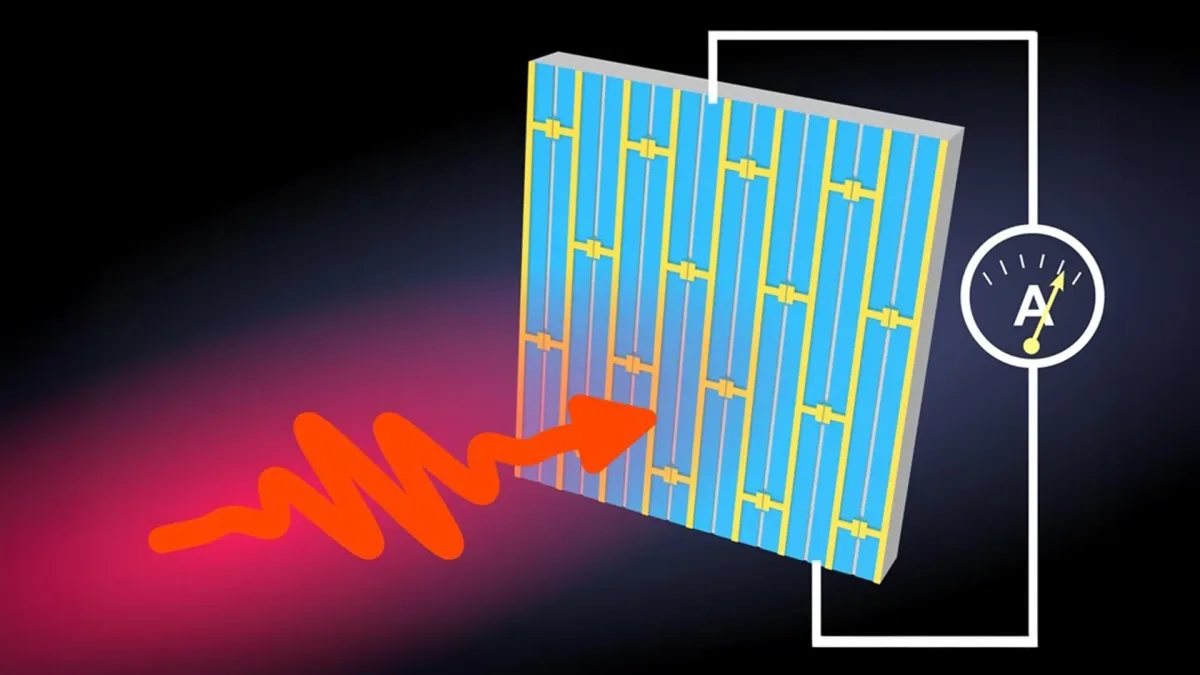
The breakthrough, recently published in the journal Advanced Photonics, relies on the in-plane photoelectric effect. Incoming terahertz photons transfer energy to electrons confined within a two-dimensional electron gas. These energized electrons then cross a carefully designed potential step to produce a measurable electrical current. Unlike conventional detectors, this mechanism does not require photons to exceed a minimum energy threshold, bypassing several efficiency limitations that have historically constrained terahertz capture.
Engineering the Metasurface Architecture
To maximize signal capture, the research team designed the detector around a metasurface - a patterned structure that concentrates electromagnetic energy into microscopic regions. The device utilizes a repeating brickwork pattern that channels incoming radiation into narrow capacitive gaps. Individual photoelectric tunable-step (PETS) detection elements are embedded directly inside these gaps where the electric field is strongest.
"Compared to the conventional approach of connecting multiple devices in parallel, this approach allowed us to significantly boost the detection sensitivity," explained Wladislaw Michailow, who led the research at the University of Cambridge and Swansea University. By electronically linking these distributed detection elements, the researchers combined their outputs into a robust overall signal without relying on external optics or complex arrays.
Performance Benchmarks and Zero-Bias Operation
During testing, the researchers cooled the device to 10 K and exposed it to radiation near 1.9 THz. The proof-of-concept detector delivered a clear electrical response, achieving a responsivity of 2.7 amperes per watt and an external quantum efficiency of 2.1 percent. This represents a twenty-fold improvement over previously demonstrated PETS detectors, largely due to the metasurface's ability to focus radiation directly into the active regions.
Crucially, the system operates with zero source-drain bias. "The devices are direct detectors operating at zero bias, and therefore, they operate without dark currents," noted Ruqiao Xia, the study's first author from the Cavendish Laboratory. Fabricated using standard semiconductor techniques similar to those used for field-effect transistors, the design eliminates the need for external focusing components like silicon lenses, making large-scale manufacturing highly practical.
The Commercial Leap for Terahertz Tech
The true significance of this quantum metasurface detector lies in its manufacturing compatibility. Historically, terahertz technology has been confined to massive, specialized installations - such as airport security scanners or advanced astronomical observatories - due to the need for liquid helium cooling and complex optical alignments. By integrating the light-collection system directly into a flat, semiconductor-friendly chip, this research effectively removes the primary physical barriers to commercial scaling.
This architectural shift is the exact catalyst required to move terahertz applications out of the laboratory. Because the design can operate at temperatures achievable with compact cryocoolers, it bridges the gap between hyper-sensitive lab equipment and room-temperature commercial devices. In the near future, this scalable geometry could enable the miniaturization of terahertz scanners into handheld medical devices for non-invasive skin cancer detection, or serve as the foundational receiver architecture for ultra-high-bandwidth 6G cellular networks.
This article was written by AI from reporting by sciencedaily.com.