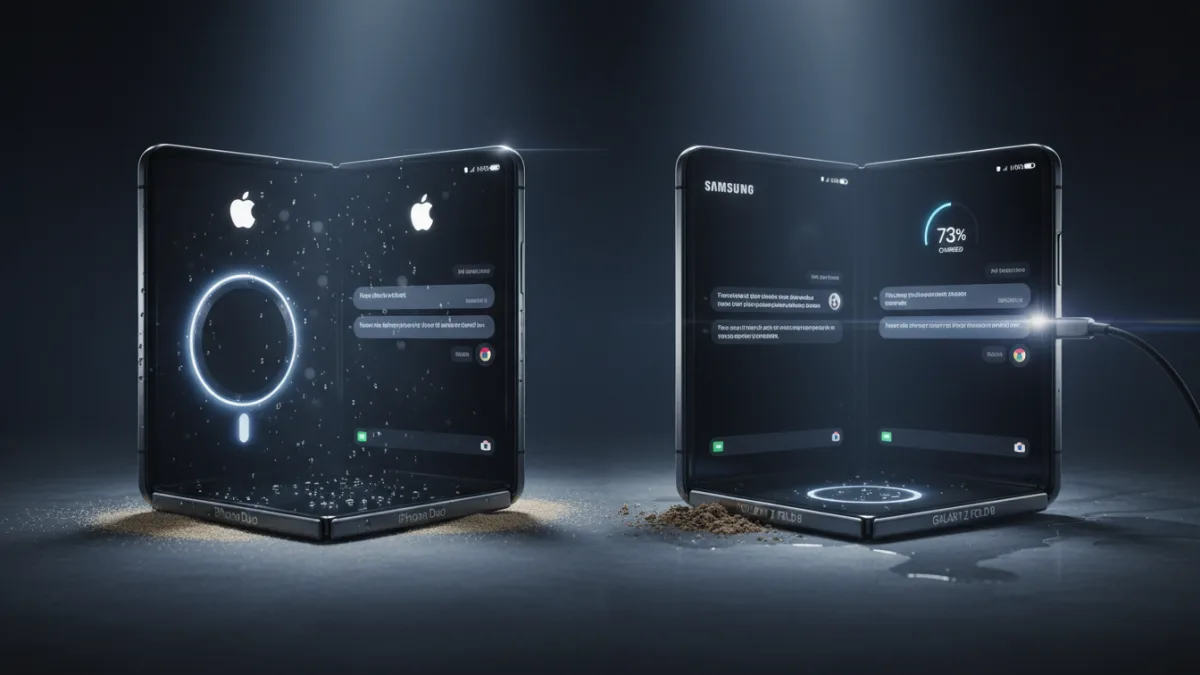
The foldable smartphone market has a new heavyweight rivalry as Apple's highly anticipated iPhone Duo goes head-to-head with the Samsung Galaxy Z Fold 8. Both flagship devices share a similar passport-style aspect ratio, deliberately stepping away from the tall and thin designs that have dominated early foldable iterations. With only a $100 price difference separating them, the battle for premium smartphone supremacy is closer than ever.
While the form factors are similar, the engineering priorities of each company reveal distinct strategies. Samsung has focused on refining the physical footprint, making the Galaxy Z Fold 8 noticeably thinner in both its folded and unfolded states. Apple, meanwhile, has prioritized environmental resilience and ecosystem integration, aiming to solve some of the most persistent pain points in the foldable category.
Head-to-Head Specifications
| Feature | iPhone Duo | Galaxy Z Fold 8 |
|---|---|---|
| Price | $1999 | $1900 |
| Folded Thickness | 11.3mm | 9.7mm |
| Unfolded Thickness | 5.2mm | 4.5mm |
| Durability | Fully waterproof & dustproof | IP48 (Waterproof, limited dust protection) |
| Main Cameras | 48MP Main & Ultrawide | 50MP Main & Ultrawide |
| Outer Selfie Camera | 12MP | 10MP |
| Inner Selfie Camera | Undisclosed (1080p video max) | 10MP |
| Wired Charging (30 mins) | 50% | 0% to 73% |
| Wireless Charging | Full MagSafe | Lacks Qi2 magnets |
Durability and Design Differences
One of the most critical battlegrounds for these devices is durability. Early generations of Samsung foldables suffered from vulnerabilities to trapped dust and dirt, and the Galaxy Z Fold 8 still carries a variation of this weakness. Its IP48 rating ensures it is fully waterproof, but it is only protected against solid particles larger than a grain of sand. In stark contrast, the iPhone Duo is rated as fully waterproof and dustproof, offering a significant advantage for long-term reliability.
Samsung reclaims some ground in the physical design department. The Galaxy Z Fold 8 measures just 9.7mm when folded and an incredibly slim 4.5mm when unfolded. The iPhone Duo is slightly bulkier, measuring 11.3mm folded and 5.2mm unfolded, which may influence buyers looking for the sleekest possible pocket profile.
Cameras, Battery, and Charging
The camera systems on both devices are highly competitive, though neither includes a dedicated telephoto lens. The iPhone Duo features a 48MP main and ultrawide setup, while the Galaxy Z Fold 8 edges slightly higher with 50MP sensors. For selfies, the iPhone Duo sports a 12MP outer camera compared to Samsung's 10MP outer lens. However, Apple's inner display camera appears to be lower resolution, as official specifications confirm it supports 1080p video but not 4K.
Battery performance reveals another split in priorities. Apple claims the iPhone Duo will last up to 24 hours in typical use, though exact battery capacity remains undisclosed pending hardware teardowns. Samsung takes the lead in wired charging speed, pushing the Galaxy Z Fold 8 from 0% to 73% in just 30 minutes, whereas the iPhone Duo reaches 50% in the same timeframe. Conversely, Apple dominates the wireless charging experience with full MagSafe support, while the Galaxy Z Fold 8 notably lacks the magnetic alignment required for the new Qi2 standard.
The Durability Factor Could Trigger an Ecosystem Shift
Historically, smartphone comparisons across operating systems rarely trigger mass migrations, as most users prefer to stay locked into their existing Apple or Android ecosystems. However, the foldable market is a different beast. The $1999 iPhone Duo is uniquely positioned to tempt Android users who have been waiting for a foldable device that doesn't feel like a fragile prototype. Samsung's historical track record with screen durability and dust ingress remains a lingering concern for buyers spending $1900 on the Galaxy Z Fold 8.
The $100 premium for the iPhone Duo is a negligible barrier at this ultra-high-end price tier, especially when it buys absolute peace of mind regarding dust resistance. Furthermore, the widespread appeal of Apple's polished user interface, combined with the seamless integration of MagSafe, creates a compelling package. If Samsung cannot solve its dust-proofing limitations in future iterations, the iPhone Duo may not just retain Apple loyalists - it could actively poach premium Android users who are tired of compromising on durability.