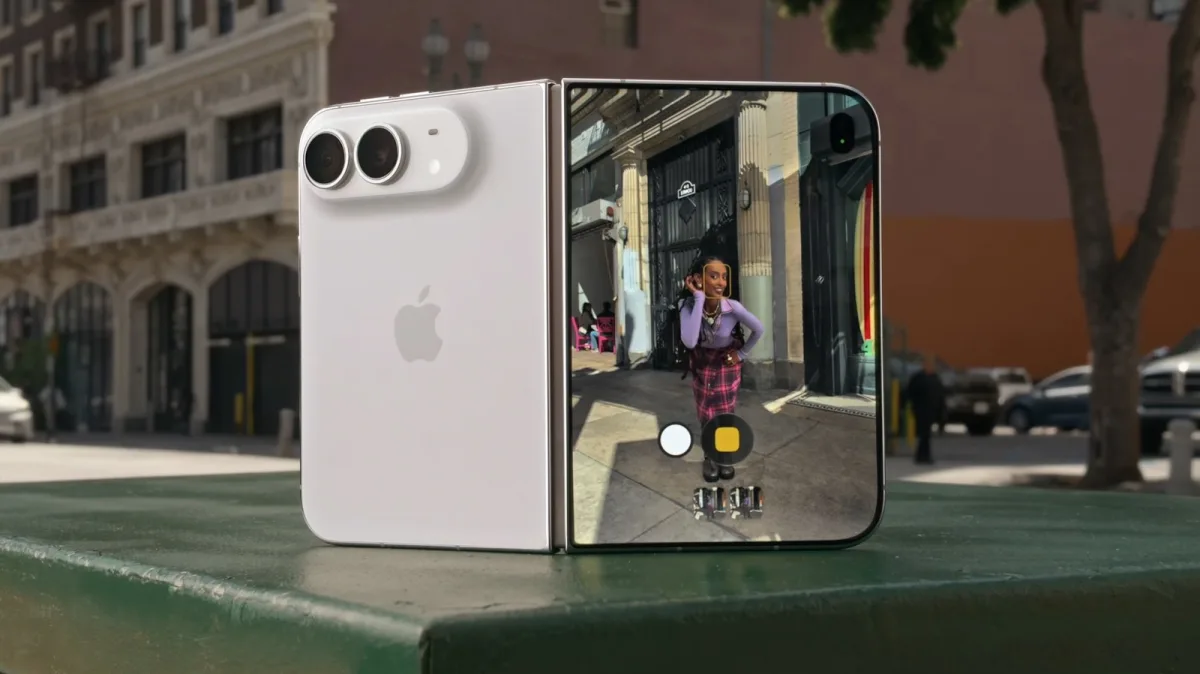
Apple has announced its first folding smartphone, the iPhone Duo, which goes on sale on October 23 to challenge Samsung's already-available Galaxy Z Fold 8. According to a comparison by SlashGear reviewing spec sheets and expert opinions of the iPhone Duo vs. Samsung Galaxy Z Fold 8, both devices share passport-style designs, dual rear cameras, and high price tags. However, they diverge in software, materials, and Apple's choice to use an under-screen inner selfie camera.
Samsung introduced its first mass-market foldable phone in 2019 and has spent seven years refining the category leading up to the Galaxy Z Fold 8. Below is how the two foldables compare across every major category.
| Feature | iPhone Duo | Samsung Galaxy Z Fold 8 |
|---|---|---|
| Inner Display | 7.6-inch folding OLED, 120Hz | 7.6-inch folding OLED, 120Hz |
| Cover Display | 5.4-inch OLED, 120Hz, 3,000 nits | 5.5-inch OLED, 120Hz, 3,000 nits |
| Processor | Apple A20 Pro | Qualcomm Snapdragon 8 Elite Gen 5 |
| Frame & Weight | Titanium, 9 ounces | Aluminum, 7 ounces |
| Front & Rear Glass | Ceramic Shield 2 (front), first-gen Ceramic Shield (back) | Gorilla Glass Victus Ceramic 3 (front), Victus 2 (rear) |
| Water & Dust Rating | IP68 | IP48 |
| Rear Cameras | 48MP primary + 48MP ultrawide (120-degree FOV) | Dual 50MP primary and ultrawide |
| SIM Support | eSIM-only | Supports Nano SIM cards |
Design
Unlike flip phones or taller book-style foldables that leave black bars at the top and bottom of 16:9 movies, both devices adopt the wider passport-style layout that brands like Google explored with the original Pixel Fold. Unfolded, each phone measures 7.6 inches, though Samsung's device is thinner. Samsung uses symmetrical corners, whereas Apple combines rounded and 90-degree bends.
Both models use similar button placements and build a fingerprint sensor into the power button, leaving the iPhone Duo without Face ID. Both carry dual rear camera sensors, though SlashGear notes that the Z Fold 8's vertical camera layout makes it wobble more on a flat surface. The iPhone Duo is also eSIM-only, while the Z Fold 8 accepts Nano SIM cards.
For durability against the elements, the iPhone Duo matches the Pixel 11 Pro Fold with an IP68 water and dust resistance rating, while the Z Fold 8 carries an IP48 rating. SlashGear notes that while the Duo could technically handle a swim or the beach, the outlet still advises keeping both phones away from dirt and water.
Build Quality
After returning to aluminum on the iPhone 17 series, Apple brought titanium back for the iPhone Duo. That material choice pushes the Duo's weight to nine ounces, compared with seven ounces for the aluminum-built Galaxy Z Fold 8.
On the exterior, the iPhone Duo pairs Ceramic Shield 2 on the front with first-generation Ceramic Shield on the back, while Samsung uses Gorilla Glass Victus Ceramic 3 on the front display and Victus 2 on the rear. While SlashGear notes both phones should survive an occasional drop, Ceramic Shield 2 proved tougher in a durability test on the iPhone 18 Pro by YouTube channel JerryRigEverything, scratching at level 7 compared with level 6 on the Z Fold 8.
Displays
The outer cover screens are nearly identical in size, at 5.5 inches on the Z Fold 8 and 5.4 inches on the iPhone Duo. Both cover displays and both 7.6-inch inner folding panels use high-resolution OLED screens with a 120Hz refresh rate, and the outer screens reach a peak brightness of 3,000 nits. SlashGear says both cover screens handle everyday messaging, browsing, and notifications well, while the inner panels suit landscape movies and upright document reading.
Apple differentiates the Duo with a new antireflective coating designed to cut down glare, which some previews report also hides the display crease better. The iPhone Duo also supports the Apple Pencil (USB-C) for note-taking and document annotation, whereas Samsung dropped S Pen support starting with the Z Fold 7 series. Inside, Apple placed the selfie camera underneath the display to avoid screen cutouts.
Performance and Software
Samsung powers the Galaxy Z Fold 8 with Qualcomm's Snapdragon 8 Elite Gen 5 processor, while the iPhone Duo runs on Apple's A20 Pro chip. Although the A20 Pro also powers the iPhone 18 Pro, SlashGear notes that differences in internal layout and cooling mean performance on the Duo may not mirror the 18 Pro, though both foldables can comfortably run demanding games at their highest settings.
On the software side, Apple reworked iOS for the folding screen, adding compact widgets, a sideways dock, smooth transitions from the cover screen to the inner display, and split-screen multitasking for two apps. It also introduces a StandBy feature that turns the phone into a glanceable display for incoming notifications, photos, or the time. SlashGear adds that developers are more likely to optimize apps for Apple's platform, and notes that iOS 27 brings a major improvement to Siri.
Samsung's OneUI counters with heavier multitasking and extra features. It lets users run up to three apps at once, save app bundles to launch together, and open apps in windows for quick checks. Despite Apple's Siri upgrades, SlashGear points out that Samsung still provides more built-in tools, including Now Brief, Photo Assist, and Fan Cam.
Cameras
SlashGear cautions that neither foldable delivers flagship-tier photography, recommending the iPhone 18 Pro or Galaxy S26 Ultra for buyers who prioritize camera quality. Neither phone includes a telephoto sensor, which the outlet notes will feel limiting.
Even so, both carry capable dual rear setups: the iPhone Duo pairs a 48MP primary sensor with a 48MP ultrawide lens offering a 120-degree field of view, while the Z Fold 8 uses two 50MP sensors for its primary and ultrawide cameras. While SlashGear could not comment directly on the Duo's photo quality, it points to TechRadar's assessment that the Z Fold 8 shoots detailed, natural-looking daylight images with solid HDR and effective background separation in Portrait mode.
Users on either device can take selfies with the rear cameras using the cover screen as a viewfinder, or use the outer selfie cameras: a 12MP sensor on the Duo and a 10MP sensor on the Z Fold 8. On the inner screen, Apple uses an under-screen selfie camera, an approach Samsung previously abandoned in favor of a hole-punch cutout due to image quality trade-offs.
Battery Life
Apple has not disclosed the exact battery capacity of the iPhone Duo ahead of teardown reports, but the company estimates up to 24 hours of typical use or 37 hours of video streaming on the cover display. According to Apple's figures, a 60W wired charger reaches 50% charge in 20 minutes - slightly slower than wired charging on the iPhone 18 - while a 35W MagSafe charger hits 50% in 30 minutes, matching the iPhone 18.
Samsung equips the Galaxy Z Fold 8 with a 4,800 mAh silicon-carbon battery, which a review by BGR found lasts a full day of moderate use. The phone supports 45W wired charging that reaches a full charge in about one hour, alongside wireless charging capped at 20W.
Which Foldable Fits Which Buyer
According to SlashGear's verdict, the iPhone Duo is the stronger choice for users already invested in Apple's ecosystem, thanks to iMessage compatibility and seamless pairing with an iPad, MacBook, and AirPods. It also stands out for buyers who want Apple Pencil (USB-C) stylus support, a matte inner screen with a less noticeable crease, and StandBy mode.
The Galaxy Z Fold 8 is SlashGear's pick for buyers seeking a more mature foldable with proven durability, physical Nano SIM support, and a price tag that is $100 lower than Apple's. It also suits power users who want OneUI's three-app multitasking and Samsung's broader set of AI tools.
This article was written by AI from reporting by slashgear.com.