
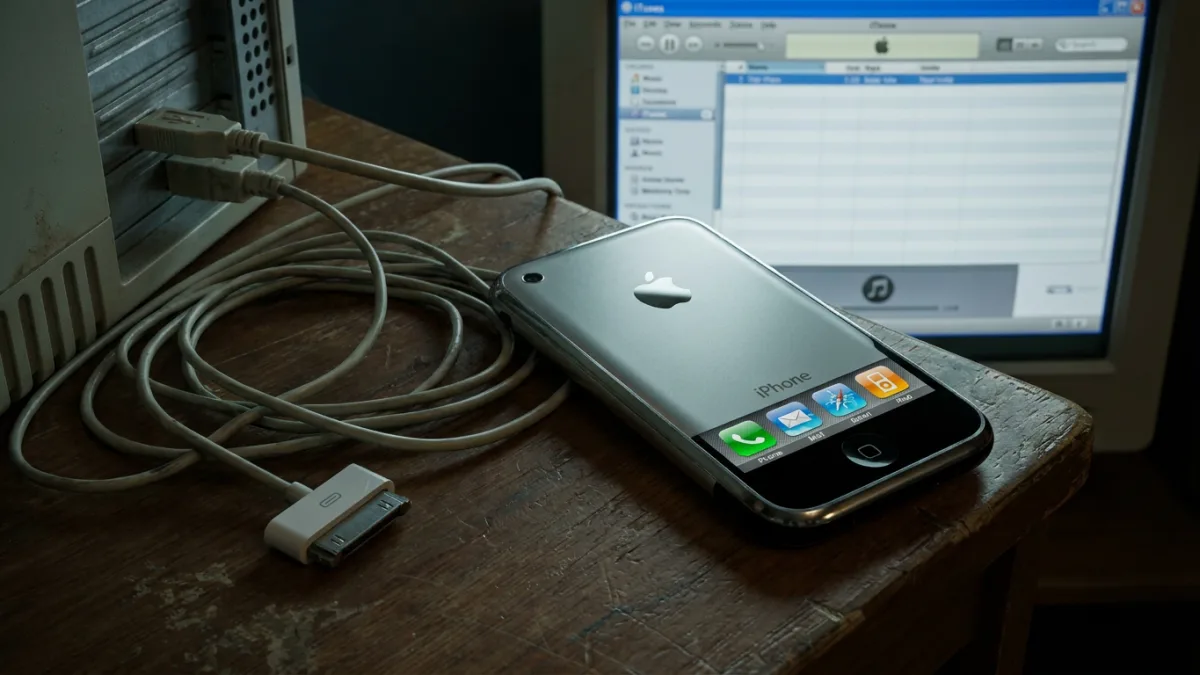
Almost 20 years ago, Apple introduced the original iPhone running iPhone OS 1, a software foundation that would eventually be rebranded as iOS. The device revolutionized the smartphone industry with its touch interface, introducing pinch-to-zoom and double-tap capabilities alongside support for a proper mobile browser. Branded by the company at the time as a “widescreen iPod,” the original iPhone was a massive release, yet iPhone OS 1 lacked several critical features that users now consider standard.
Missing Hardware and Connectivity
Several key hardware and network capabilities introduced in later releases were absent from the first handset. The original iPhone lacked 3G connectivity, which led to the subsequent model being dubbed the iPhone 3G, and AT&T served as the exclusive carrier in the U.S. The device also shipped without built-in GPS, hindering Google Maps access by offering no turn-by-turn directions.
Furthermore, the first model did not include Touch ID, Face ID, a Retina Display, wireless charging, or water resistance. It also predated both the Lightning and USB-C connectors.
The Absence of the App Store and Basic Tools
While modern iPhones offer hundreds of thousands of apps, the original device only included pre-installed software. When the App Store eventually launched, Apple reported over 10 million downloads during its first weekend. At that time, the company noted that more than 800 native apps were available, with over 200 free options and more than 90% priced under $10.
Basic text manipulation was also missing, as copy and paste capabilities were not available in iPhone OS 1. Users had to retype information manually and could not forward a text message to another person until the release of OS 3.0. Messaging was similarly limited: iMessage did not arrive until iOS 5, and Photo Messaging via MMS was introduced with iPhone OS 3.0 in 2009, remaining exclusive to the iPhone 3G and iPhone 3GS.
Customization was heavily restricted, with users limited to a black background until Home Screen wallpapers were released with iOS 4 in 2010. According to BGR, Apple took ages to catch up with its Android counterpart in this department, though it now offers several customization options.
Siri, iCloud, and System Controls
Although Siri is practically the center of iOS 27, the assistant was nowhere near being released with the first iPhone software. Originally a standalone app acquired by Apple, Siri was only included starting with the iPhone 4S running iOS 5. Other missing system features included AirDrop, a functional Control Center, app folders, and the ability to hide or delete stock apps.
Data backup was also a different experience, as iCloud was not available. Apple added support for MobileMe, iCloud's predecessor, in iPhone OS 2. For a long time, users relied on a wired connection to a computer using iTunes to keep their data safe. Apple has since ended macOS support for iTunes, replacing it with separate Music, Podcasts, and TV apps.
Laying the Foundation
Despite the missing features, iPhone OS 1 created the foundation for what the iPhone would become. Future releases eventually shaped user expectations by introducing capabilities like video recording with the iPhone 3GS, a selfie camera on the iPhone 4, larger models with the iPhone 6 and iPhone 6 Plus, and 5G support starting with the iPhone 12.
This article was written by AI from reporting by bgr.com.