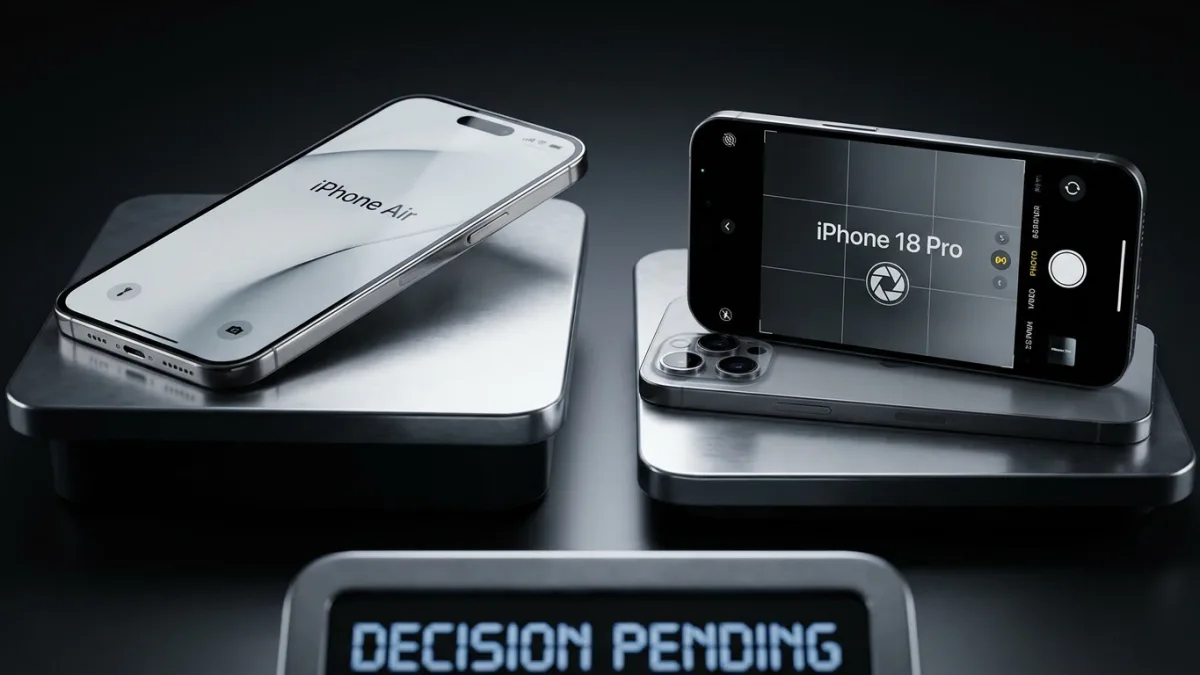
Buyers staring at Apple's current lineup face a surprisingly difficult choice: the ultra-thin iPhone Air or the powerhouse iPhone 18 Pro, separated by a mere $100. While the Air delivers a striking 5.64mm titanium chassis, the newer Pro model packs a variable-aperture camera and the A20 Pro chip into a heavier frame. Consumers upgrading their daily driver must weigh whether the Air's unmatched 165-gram lightness justifies sacrificing the Pro's multi-lens camera system and extended battery life.
The $100 Specification Gap
At Apple's current retail pricing, the 256GB iPhone Air costs $1,099, while the equivalent iPhone 18 Pro sits just slightly higher at $1,199. This narrow price gap forces buyers to choose between cutting-edge aesthetics and raw performance. The iPhone 18 Pro justifies its premium with the A20 Pro chip, featuring a 7-core GPU and dual 16-core Neural Engine, alongside next-generation vapor chamber cooling for sustained workloads.
In contrast, the Air relies on the older A19 Pro chip and lacks the advanced thermal management found in the Pro series. Connectivity also sees a generational divide between the two models. The iPhone 18 Pro utilizes the newer Apple C2 cellular modem, whereas the Air operates on the Apple C1X modem.
Both devices feature Wi-Fi 7, an Always-On OLED display with ProMotion, and the Ceramic Shield 2 front glass. This ensures that baseline flagship features remain intact across the board, regardless of which model you choose.
Design vs. Photographic Power
The physical differences between the two devices dictate their target audiences. The iPhone Air is a marvel of engineering, weighing just 165 grams with a depth of 0.22 inches (5.64 mm) and a polished titanium frame. The iPhone 18 Pro is noticeably bulkier at 211 grams and 0.34 inches (8.75 mm) thick, utilizing an aluminum unibody with a Ceramic Shield back.
However, that extra bulk houses a vastly superior camera array. Photography enthusiasts will find the iPhone 18 Pro significantly more capable, featuring a 48-megapixel Fusion Main camera with variable-aperture settings ranging from ƒ/1.48 to ƒ/4.0. It also includes dedicated 48-megapixel Ultra Wide and Telephoto lenses, whereas the Air is limited to a single 48-megapixel Fusion Main camera with a fixed ƒ/1.6 aperture.
Furthermore, the Pro model supports 4K Dolby Vision video up to 120 fps and ProRes RAW recording. The Air caps out at 60 fps without ProRes support, making it less ideal for serious mobile videographers.
Battery Life and Charging Speeds
Endurance is another critical factor where the thicker chassis of the Pro model pays off. The iPhone 18 Pro delivers up to 36 hours of video playback, compared to the 27 hours offered by the iPhone Air. For users needing even more power, the iPhone 18 Pro Max pushes that figure to 45 hours, though it weighs a hefty 249 grams.
Charging capabilities also favor the newer Pro models. The iPhone 18 Pro supports up to 50% wired charge in around 15 minutes using a 60W-capable adapter with Adjustable Voltage Supply. The Air requires 30 minutes to reach the same 50% charge using a standard 20W adapter.
Both devices support MagSafe and Qi2 wireless charging. However, the Pro reaches 25W compared to the Air's 20W limit, giving it a slight edge in wireless top-ups.
iPhone Air vs. iPhone 18 Pro: Key Specifications
| Feature | iPhone Air | iPhone 18 Pro |
|---|---|---|
| Display Size | 6.5-inch (2736 x 1260) | 6.3-inch (2622 x 1206) |
| Processor | A19 Pro | A20 Pro |
| Thickness & Weight | 5.64 mm / 165 grams | 8.75 mm / 211 grams |
| Rear Cameras | Single 48MP (Fixed ƒ/1.6) | Triple 48MP (Variable ƒ/1.48 - ƒ/4.0) |
| Battery (Video Playback) | Up to 27 hours | Up to 36 hours |
| Price (256GB) | $1,099 | $1,199 |
Looking Ahead: The 2027 iPhone Air
For buyers hesitant about the current Air's limitations, waiting might be the best strategy. According to reports from Bloomberg, Apple is targeting spring 2027 for the next-generation iPhone Air. Leaks suggest the upcoming model will address current shortcomings by incorporating the A20 Pro chip and a smaller Dynamic Island.
Battery life and thermal performance are also expected to see major upgrades. Supply chain leaks indicate the 2027 Air will feature a 3,500mAh battery, a notable increase from the current 3,149mAh capacity. Additionally, reports suggest Apple will introduce vapor chamber cooling and an Ultra Wide camera to the next iteration.
The Luxury Tax of Thinness
At retail price, the iPhone 18 Pro is objectively the better financial decision. For just $100 more at the 256GB tier, buyers gain a telephoto lens, variable aperture, nine extra hours of battery life, and a faster processor. The iPhone Air is not priced based on its spec sheet; it is priced as a lifestyle device for users who prioritize a 165-gram, 5.64mm form factor above all else.
However, retail discounts completely change this calculation. The iPhone Air has previously seen price drops down to $899.99. If buyers can secure the Air at a $300 discount compared to the $1,199 iPhone 18 Pro, the compromises in battery and camera versatility become much easier to accept.
Unless you find a steep discount, the iPhone 18 Pro remains the definitive choice for anyone who values daily utility over extreme portability. The sheer volume of hardware upgrades packed into the Pro model makes the $100 premium one of the best deals in Apple's current lineup.