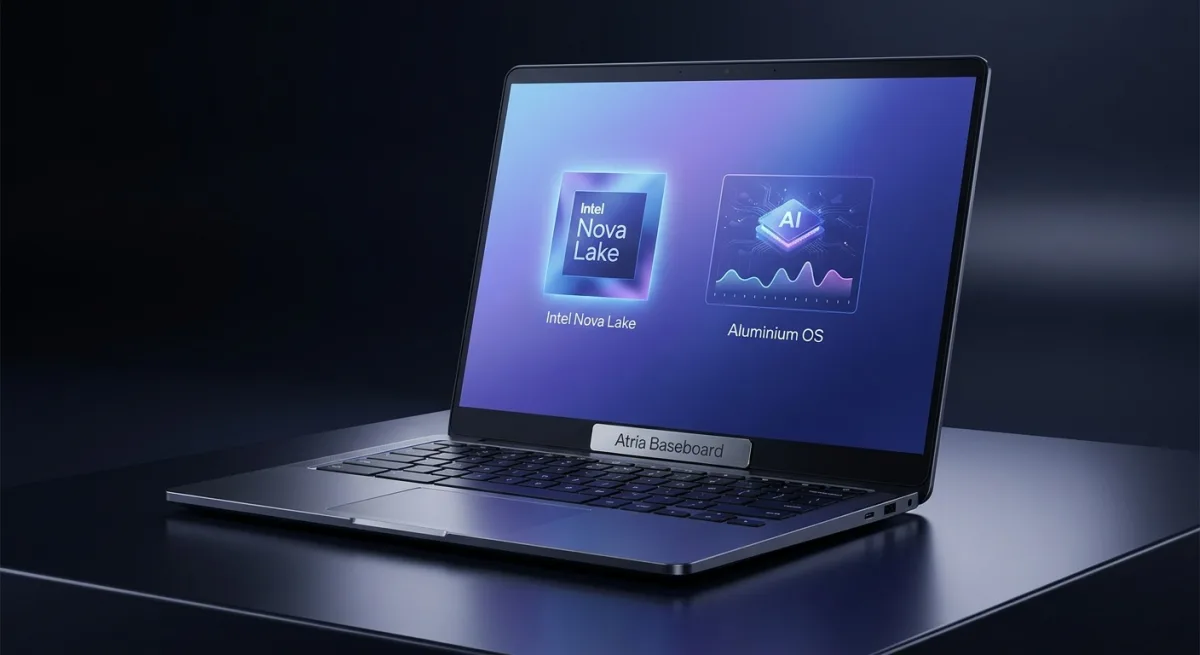
The next generation of Intel Nova Lake Chromebooks has officially entered development, promising a massive leap in processing power and on-device AI capabilities. Discovered within the Chromium Gerrit, a new baseboard codenamed "Atria" explicitly confirms that Google is already laying the groundwork for Intel's upcoming architectural overhaul. This development signals a major shift for ChromeOS hardware, preparing devices for a future where desktop-class performance meets heavy AI workloads.
Inside the 'Atria' Baseboard and Nova Lake Architecture
Expected to launch under the "Core Ultra Series 4" branding, the Intel Nova Lake chips represent a significant upgrade over the current Chromebook Plus lineup. While desktop variants will scale up to 52 cores, the mobile processors destined for boards like Atria will utilize three major next-generation architectures to boost efficiency and gaming performance.
- Coyote Cove & Arctic Wolf: These new Performance (P-Cores) and Efficiency (E-Cores) are designed to deliver substantial Instructions Per Clock (IPC) improvements over current generations.
- Xe3 Graphics: The upgrade to Intel's Xe3 architecture will provide a massive boost to integrated graphical performance and gaming capabilities.
- Next-Gen NPU6: Packing a Neural Processing Unit capable of up to 74 TOPS (Tera Operations Per Second), this chip easily surpasses the 40 TOPS requirement of Microsoft's Copilot+ PCs.
Powering the Future of 'Aluminium OS'
The timing of the Atria board's development aligns perfectly with Google's ambitious "Project Aluminium." This massive internal undertaking aims to re-baseline ChromeOS on a desktop-class Android foundation. By merging Android's vast app ecosystem with the desktop functionality of ChromeOS, Google is creating an operating system that will require serious hardware horsepower.
When Nova Lake chips hit the market - likely between late 2026 and 2027 - Aluminium OS should be maturing out of its initial launch phase. A flagship device built on the Atria baseboard, equipped with top-tier Xe3 graphics and a 74 TOPS NPU, is exactly the kind of future-proof hardware Google needs. This power will be essential to run heavy on-device Gemini AI processing and compete directly with premium Windows and macOS machines.
The Shift Toward Premium ChromeOS Hardware
The discovery of the Atria baseboard proves that Google is no longer treating ChromeOS as just a lightweight, budget-friendly platform. By integrating Intel's upcoming 74 TOPS NPU and Xe3 graphics, the company is clearly preparing for a heavy reliance on local AI processing and advanced gaming. This marks a definitive pivot toward the premium laptop market.
If Project Aluminium successfully merges the Android and ChromeOS ecosystems, the hardware requirements will naturally skyrocket. Devices built on the Nova Lake architecture will be essential to ensure this unified OS runs smoothly without compromising battery life or performance. As development on Atria continues in the Chromium Gerrit, we can expect a new family of high-end, future-proof Chromebooks to emerge over the next year.