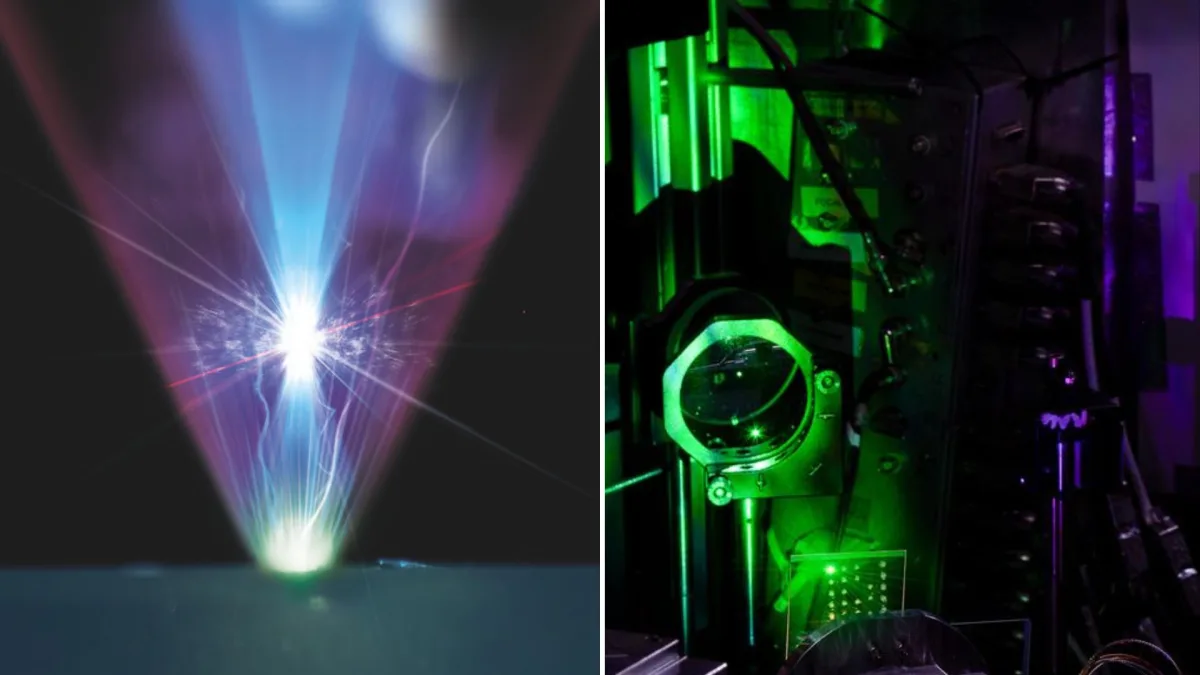
An international team of physicists has successfully generated the most high-intensity laser light ever recorded in a laboratory, fundamentally changing how scientists study the interaction between light and matter. By utilizing the Gemini laser to compress light through clouds of charged plasma, researchers from the University of Oxford, Queen’s University Belfast, and global partners have unlocked a practical pathway to explore Quantum Electrodynamics (QED). For physics researchers and quantum engineers, this breakthrough eliminates the need for messy particle beam collisions, providing a streamlined method to test the fundamental laws of the universe.
The discovery, published in the journal Nature on April 22, relies on two sophisticated techniques: Relativistic Harmonic Generation and a Coherent Harmonic Focus. The project was rooted in the doctoral work of Dr. Robin Timmis, whose research was backed by the Oxford Center for High Energy Density Science and the Oxford-Berman-Physics Scholarship.
The Mechanics of Relativistic Harmonic Generation
To achieve this unprecedented energy concentration, the research team fired intense pulses from the Gemini laser into a plasma mirror moving at relativistic speeds. Because this plasma mirror travels toward the light source, the reflected light is dramatically compressed and boosted to much higher energies. This operates on a principle similar to the Doppler effect, where waves are compressed as the source approaches the observer.
This process, known as Relativistic Harmonic Generation, effectively traps and amplifies the light waves. By utilizing clouds of charged particles to manipulate the light, the team was able to push the boundaries of what was previously considered possible in a controlled laboratory environment.
The "Quantum Magnifying Glass" Effect
Following the initial compression, the team concentrated these amplified light waves using a Coherent Harmonic Focus (CHF). Much like a traditional magnifying glass focuses sunlight to burn a piece of paper, this advanced technique concentrates multiple wavelengths of high-energy light into a single microscopic point. This acts as a quantum magnifying glass, creating an unprecedented concentration of energy.
According to Dr. Robin Timmis, the lead author from the Department of Physics at the University of Oxford, the discoveries made so far are fascinating. She noted that simulations suggest this mechanism has produced the most intense source of coherent light ever created, marking just the beginning of understanding the complex physics behind this mechanism.
Bridging a 20-Year Gap in Physics
For decades, probing the deep laws of QED required smashing particle beams into lasers. Researchers compared this outdated process to analyzing a car crash by watching footage from ten different moving cameras. This new method integrates the entire interaction within the laser system itself, allowing for direct observation without complex mathematical conversions.
Spanning 2024 and 2025, the project involved high-field physics experts from the UK’s AWE plc, the University of Michigan, and Germany’s University of Jena. Professor Brendan Dromey from Queen’s University Belfast noted that this blend of laser technology, plasma physics, and ultrafast materials science resolves a persistent mismatch between theory and experiment that has frustrated the field for over two decades.
The Shift Toward Streamlined Quantum Observation
The successful demonstration of this high-intensity laser light marks a critical pivot in experimental physics. By moving away from chaotic particle beam collisions and integrating the interaction directly into the laser system, researchers have drastically lowered the barrier to entry for extreme quantum experiments. This streamlined approach will likely accelerate discoveries in ultrafast materials science and plasma physics over the next decade.
As laboratories worldwide adopt the Coherent Harmonic Focus technique, the ability to force light to collide directly with the quantum vacuum could finally reveal the mechanics of the universe. Testing the laws of physics under conditions previously thought impossible to replicate in a lab is no longer a theoretical dream, but a practical reality.
This article was written by AI from reporting by interestingengineering.com.