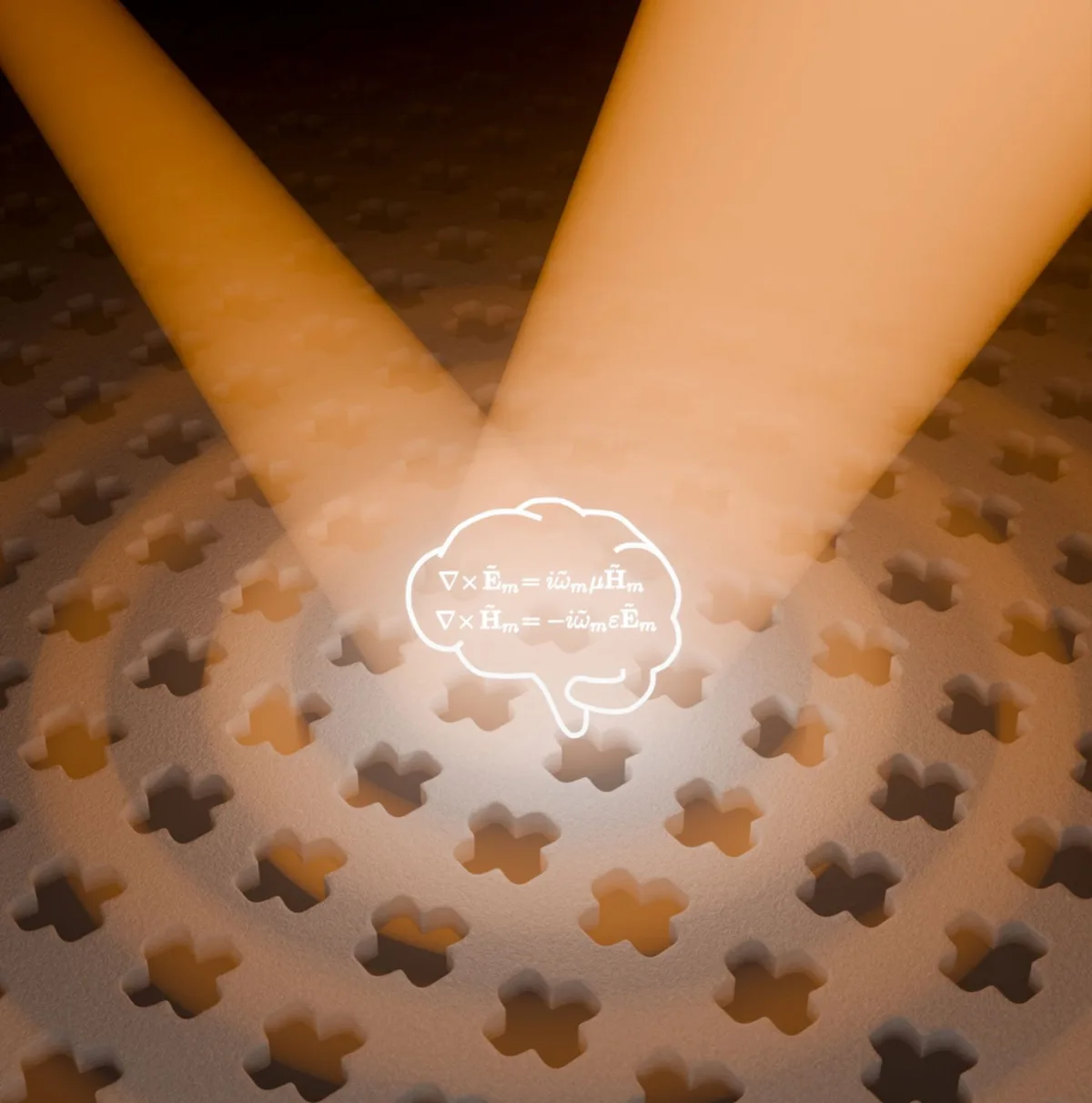
Training artificial intelligence to design advanced optical components traditionally requires massive datasets and months of computing time. Now, researchers at Chalmers University of Technology have bypassed this bottleneck by embedding the fundamental laws of physics directly into neural networks. This physics-informed AI dramatically accelerates the development of nanophotonics, paving the way for breakthroughs in quantum computing and ultra-thin lenses.
The research team focuses on nanophotonics, a field dedicated to manipulating light at scales smaller than its wavelength. Because natural materials have strict limitations, scientists are forced to simulate artificial optical materials on supercomputers. Previously, generating a single data point took anywhere from 10 minutes to an hour, requiring up to 40,000 simulations to properly train a model.
"It might take us a whole month to generate enough data to train the neural network," explained Viktor Lilja, a doctoral student at Chalmers. By integrating electromagnetic equations directly into the system, the AI no longer needs to relearn physical relationships from scratch, cutting a 30-day process down to just three days.
I know electromagnetism’s equations inside out and I teach them, but I still can’t draw all the conclusions that the neural network can. The physics is so complex that I don’t understand the properties of a material just by looking at it - but the computer does.
- Philippe Tassin, Chalmers University of Technology
Accelerating Quantum and Optical Tech
The research, published in Laser & Photonics Reviews, targets the development of mechanically compliant photonic crystals. These engineered structures reflect light with extreme efficiency, a critical requirement for transmitting information between quantum computers over long distances. Once trained, the network can evaluate any structure and output its optical properties in a single millisecond.
Beyond quantum applications, the accelerated design process will directly impact consumer technology. The ability to rapidly simulate how light interacts with nanostructures will enable the production of lighter, thinner, and significantly more effective camera and eyeglass lenses.
The Shift Away From Brute-Force AI
The Chalmers breakthrough highlights a critical pivot in scientific machine learning: moving away from brute-force data consumption toward rule-bound intelligence. By hardcoding the laws of electromagnetism into the neural network, researchers are solving the "black box" problem that plagues traditional AI models.
This approach not only slashes compute time by 90% but also prevents the AI from generating physically impossible designs. As quantum computing demands increasingly complex nanostructures to stabilize qubits and transmit data, physics-informed AI will become the mandatory standard for material science, proving that the smartest algorithms are those that already know the rules of the universe.