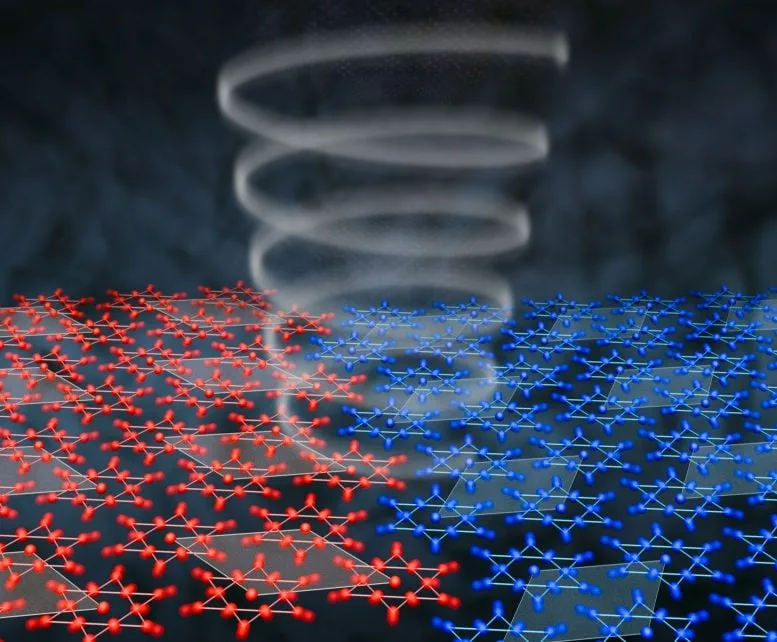
Symmetry is the invisible rulebook of the natural world, strictly dictating how atoms and electrons move and preventing certain collective vibrations from ever interacting. However, a groundbreaking study has revealed that quantum fluctuations can shatter these rigid boundaries, creating a dynamic bridge between previously isolated atomic motions. This discovery offers a revolutionary method to control ferroaxial quantum states using light, bypassing the traditional need for magnetic fields.
For condensed matter physicists and quantum computing engineers, this breakthrough unlocks a practical pathway to manipulate complex quantum materials at room temperature. By proving that ultrafast laser pulses can tune these interactions, the research provides a critical step toward developing high-speed, light-driven quantum devices that do not rely on extreme cryogenic environments.
The study, published in Nature Physics, was led by Edoardo Baldini’s group at the University of Texas at Austin and the Max Planck Institute for the Structure and Dynamics of Matter (MPSD) in Hamburg. The researchers focused on a layered material that forms an unusual quantum state at room temperature. In this state, ions and electrons reorganize into a fixed, wave-like arrangement called a charge-density wave (CDW), which visually appears as a pattern of star-of-David clusters.
These clusters can point in two different orientations, giving the crystal an internal handedness known as planar chirality. Because this ferroaxial order does not directly respond to electric or magnetic fields, it has historically been incredibly difficult to probe. However, the star-of-David clusters can move together in a collective vibration - known as an amplitudon - that periodically changes the strength of the CDW.
The amplitudon acts as a resonant bridge between vibrations of different symmetry, linking the lower energy of atomic motions with the higher energy of the electronic sector.
- Emil Viñas Boström, Theorist, MPSD
To investigate how this oscillation affects the crystal, the team utilized a highly specialized light scattering method. They tracked how crystal vibrations responded to light with well-defined helicity, meaning the polarization rotated either clockwise or counterclockwise. They discovered that some vibrations responded significantly stronger when the handedness of the light matched the handedness of the crystal.
"By looking at how vibrations respond to left- and right-circularly polarized light, we can see the handedness of the CDW and map individual ferroaxial domains," explained Xinyue Peng, a graduate student at UT Austin. By adjusting the temperature, the team aligned the energy of a regular crystal vibration with the energy of the amplitudon, which actively connected crystal vibrations that symmetry would normally keep apart, according to lead author Francesco Barantani.
To account for these unprecedented results, researchers in Angel Rubio’s group at the MPSD built a microscopic theory in collaboration with Lara Benfatto at Sapienza University of Rome. Furthermore, additional experiments conducted by Michael Rübhausen’s group at the University of Hamburg supported the strength of the model. The full findings are available via DOI: 10.1038/s41567-026-03241-3.
The Optical Leap for Quantum Materials
The most significant implication of this research is its operational environment: room temperature. Traditional quantum states often require near-absolute zero temperatures and massive, energy-intensive magnetic fields to maintain stability and allow for manipulation. By demonstrating that resonant chiral dressing works effectively at room temperature, this study moves the manipulation of quantum materials out of the highly controlled cryogenic laboratory and closer to real-world applications.
Furthermore, shifting from magnetic control to optical control opens the door to ultrafast quantum switching. Laser pulses can operate at femtosecond speeds, vastly outpacing the physical limitations of magnetic field modulation. If engineers can reliably tune these ultrafast laser pulses to specific energies to switch on interactions that symmetry normally prohibits, it could fundamentally accelerate the development of next-generation optical quantum processors and advanced sensors.
This article was written by AI from reporting by scitechdaily.com.