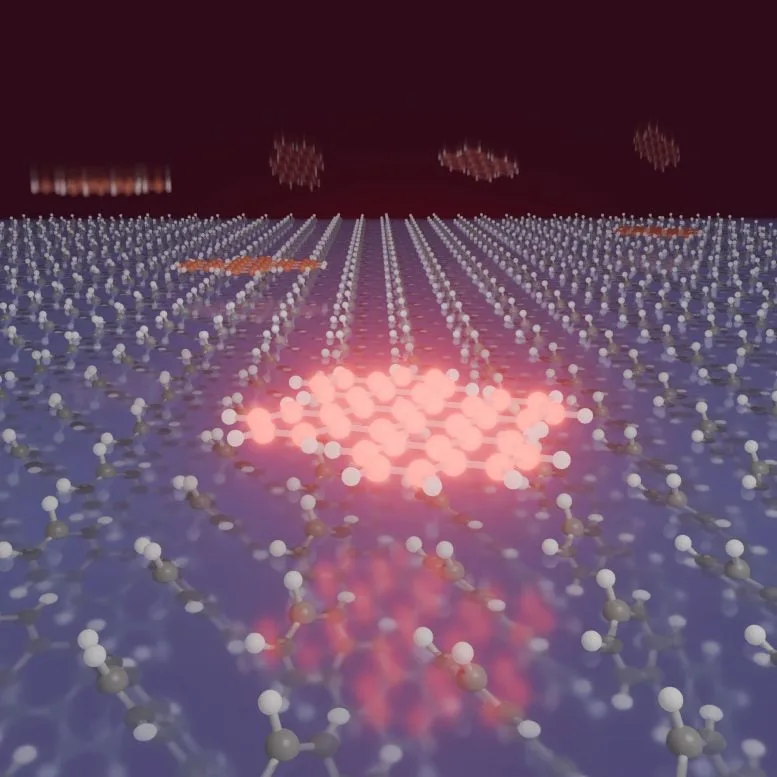
Researchers at the Max Planck Institute for the Science of Light (MPL) have successfully preserved quantum coherence on a surface at the fundamental Fourier limit, overcoming a major barrier in quantum physics. By utilizing an ultra-clean, self-cleaning organic crystal, the team maintained the delicate quantum properties of individual molecules. This breakthrough, published in the journal Science, achieves a level of stability previously thought impossible outside of a vacuum or bulk material.
Many optical quantum technologies rely on nanoscale objects that interact strongly with light. These quantum emitters are essential for generating single photons, storing quantum information, and distributing entanglement for quantum communication. Historically, studying a single emitter required trapping it in a vacuum or embedding it deep inside a bulk material to protect it from environmental noise.
While placing a molecule directly on a surface offers the advantage of direct manipulation, surface contamination typically creates a fluctuating environment that destroys the molecule's quantum properties. To solve this, the MPL Nano-Optics Division, led by Prof. Vahid Sandoghdar, engineered a highly controlled environment using a unique organic crystal.
The team utilized a specific preparation method to achieve this unprecedented stability:
- They placed a small organic crystal inside a cryostat under vacuum conditions.
- The crystal was allowed to slowly evaporate at room temperature, naturally carrying away surface contaminants with its uppermost layers.
- The environment was then rapidly cooled to a few degrees Kelvin above absolute zero, halting the sublimation process.
- Finally, researchers deposited molecules onto the freshly cleaned surface using a microfabricated oven.
The quality of quantum emitters can be evaluated by their coherence times, which indicate how long they keep their quantumness.
- Dr. Alexey Shkarin, Nano-Optics Division, MPL
By placing molecules on this pristine surface, the researchers found that the molecules consistently reached the Fourier limit. This limit represents the maximum possible coherence time, determined solely by how long an emitter takes to transfer its energy to its surroundings. Achieving this on a surface proves that the molecules experienced an exceptionally quiet environment, free from the noise that usually degrades quantum states hundreds or thousands of times faster.
Beyond simply holding the molecules in place, the surface actively influenced their behavior. The experiments revealed that the adsorbed molecules adopted specific orientations and experienced shifts in their energy levels. Prof. Sandoghdar noted that their future work will focus on combining this method with atomic force microscopy (AFM) and scanning tunneling microscopy (STM) to "gain local nanometer control over individual quantum emitters."
The Missing Link for Scalable Quantum Architecture
The ability to maintain the Fourier limit on a solid surface fundamentally changes how we approach quantum hardware design. Until now, the necessity of isolating quantum emitters in complex vacuum traps has been a significant bottleneck for scaling quantum computers and communication nodes. By proving that an ultra-clean crystal surface can provide the same level of quantum protection, the MPL team has opened a pathway to solid-state quantum devices that are far easier to probe and manipulate.
Furthermore, the integration of this technique with STM and AFM technologies could allow engineers to physically arrange individual quantum emitters into precise circuits. Instead of relying on statistical distribution within a bulk material, researchers can now theoretically build and tune quantum states of matter atom by atom on a stable surface. This level of nanometer control is exactly what the industry needs to transition from experimental quantum physics to manufacturable quantum technologies.
This article was written by AI from reporting by scitechdaily.com.