

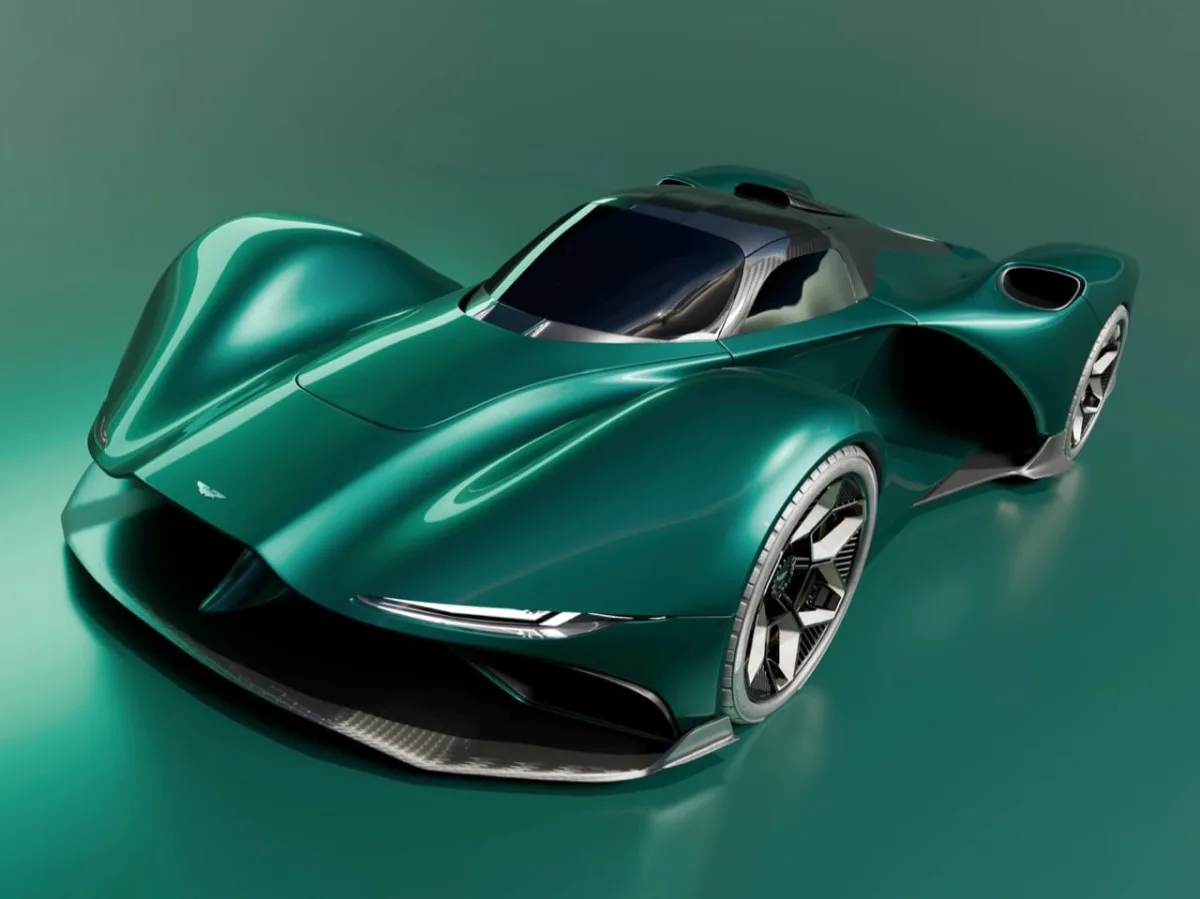
The Aston Martin Veil Concept trades the aggressive, faceted carbon fiber of the Valkyrie for surfaces that flow like liquid metal. Designed by Hyunwoo Kim, this striking hypercar exploration reimagines the future of Gaydon's track-focused lineup by prioritizing organic, continuous curves over sharp muscularity. The concept asks what happens when extreme performance intent is wrapped in a seamless, sculptural form.
Finished in a teal paint that closely matches the current Aston Martin F1 team livery, the vehicle catches light like water to emphasize its continuous form language. Kim developed the concept through an unconventional process, starting with physical paper mock-ups to explore three-dimensional shapes before moving to digital CAD modeling. This tactile approach resulted in proportions and surface relationships that feel naturally discovered rather than artificially engineered.
From above, the Veil resembles a manta ray or a fighter jet, featuring massive rear fender volumes that extend from a central spine bisecting the cockpit. The cabin architecture draws heavy inspiration from Le Mans Hypercars, utilizing a single piece of formed glass for the canopy. While this unified glass structure would present significant regulatory challenges for street legality, it perfectly suits a track-focused prototype where visibility and weight reduction are paramount.
The central spine continues past the cabin to act as a vertical stabilizer, providing high-speed stability without the drag penalty associated with a traditional fixed rear wing. Beneath the surface, the rear fender volumes function as aerodynamic channels, guiding air along the body sides and over the rear diffuser. The negative space carved between these fenders accelerates airflow underneath the car, feeding the diffuser with high-velocity air to maximize ground-effect suction.
At the front, the design is deliberately minimal, omitting a traditional grille in favor of substantial side intakes designed to cool a presumed mid-mounted hybrid powertrain. The slim, horizontal headlights emphasize the car's width, departing from the intimidating, angry-eye aesthetic common in modern hypercars. At the rear, the exhaust outlets are cleanly integrated directly into the diffuser structure, avoiding the bulky quad-pipe arrangements seen on competitors.
The Shift Toward Sculptural Aerodynamics
The Aston Martin Veil Concept perfectly illustrates a growing tension in hypercar design: the balance between heritage elegance and the brutal demands of modern aerodynamics. By relying heavily on ground-effect downforce and underbody airflow management, the Veil mirrors the engineering philosophies currently dominating Formula 1 and Le Mans prototypes. It proves that generating massive vertical load no longer requires bolting a massive, drag-inducing wing to the rear deck.
What makes Kim's design particularly compelling is its maturity. Instead of relying on nostalgic callbacks to vintage racers or leaning into aggressive, futuristic tropes, the Veil finds a sophisticated middle ground. If Aston Martin's advanced design studio is looking for a way to evolve the visual language established by the Valkyrie and Valhalla, this liquid-metal approach offers a compelling blueprint for the electrified, aero-driven future.
