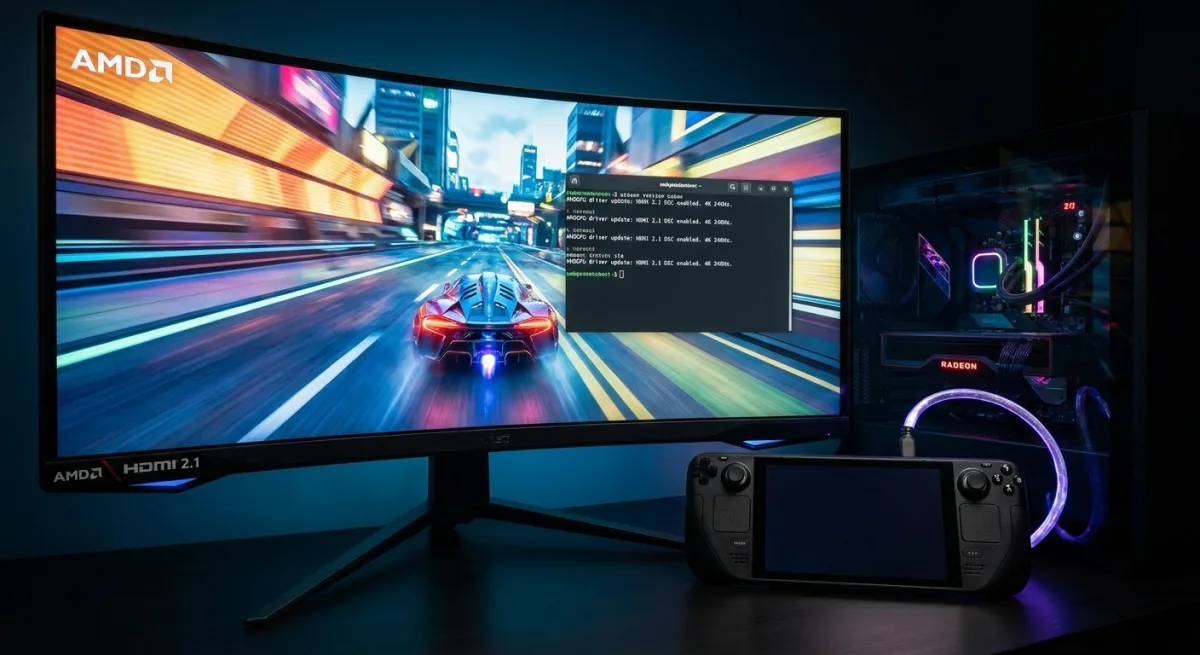
Linux gamers and open-source enthusiasts have long struggled with display limitations, but a major breakthrough is finally here. AMD has officially updated its AMDGPU kernel driver patches to support HDMI 2.1 Display Stream Compression (DSC), unlocking high-resolution, high-refresh-rate gaming on Linux. The newly updated patches build upon the Fixed Rate Link (FRL) support introduced earlier this month.
By integrating DSC, the open-source AMDGPU driver can now handle visually lossless, low-latency compression. This bandwidth efficiency is critical for driving demanding display configurations, such as 4K resolution at 240Hz or even 8K at 120Hz, directly through an HDMI 2.1 connection. For years, full HDMI 2.1 support on open-source drivers was blocked by strict legal restrictions imposed by the HDMI Forum.
The sudden release of these patches has sparked widespread speculation within the community. Many believe that Valve's heavy investment in Linux gaming and the Steam Deck ecosystem may have facilitated a legal workaround or compromise, finally allowing AMD to publish the open-source code. The latest patches for both HDMI FRL and FRL DSC were sent out today and are slated to merge with the next AMDGPU Display Core (DC) patch series.
For users eager to test these capabilities, the full HDMI 2.1 implementation is highly likely to be upstreamed into the mainline Linux kernel during the upcoming Linux 7.2 cycle. This update will ensure that Linux users no longer have to rely on DisplayPort connections to get the most out of their high-end monitors and televisions.
The Valve Effect on Open-Source Hardware
The sudden arrival of HDMI 2.1 DSC for the AMDGPU Linux driver highlights a massive shift in how proprietary standards interact with open-source ecosystems. If Valve indeed brokered this compromise with the HDMI Forum, it proves that corporate backing can shatter long-standing legal barriers in Linux development. This update is not just about hitting 4K at 240Hz; it sets a precedent that could eventually force other closed standards to accommodate open-source implementations.
As the Linux 7.2 cycle approaches, AMD users will finally achieve feature parity with Windows when connecting to modern high-end TVs and monitors. This removes one of the final hardware friction points for living room Linux gaming, directly benefiting future iterations of SteamOS and solidifying Linux as a tier-one gaming platform.