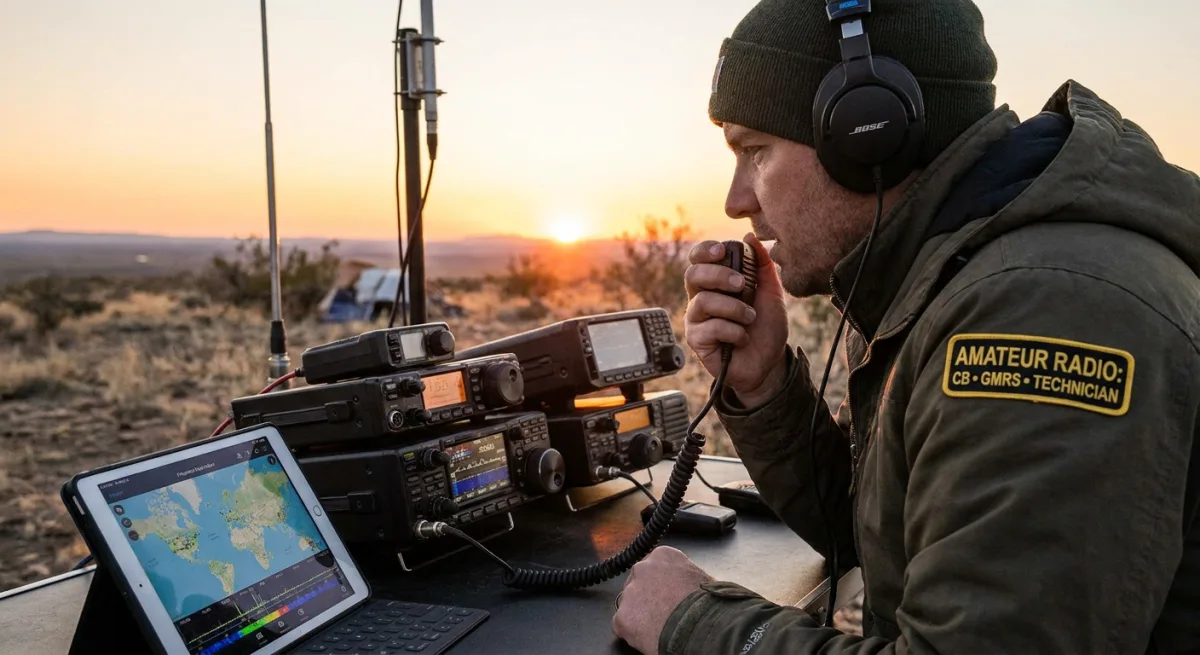
When cell towers fail and Wi-Fi networks collapse, smartphones instantly transform into useless glass bricks. Building a resilient offline communication strategy requires more than just buying a cheap walkie-talkie; it requires understanding the legal and technical frameworks of radio transmission. This amateur radio license guide breaks down the exact differences between CB, GMRS, and Technician Class operations, ensuring you have a reliable lifeline when modern infrastructure goes dark.
CB Radio: The No-License Starting Point
Citizens' Band (CB) radio remains the most accessible entry point because it requires no FCC license in the United States. Operating across 40 channels in the 27 MHz range (11 meters), modern CB units support AM, FM, and Single-Side Band (SSB) transmissions. In countries like Australia and New Zealand, UHF frequencies are also utilized alongside the 11-meter band.
While CB is an excellent tool for short-range, line-of-sight communication - popular among off-roaders, farmers, and truckers - its limited power output makes it unreliable for long-distance emergency scenarios. It is a safe way to experiment without causing interference on emergency channels, but it serves only as a basic introduction to the radio spectrum.
GMRS: The Practical Middle Ground
For users seeking better local communication without the hurdle of a technical exam, the General Mobile Radio Service (GMRS) offers a highly practical upgrade. GMRS requires an FCC license, but applicants only need to pay a fee rather than pass a test, making it an ideal choice for family or group coordination.
Operating over the 462 and 467 MHz bands, GMRS allows handheld units to transmit at 5 watts. More importantly, it grants access to elevated repeaters capable of 50-watt transmissions. These repeaters sit in high positions to catch and rebroadcast signals, drastically expanding the effective communication radius far beyond what a basic CB radio can achieve.
How to Secure Your Technician Class License
The entry-level Technician Class license unlocks the true potential of offline communication, granting access to specific amateur bands and advanced technologies like the Automated Packet Reporting System (APRS).
- Pass the FCC exam: Complete the 35-question test covering basic rules, operating practices, radio theory, and antenna safety. This ensures you understand how to operate legally without interfering with military, aircraft, or emergency service frequencies.
- Master VHF and UHF bands: Focus your initial operations on frequencies above 30 MHz. This enables reliable local communication around towns and buildings using handhelds, while VHF refracts around terrain for extended reach.
- Configure APRS for offline data: Tune your equipment to the 2-meter band (144.390 MHz) to send small data packets. This allows your radio to transmit offline GPS positions, short text messages, and weather station data without relying on the internet.
Understanding Amateur Radio Power Limits
Once licensed, operators gain access to significantly higher transmission power limits compared to standard consumer radios. According to the ARRL, Technician Class operators can utilize:
- 200 watts PEP on allowed HF bands, which provides enough power to bounce signals across the globe.
- 1,500 watts PEP on VHF and UHF bands (above 30 MHz), subject to specific geographical exceptions.
- 50 watts PEP with a 100 kHz bandwidth on the 219 - 220 MHz frequencies.
The Hardware Trap Most Beginners Fall Into
The biggest mistake newcomers make when preparing for grid-down scenarios is stockpiling expensive radio hardware before understanding the legal and technical boundaries of the spectrum. Buying a high-powered handheld radio without a Technician license is like buying a sports car without knowing how to drive; you are legally restricted from using its most critical features, such as repeater access and APRS data transmission.
While GMRS is an excellent, exam-free middle ground for family coordination, it fundamentally lacks the robust, community-driven infrastructure of amateur radio. By investing the time to pass the 35-question Technician exam first, operators unlock a communication skill set that completely bypasses the fragile chain of subscription-based apps, commercial routers, and vulnerable cell towers. In an era where digital connectivity is increasingly precarious, the true value lies in the license, not just the hardware.
This article was written by AI from reporting by makeuseof.com.