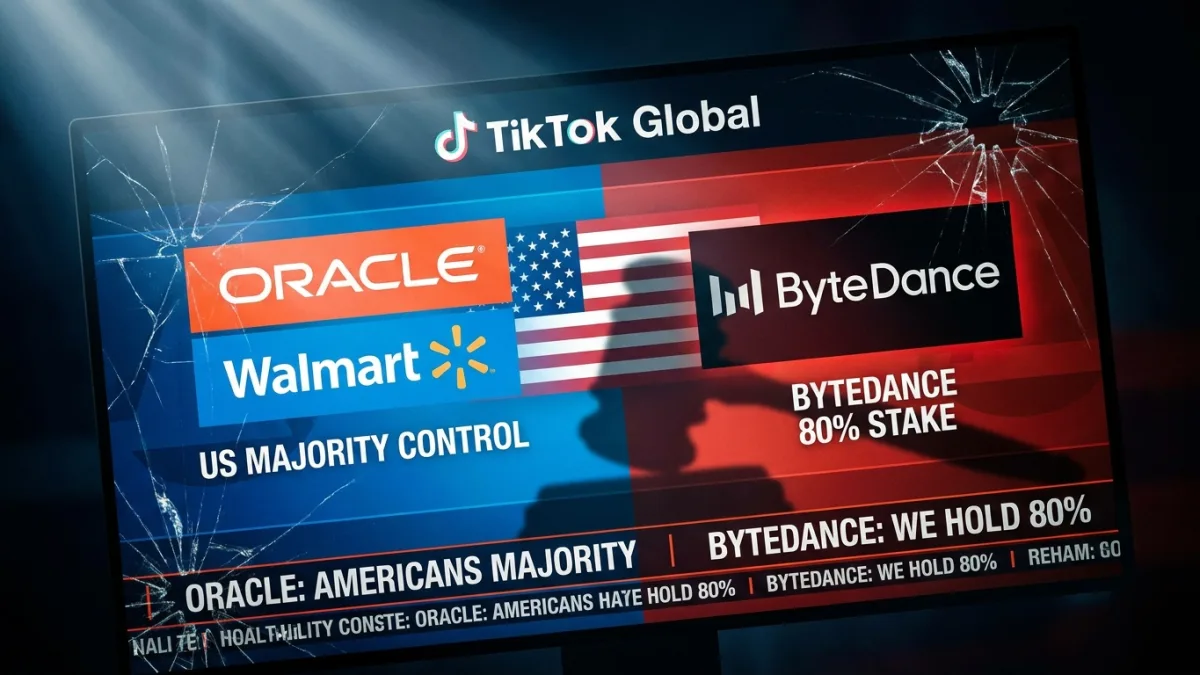
The highly contested TikTok Oracle deal has descended into a chaotic ownership dispute, with ByteDance and US investors releasing directly contradictory statements about who will actually control the platform. As the threat of a US app store ban looms, the agreement has exposed the fragile intersection of tech business and geopolitical posturing. President Donald Trump extended the initial ban deadline to September 27, supporting a bid where Oracle and Walmart would acquire a combined 20 percent stake in the newly formed TikTok Global.
As part of the brokered agreement, the involved companies reportedly agreed to contribute $5 billion toward a "patriotic education" fund. However, the core structure of the remaining 80 percent stake remains fiercely contested, threatening to derail the entire pact. A spokesperson for ByteDance asserted that the Beijing-based company would directly hold an 80 percent share of the new entity before an expected initial public offering.
Upon creation of TikTok Global, Oracle/Walmart will make their investment and the TikTok Global shares will be distributed to their owners, Americans will be the majority and ByteDance will have no ownership in TikTok Global.
- Ken Glueck, Executive Vice President, Oracle
This fundamental disagreement over basic terms highlights the fluid and unstable nature of the negotiations. Trump has publicly insisted that Oracle and Walmart must have "total control" over the platform, warning that he will block the deal otherwise. Despite the confusion, Trump previously claimed the app would have nothing to do with China, it'll be totally secure,
signaling that the administration may prioritize the appearance of a political victory over the actual structural details.
Algorithmic Bias and Moderation Struggles
Beyond the TikTok negotiations, major social platforms are grappling with severe algorithmic and moderation failures. Twitter is currently investigating claims of racial bias within its photo preview algorithm. Multiple users demonstrated that when an image features both a Black person and a white person, the automated preview disproportionately crops the image to display the white face.
Meanwhile, Facebook is struggling to enforce its new policies against extremist content, specifically targeting the QAnon conspiracy theory. Groups have successfully evaded detection by subtly altering their names, changing "Q" to "Cue" or using the number "17" to represent the 17th letter of the alphabet. Other communities have disguised their content within seemingly harmless yoga or parenting groups. In response to the growing threat, Twitter expanded its restrictions, banning over 7,000 QAnon-linked accounts and applying new limits to political candidates who promote the conspiracy.
On the video front, YouTube has actively tweaked its recommendation algorithm to prevent misinformation from going viral, successfully reducing the promotion of false narratives. Conversely, TikTok has opted for a quieter approach to political content moderation. Instead of applying fact-checking labels like its competitors, the company is simply removing large volumes of political content behind the scenes.
Global Tech Policy and Antitrust
The US government's aggressive tech policies faced a significant legal hurdle when a California judge blocked the administration's ban on WeChat downloads. The ruling prevents the Commerce Department from forcing Apple and Google to remove the Chinese messaging app from their stores. Leading up to the attempted ban, WeChat downloads surged, pushing it to the 100th most-downloaded app in the US, a massive jump from its typical rank between 1,000th and 1,500th.
In Europe, regulatory pressure is mounting against American tech giants. The European Union is considering new legislation that would force Apple to grant competitors access to the near-field communication (NFC) technology embedded in iPhones and smartwatches, breaking Apple's grip on mobile payments. Simultaneously, Facebook is threatening to pull its services out of Europe entirely if regulators enforce a preliminary order halting the transfer of European user data to US-based servers.
Back in the US, the agencies tasked with regulating these massive corporations are severely underfunded. The antitrust divisions of the Federal Trade Commission (FTC) and the Department of Justice (DOJ) operate on a combined annual budget that is less than what Facebook generates in just three days of revenue. This financial disparity severely limits their ability to effectively police the tech industry.
Other Notable Updates
- Voter Registration: Facebook has helped 2.5 million people register to vote across its platforms, aiming for a total goal of 4 million ahead of the US elections.
- Small Business Virality: TikTok is driving massive views for niche businesses, such as Erika Thompson of Texas Beeworks, who gained viral fame by showcasing the intricacies of bee removal.
- Political Disinformation: A network of 94 Facebook Pages with 800,000 followers spread pro-government messages for Guinean President Alpha Condé, yet Facebook ruled it did not meet the threshold for coordinated inauthentic behavior.
- Ad Tracking Scrutiny: Google's decision to block online advertising trackers for privacy reasons is facing DOJ antitrust scrutiny, as publishers argue it unfairly benefits Google's own ad business.
- Encrypted App Hacks: Iranian state-linked hackers are deploying surveillance tools capable of bypassing encrypted messaging platforms like Telegram to spy on dissidents.
- Contact Tracing Failures: France is attempting to revive its failed COVID-19 contact tracing app, which struggled heavily after the government rejected the standardized API built by Apple and Google.
- Rights Management: Facebook is updating its rights management platform, allowing partners to claim ownership of images and control where they appear across Facebook and Instagram.
- Corporate Expansion: Facebook is officially opening a new office in Lagos, Nigeria, housing engineering, sales, and policy teams.
- AI Disinformation Risks: Advanced AI text generators like GPT-3 are raising alarms among researchers, who warn the technology could create an infinite supply of credible-sounding disinformation.
- Section 230 Reform: Both Donald Trump and Joe Biden have publicly stated they want to change Section 230, though they differ significantly on the proposed solutions.
The Splinternet Becomes Official Policy
The mechanics of the TikTok Oracle deal reveal that the primary objective was never strict data security, but rather the projection of executive power and the rewarding of corporate loyalists. By forcing a structural change within ByteDance under the threat of an outright ban, the US administration has inadvertently validated the concept of a nationalist internet. Chinese state media is already framing this nationalist splintering as a new global model for digital regulation.
If a government can force the sale of a foreign app's operations based on opaque national security claims, it sets a dangerous precedent that other nations will inevitably use against American tech giants operating abroad. Furthermore, Trump's explicit praise for Oracle founder Larry Ellison and Walmart CEO Doug McMillon - both high-profile loyalists - demonstrates how regulatory threats can be weaponized to broker lucrative deals for favored legacy businesses.
Ultimately, the conflicting 80 percent ownership claims prove that the technical realities of the deal are secondary to the political narrative. Whether ByteDance retains control or Oracle takes over, the lasting legacy of this standoff is the normalization of state-mandated corporate restructuring. The era of a unified, global internet is rapidly closing, replaced by a fractured landscape where app availability is dictated by geopolitical leverage rather than consumer choice.
This article was written by AI from reporting by theverge.com.