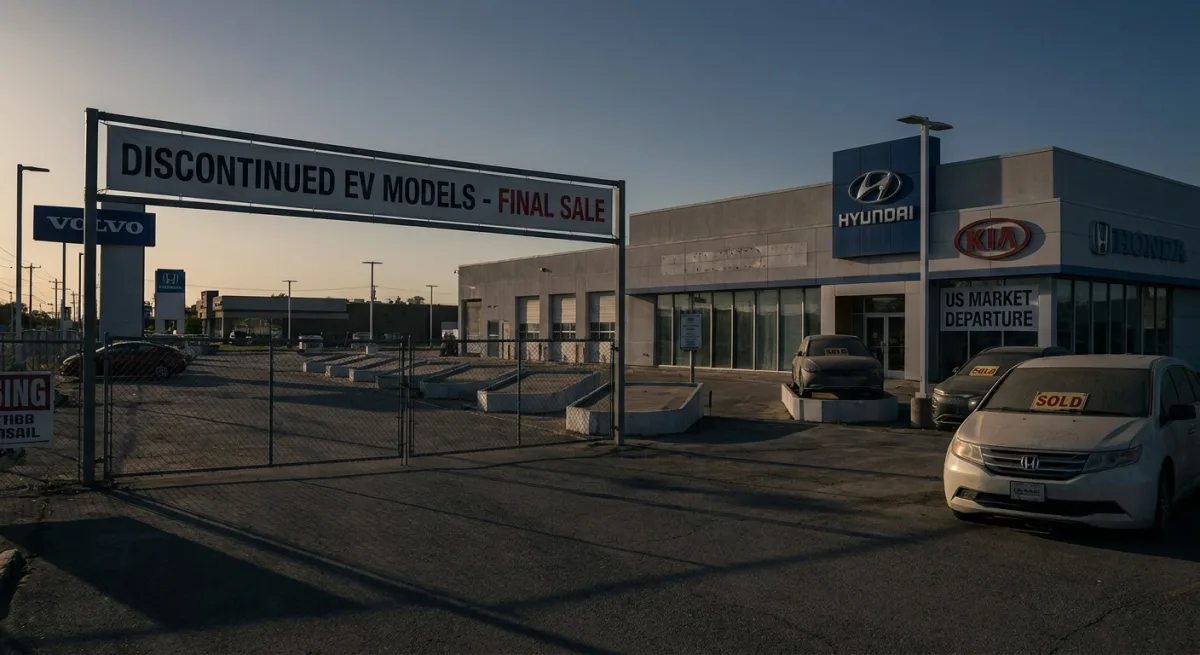
The wave of discontinued EV models hitting the US market in 2026 is drastically reducing consumer choice and driving up prices. For buyers looking to transition to electric vehicles, the sudden disappearance of at least a dozen prominent cars means navigating a market reshaped entirely by aggressive trade policies rather than technological shortcomings.
Automakers including Tesla, Honda, Volvo, BMW, Hyundai, and Kia are systematically pulling vehicles from American dealerships. This mass exodus is driven by the compounding financial pressure of a 25 percent import tariff, a staggering 100 percent tariff on Chinese-made EVs, and the expiration of the $7,500 federal tax credit. These combined factors have rendered imported electric vehicles economically unviable, forcing manufacturers to either localize production immediately or abandon the market altogether.
The Tariff Casualties: Volvo, Hyundai, and Kia
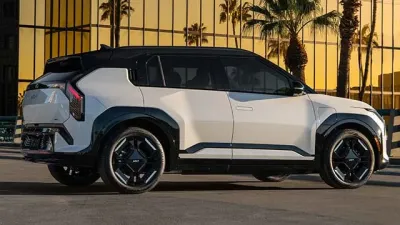
The most immediate victims of the new trade regime are vehicles manufactured overseas that previously relied on competitive pricing. The Volvo EX30 serves as the starkest example of how tariff stacks can dismantle a product strategy. Originally positioned as a breakthrough affordable EV priced under $35,000, the vehicle faced a 100 percent tariff due to its Chinese manufacturing origins.
In response, Volvo shifted production to its Ghent facility in Belgium, only to be hit by the Trump administration's blanket 25 percent tariff on all imported vehicles. Consequently, the US price of the EX30 surged to $40,345. After selling just 5,409 units in 2025, Volvo confirmed the model will not return to the US for the 2026 model year, despite remaining available in Canada, Mexico, and global markets.
South Korean manufacturers are facing identical hurdles. Hyundai has officially paused the Kona Electric for the 2026 model year, as the 25 percent import tariff erased the margins on the $33,000 vehicle. The Hyundai Ioniq 6 has been entirely dropped from the US lineup, though the high-performance Ioniq 6 N variant may still see a limited release. Similarly, Kia has discontinued the Niro EV, imported from its Hwaseong plant, and indefinitely delayed the GT trims of both the EV6 and EV9 due to deteriorating market conditions.
Strategic Retreats: Honda's $15.7 Billion Pivot and Tesla's Robot Shift
Beyond tariffs, some automakers are executing massive strategic pivots. Honda's cancellation of its highly anticipated 0 Series represents the most expensive retreat in the current cycle. The Japanese automaker scrapped the Honda 0 Saloon, the Honda 0 SUV, and the Acura RSX - all previously slated for production at the company's EV hub in Marysville, Ohio.
This abrupt cancellation triggered up to $15.7 billion in associated losses, marking Honda's first annual loss since listing on the Tokyo Stock Exchange in 1957. The company is now aggressively pivoting toward hybrid vehicles, which recently set an all-time sales record of 30,671 units in February. Currently, Honda's only surviving EV in the US is the Prologue, manufactured in Mexico through a joint venture with General Motors.
Tesla is also trimming its lineup, though for entirely different strategic reasons. The company has officially retired the Model S and Model X, its oldest and most expensive vehicles, which accounted for less than 3 percent of total deliveries in 2025. CEO Elon Musk announced the retirement as an "honourable discharge," confirming that the Fremont production lines will be retooled to manufacture Optimus humanoid robots, targeting a production volume of one million units annually. With the Model S previously starting at $94,990 and the Model X at $99,990, Tesla is abandoning a shrinking luxury sedan segment in favor of high-margin autonomous robotics.
Platform Transitions: BMW's Planned Obsolescence
Unlike the abrupt cancellations seen elsewhere, BMW is executing a calculated phase-out of its current generation to make way for advanced architectures. The German automaker is discontinuing the i4 sedan and the iX SUV in the US market. The i4, known for reaching 60 mph in 3.7 seconds and delivering 333 miles of range, will cease production by late 2026.
These models are being replaced by next-generation vehicles built on the Neue Klasse platform. The upcoming i3 sedan, entering production at the Munich plant in August, promises up to 440 miles of range. Meanwhile, the iX is being succeeded by the iX3, which integrates BMW's Gen6 eDrive technology for faster charging and superior range. While the iX will continue to be sold in Europe, American buyers face a temporary gap in availability as the selection of premium EVs shrinks during this transition period.
Summary of Discontinued US EV Models in 2026
| Manufacturer | Discontinued/Paused Models | Primary Reason for Exit |
|---|---|---|
| Volvo | EX30 | 100% Chinese tariff, 25% import tariff |
| Hyundai | Kona Electric, Ioniq 6 | 25% import tariff, margin loss |
| Kia | Niro EV, EV6 GT, EV9 GT | Tariffs and slowing EV demand |
| Honda | 0 Saloon, 0 SUV, Acura RSX | Strategic pivot to hybrids ($15.7B loss) |
| Tesla | Model S, Model X | Low sales volume, pivot to Optimus robots |
| BMW | i4, iX | Transition to Neue Klasse platform |
The Shift Toward Domestic Production
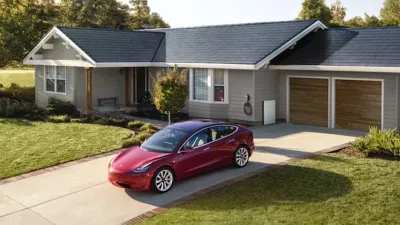
The compounding effect of these 2026 trade policies is fundamentally rewriting the rules of the American automotive sector. By stacking a 25 percent general import tariff alongside a 100 percent tariff on Chinese-made EVs and removing the $7,500 federal tax credit, regulators have created an environment where only domestically manufactured electric vehicles can survive. Models built within the US, such as the Hyundai Ioniq 5 from Georgia, Kia's standard EV6 and EV9 from West Point, and Tesla's Model 3, Model Y, and Cybertruck, remain viable and on sale.
This aggressive protectionism is achieving its explicit goal of forcing automakers to localize their supply chains, but it comes at a severe short-term cost to the consumer. Buyers are now facing a smaller, more expensive, and less diverse market just as global EV technology reaches new heights of efficiency and affordability. Until manufacturers can fully scale their US-based facilities, American drivers will bear the financial brunt of this geopolitical transition, effectively being locked out of the affordable EV revolution currently sweeping the rest of the world.