Investing in the best home EV chargers is the single most important decision you will make after purchasing an electric vehicle. Relying on public DC fast-charging stations is not only inconvenient but costs roughly three times as much as charging in your own garage. For new EV owners, upgrading to a dedicated Level 2 charging station eliminates range anxiety and ensures your battery is full every morning.
This guide is specifically designed for electric vehicle owners and prospective buyers who need to navigate the complex landscape of home charging equipment. By understanding your home's electrical capacity and choosing the right unit, you can drastically reduce your daily running costs and take advantage of smart grid features. We tested these units extensively using a diverse fleet, including a Tesla Model 3, Rivian R1T, BMW i4, Hyundai Ioniq 5, Kia EV9, and Lucid Air Pure.
The EV charging market is undergoing a massive transition in 2026, with automakers shifting toward Tesla's North American Charging Standard (NACS) and the impending expiration of the Inflation Reduction Act's tax credits. Choosing a future-proof charger now ensures compatibility with next-generation vehicles while maximizing financial incentives. Below is a breakdown of the top performers based on months of rigorous real-world testing.
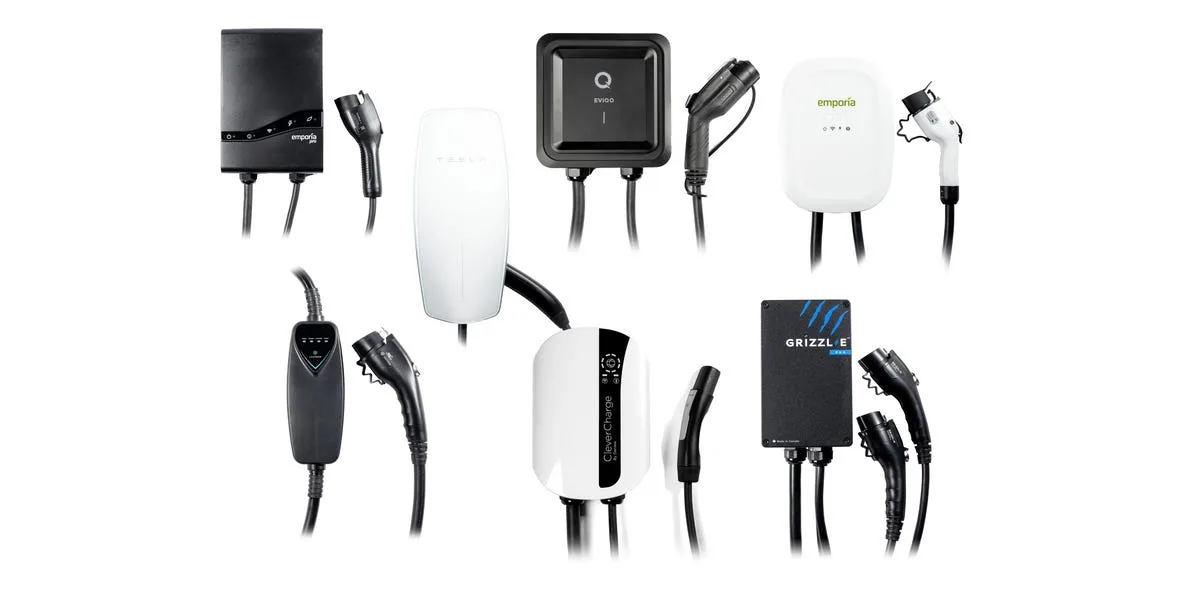
Top Home EV Chargers Comparison
| Charger Model | Best For | Key Feature |
|---|---|---|
| Emporia Pro | Overall Value & Safety | Built-in load balancing |
| Lectron Portable | Budget Buyers | Portability and Wi-Fi |
| Grizzl-E Duo | Two-EV Households | Seamless power sharing |
| Tesla Universal | Mixed Garages | Integrated NACS/J1772 adapter |
| Danlaw CleverCharge | Data Enthusiasts | OBD-II vehicle tracking |
Emporia Pro and Classic: The Best Overall Performers
Many EV owners face a frustrating hurdle: their home's electrical panel lacks the capacity to support a high-output charger, necessitating a costly service upgrade. The Emporia Pro solves this elegantly by including the company's Vue 3 energy monitor. This device installs directly into your electrical panel, allowing the system to adjust the EV-charging output in real time to ensure it never exceeds what your house can safely handle.
While this load-balancing feature makes the initial installation slightly more involved, it saves thousands of dollars in potential panel upgrades. The new Emporia Pro features a much slimmer profile and a thinner cable that is significantly easier to maneuver than the company's previous Level 2 charger. That older model, now rebranded as the Emporia Classic, is still sold alongside the Pro for those who do not need dynamic load management.
For budget-conscious buyers, you can purchase the Vue 3 home energy monitor for $100 and pair it with the Emporia Classic for a combined price of $529, achieving the exact same load-balancing capability. Both units deliver a robust 11.5-kilowatt output and pair with Emporia's highly capable app. The app integrates with the Smartcar API and tracks detailed electricity pricing, though its interface can feel cluttered if you aren't using Emporia's other smart home products.
Danlaw CleverCharge: Unmatched Vehicle Tracking
The Danlaw CleverCharge stands out by offering a level of intelligence rarely seen in typical Wi-Fi-connected smart chargers. It utilizes a dedicated dongle that plugs directly into your vehicle's OBD-II port under the dashboard. This dongle communicates with the charging unit to initiate sessions securely, preventing unauthorized users from drawing power.
Because it reads direct telemetry, the CleverCharge tracks energy consumption on every drive to generate highly accurate real-world range estimates. It even sends push notifications suggesting when you should plug in based on your predicted driving behavior for the next day. For many EVs and plug-in hybrids, the app displays a self-reported battery health rating out of 100 percent, and can even alert you to specific error codes if your check-engine light illuminates.
The unit features a thin 25-foot cord that easily snakes under a closed garage door, making driveway charging hassle-free. However, there is a significant catch: vehicles that lack a standard OBD-II port or compatible communication protocol - specifically Tesla, Rivian, and Lucid models - cannot utilize any of these advanced tracking features. Despite this limitation, it remains priced at the lower end of the market.
Eviqo Level 2: Affordable but Flawed App Experience
The Eviqo Level 2 charger is a frequent top seller, checking all the essential boxes with a 25-foot cord, programmable charge times, and energy tracking. Its standout physical feature is a NEMA 14-50 plug attached to an unusually long cable, providing excellent mounting flexibility in garages with awkwardly placed outlets.
Unfortunately, the software experience holds it back. Setting up overnight charging to capitalize on off-peak electricity rates is unnecessarily complex, requiring users to program two separate rules to bridge the midnight hour. Furthermore, the app's main screen features a prominent current-output slider that is far too easy to bump accidentally, and historical charging data is limited to broad weekly or monthly totals rather than individual sessions.
Customer service also proved to be a pain point during testing. When a unit arrived missing its wall-mount bracket, resolving the issue required weeks of delayed email exchanges. It ultimately took over six weeks to receive the simple replacement part, highlighting potential post-purchase support issues.
Lectron Portable Level 2: The Budget Champion
Lectron has built a strong reputation as an affordable supplier of EV charging equipment and adapters, frequently serving as the go-to brand for NACS to SAE adapters. The Lectron Portable Level 2 resembles the basic portable units often included with new vehicle purchases, but it packs essential smart features.
This unit includes Wi-Fi connectivity, allowing users to control charge times and monitor energy consumption via a dedicated app. While it comes with a wall mount for semi-permanent installation, buyers will need to supply their own hook for cord management. The app lacks the historical depth of premium competitors - restricting individual charge lookbacks to just one month - but at its highly aggressive price point, it delivers perfectly capable home charging.
ChargePoint Home Flex: Premium App Integration
As one of the largest public charging networks, ChargePoint brings its software expertise directly to your garage. The ChargePoint Home Flex integrates seamlessly into the same mobile app used for the company's public stations, creating a unified ecosystem for the user. By adding your specific vehicle model to the app, it accurately tailors the battery percentage replenished and the number of EPA miles added.
The app excels in cost tracking, allowing users to select from dozens of local utility rate plans to calculate charging costs down to the penny, even on complex variable-rate schedules. The hardware is equally refined, featuring a built-in notch at the top of the unit for wrapping the cord and a central dock where the plug securely latches.
However, this premium experience comes at a high cost. The Home Flex is one of the most expensive units tested, and it carries a slightly lower outdoor rating than some rugged competitors. Additionally, accessing its lower output settings requires a hardwired installation rather than a simple plug-in setup.
Tesla Universal Wall Connector: Future-Proofing Your Garage
The Tesla Universal Wall Connector is arguably the most strategic purchase on the market today. It features a brilliantly engineered built-in adapter that switches seamlessly between standard J1772 and Tesla's NACS plug types. The adapter is electronically locked into place, ensuring it cannot be misplaced or stolen, making it the ultimate solution for households with mixed EV brands.
Delivering a peak output of 11.5 kilowatts, this hardwire-only unit supports power sharing with other Wall Connectors on the same circuit. It integrates flawlessly into the standard Tesla mobile app for energy monitoring, which is essential for tracking efficiency. During testing with third-party software like TeslaFi, we noted average charging losses of roughly 5 to 8 percent, which is standard across the industry.
Installation requires commissioning via the separate Tesla One app, where users configure the maximum circuit output. While you can restrict charging access to specific Tesla vehicles, this security feature does not extend to non-Tesla models. Despite its thicker profile to accommodate the adapter, the 24-foot cable remains impressively slim and easy to maneuver.
Grizzl-E Duo and Lectron Socket Splitter: Solutions for Two EVs
Transitioning to a multi-EV household usually requires expensive electrical upgrades, but the Grizzl-E Duo offers a brilliant workaround. Housed in a beefy aluminum enclosure, it plugs into a single NEMA 6-50 or 14-50 outlet and features two 24-foot cables. When one car is plugged in, it receives maximum power; when a second car is connected, the unit instantly splits the output 50-50.
While the Grizzl-E Duo lacks Wi-Fi connectivity and features thick, heavy cables that resist winding, it is the most cost-effective dual-plug charger available. An alternative approach is the Lectron Socket Splitter, which acts like a high-voltage power strip. It prioritizes the left outlet and automatically switches to the right outlet only after the first vehicle finishes charging.
However, the Lectron Splitter cannot charge two vehicles simultaneously, is not outdoor-rated, and exhibited build quality issues during testing, with one socket becoming loose after minimal use. For true dual-charging, the Grizzl-E Duo remains the superior hardware solution.
Actionable Steps: How to Choose and Install Your EV Charger
Setting up your home charging infrastructure requires careful planning. Follow these critical steps to ensure a safe and cost-effective installation:
- Understand Charging Levels: Level 1 uses a standard 120-volt household outlet, outputting roughly 1 kilowatt, which takes days to charge a modern EV. Level 2 uses 240-volt electricity, delivering between 6 and 19 kilowatts, easily charging a 60.0-kWh battery overnight. Level 3 (DC Fast-Charger) is strictly for public commercial use.
- Check Your Electrical Panel: Inspect your main breaker box to verify your home's total amperage rating (typically 150-amp or 200-amp service). You must consult a certified electrician to determine if you have the capacity to add a dedicated 40-amp or 50-amp circuit for the charger.
- Select the Right Connector: Identify whether your vehicle uses the traditional J1772 standard or the newer NACS (J3400) standard. If you plan to switch brands in the future, invest in a unit with an integrated adapter.
- Claim Tax Breaks: The Inflation Reduction Act provides a federal tax credit covering 30 percent of your total hardware and installation costs, capped at $1,000. You must complete your installation before this incentive expires on June 30, 2026.
The Inevitable Shift to Smart Load Management and NACS
The home EV charging landscape is rapidly evolving from simple power delivery to intelligent grid management. As more households adopt multiple electric vehicles, the sheer electrical draw threatens to overwhelm standard residential panels. Upgrading a home's electrical service can cost upwards of $3,000, making dynamic load-balancing technology - like that seen in the Emporia Pro - not just a luxury, but a critical necessity for mass EV adoption.
Furthermore, the industry's aggressive pivot toward Tesla's NACS standard is rendering older J1772-only units obsolete. Buying a charger without native NACS support or an integrated, lockable adapter is a short-sighted investment in 2026. The Tesla Universal Wall Connector perfectly encapsulates where the market is heading: hardware that seamlessly bridges the gap between legacy vehicles and the unified charging future, all while integrating deeply into a polished software ecosystem.