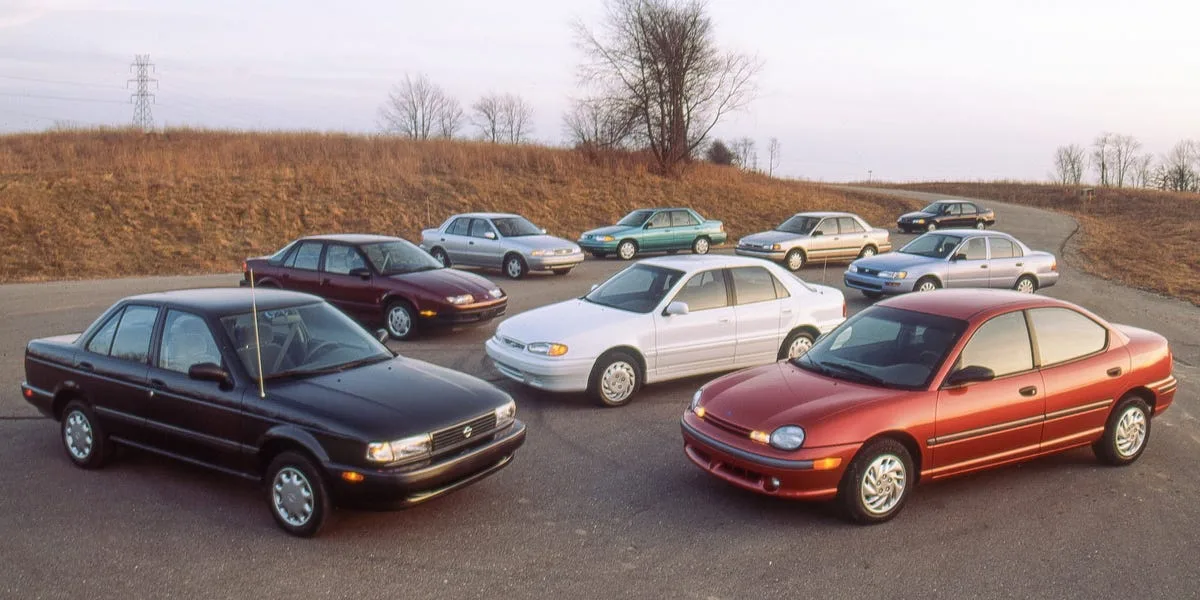
In 1994, a budget of $13,500 was enough to secure a brand-new compact sedan, though it often meant sacrificing modern necessities like anti-lock brakes, airbags, or even a factory radio. A recently unearthed archive comparison test pits nine of the era's most popular entry-level four-doors against each other, revealing a landscape where raw driving dynamics and lightweight chassis design often outweighed feature lists. The lineup includes the Dodge Neon, Ford Escort, Honda Civic, Hyundai Elantra, Kia Sephia, Mazda Protegé, Nissan Sentra, Saturn SL1, and Toyota Corolla.
The rules for this retro shootout were strict: each car had to cost less than $13,500, feature four doors, front-wheel drive, and room for four adults. While air conditioning and a sound system were strongly recommended, not every manufacturer managed to fit them under the price cap. The resulting test highlights a fascinating era of automotive engineering, where a 2,400-pound curb weight was standard and manual transmissions were the default choice for budget-conscious buyers.
1994 Compact Sedan Performance Metrics
To understand how these nine vehicles stack up, it is essential to look at the raw numbers. The performance gap between the fastest and slowest cars in this segment was remarkably wide, dictated entirely by engine displacement and tuning.
| Vehicle Model | Price As Tested | Horsepower | 0-60 mph (sec) | Curb Weight (lb) |
|---|---|---|---|---|
| Dodge Neon Sport | $13,466 | 132 hp | 7.9 | 2,492 |
| Honda Civic DX | $13,210 | 102 hp | 8.7 | 2,332 |
| Mazda Protegé DX | $13,455 | 103 hp | 8.9 | 2,402 |
| Nissan Sentra XE | $13,129 | 110 hp | 9.2 | 2,480 |
| Toyota Corolla DX | $13,498 | 105 hp | 9.3 | 2,376 |
| Hyundai Elantra GLS | $12,965 | 124 hp | 10.0 | 2,656 |
| Ford Escort LX | $11,580 | 88 hp | 10.1 | 2,442 |
| Kia Sephia GS | $12,065 | 88 hp | 10.2 | 2,420 |
| Saturn SL1 | $13,455 | 85 hp | 10.5 | 2,366 |
The Champion: Dodge Neon Sport
Taking the top spot in this highly competitive group is the Dodge Neon Sport. Chrysler's entry-level sedan dominated the performance metrics, largely thanks to its class-leading 2.0-liter four-cylinder engine producing 132 horsepower. It sprinted from 0 to 60 mph in just 7.9 seconds, leaving the rest of the pack in the dust. The Neon also boasted a top speed of 118 mph and pulled 0.80 g on the skidpad.
However, the Neon's victory did not come without compromises. The engine was notoriously loud, featuring a tractor-like idle and a secondary whine above 3,000 rpm. Despite the noise and an interior filled with sharp plastic edges, the Neon won over testers with its tossable chassis, excellent five-speed manual gearbox, and standard dual airbags packaged neatly into a compact steering wheel hub.
The Runner-Up: Nissan Sentra XE
Securing second place is the Nissan Sentra XE, a car that prioritized driving joy over passenger comfort. Powered by a smooth 1.6-liter engine producing 110 horsepower, the Sentra featured a 7,000 rpm redline and a jewel-like five-speed transmission. It managed a 0-60 mph time of 9.2 seconds and offered near-perfect steering feel on its short 95.7-inch wheelbase.
The Sentra's fatal flaw was its interior packaging. The rear seats were severely cramped, making it unsuitable for taller passengers. Furthermore, it lacked airbags entirely. Yet, for drivers who valued an eager, high-revving engine and sharp cornering capabilities, the Sentra was the most engaging car in the test.
The Sophisticate: Honda Civic DX
The Honda Civic DX claimed third place by offering a level of refinement that felt a class above its competitors. Priced at $13,210, the Civic featured a highly sophisticated front control-arm and rear multilink suspension system, delivering a limousine-like ride quality that absorbed bumps effortlessly.
There is none of the bobbing and jittering of lesser cars here. The Honda just hangs from its four corners, perfectly damped.
- Winfield, Car and Driver
Under the hood, the 1.5-liter engine produced 102 horsepower. While it lacked low-end torque, it shined at higher RPMs, pushing the Civic to 60 mph in 8.7 seconds. The interior was praised for its elegant, uptown styling, though the DX trim was notably sparse, lacking a radio, tachometer, and clock.
The Mid-Pack Contenders: Mazda, Ford, and Toyota
The middle of the pack highlights the diverse strategies automakers used to hit the $13,500 price point. The Mazda Protegé DX (4th place) offered a frisky 103-horsepower engine and agile handling, but suffered from the longest braking distance in the test (225 feet from 70 mph) and a lack of airbags. The Ford Escort LX (5th place) provided a supple ride and a spacious, cheerful interior for just $11,580, but its 88-horsepower engine was rough, and its soft suspension led to wobbly handling.
Tying for sixth place was the Toyota Corolla DX. While it tied for top marks in fit-and-finish and overall quality, it was severely penalized for its lack of features. At $13,498, the Corolla arrived completely stripped - no radio, no anti-lock brakes, no tachometer, and half-vinyl seats. Its 105-horsepower engine was boomy at highway speeds, making it a tough sell despite Toyota's legendary reliability.
The Back of the Pack: Hyundai, Saturn, and Kia
The bottom three vehicles struggled to balance price with performance and refinement. Tying the Corolla for sixth place was the Hyundai Elantra GLS. Despite boasting a 124-horsepower DOHC engine, its heavy 2,656-pound curb weight resulted in a sluggish 10.0-second 0-60 mph time and the worst fuel economy in the group (22 mpg observed). Its suspension felt soggy, though it offered the most comfortable rear seat.
The Saturn SL1 (8th place) suffered from an anemic 85-horsepower engine that took a painful 10.5 seconds to reach 60 mph. The engine was loud, the manual transmission was clunky, and the interior was cramped, though it did offer anti-lock brakes. Finally, the Kia Sephia GS (9th place) offered excellent value on paper with power windows and air conditioning for $12,065. However, its 88-horsepower engine, mushy clutch, unsettled handling, and poor interior ergonomics relegated it to last place.
The Weight of Modern Refinement
Looking back at this 1994 comparison reveals a stark contrast in how the automotive industry defines an entry-level vehicle today. In 1994, a compact sedan weighed roughly 2,400 pounds, featured a manual transmission, and required buyers to pay extra for a radio or passenger-side mirror. Today, a base model compact car easily exceeds 3,000 pounds, burdened by mandatory safety structures, advanced driver-assistance systems (ADAS), and massive infotainment screens.
While modern cars are undeniably safer and more comfortable, they have lost the raw, mechanical connection that made cars like the Dodge Neon and Nissan Sentra genuinely fun to drive at legal speeds. The Neon won this test not because it had the best touchscreen or the quietest cabin, but because its 132-horsepower engine and lightweight chassis delivered an engaging driving experience. As the industry pivots toward heavy, battery-laden electric vehicles, the agile, featherweight dynamics of the 90s economy car are a driving characteristic we are unlikely to ever see again.
This article was written by AI from reporting by caranddriver.com.