
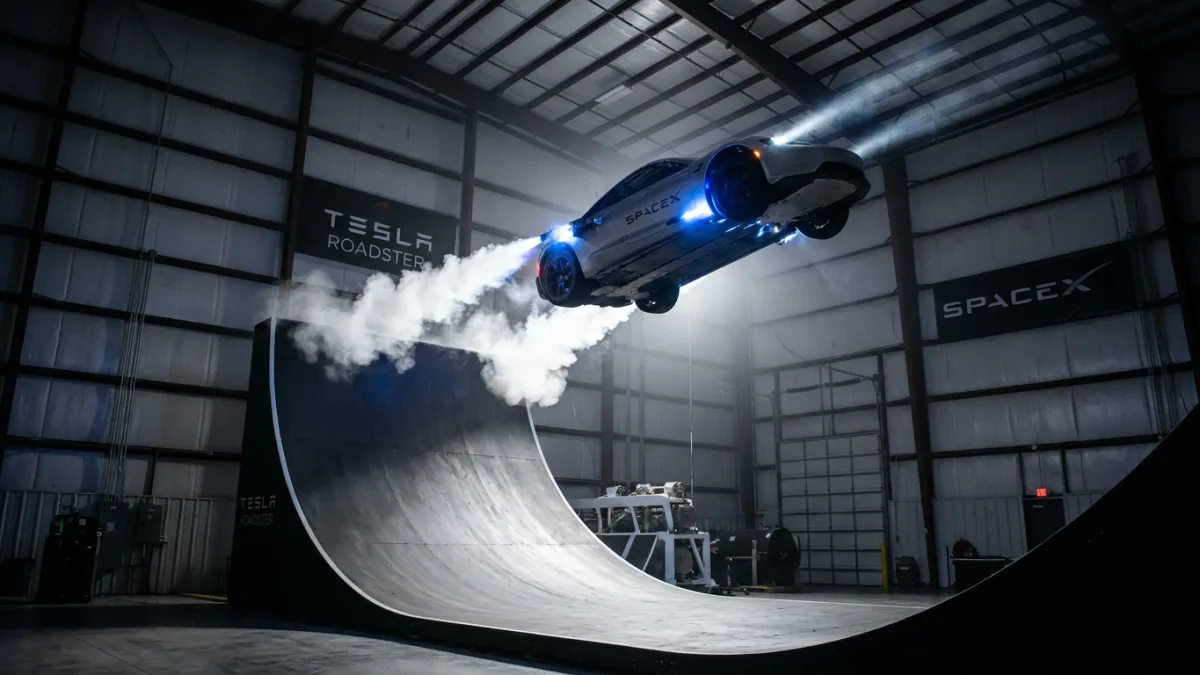
Tesla has revealed the new generation of its Roadster electric sports car during an extraordinary demonstration at a SpaceX facility in Texas. An unmanned prototype drove up a ramp, traveled upside down, launched into the air, and executed a spin before landing on its wheels. The company also showcased another test where the car jumped over several Tesla vehicles, alongside recording a zero to 60 mph acceleration time of 0.81 seconds.
However, calling the new Tesla Roadster a “flying car” requires some precision. The demonstration proved its ability to perform short jumps and aerial maneuvers using compressed air, but it did not prove its capability for sustained point-to-point flight like airplanes or electric vertical takeoff and landing (eVTOL) vehicles.
Aerial display inside SpaceX facility
The unveiling took place on October 15, 2026, inside a SpaceX test facility in McGregor, Texas. The maneuvers were conducted without a driver inside the prototype to avoid putting anyone at risk while demonstrating the new technology.
The car began by driving up a massive ramp that gradually curved until it was completely upside down. It maintained its grip on the surface using a bottom suction system, then launched off the end of the ramp and spun in the air before using gas thrusters to land on its wheels.
According to the published details of the demonstration, the suction system can generate significant downforce that pulls the car toward the surface and increases traction, even when driving upside down. After leaving the ramp, cold gas thrusters inspired by SpaceX technologies take over to control the vehicle's thrust, altitude, and direction.
How does the Tesla Roadster fly?
The Roadster does not use wings or massive propellers like drones and eVTOL vehicles. Instead, it relies on tanks containing compressed gas that is released at high speed through nozzles distributed around the car's body.
This technology is known as cold gas thrusters. It does not burn fuel like traditional rocket engines; rather, it releases gas stored under high pressure to generate thrust. This force can be used to improve acceleration, braking, and stability, or to push the car upward, move it sideways, and control its rotation for a short period.
Information published about the Rocket version indicates it uses ten thrust nozzles connected to a system containing about 600 liters of compressed gas. Four rear nozzles generate the main thrust, while the other nozzles help lift and control the car's direction while it is in the air. Basic information can be found on the official Tesla Roadster page.
Three versions of the Roadster
Tesla plans to offer the car in three main configurations named Performance, Thrust, and Rocket. Not all versions get the same aerial capability; Performance is the road-oriented version, while Thrust adds rear thrusters to improve acceleration, and Rocket offers the full aerial propulsion system.
- Performance version: A two-seat road-oriented car, without the full aerial propulsion system.
- Thrust version: A two-seat car designed for performance and track use, utilizing rear cold gas thrusters to boost acceleration.
- Rocket version: A single-seat car with a full propulsion system that allows jumping, spinning, and controlling the vehicle while in the air, which will be available by invitation only.
Tesla clarifies that the Rocket version will not be available in all regions, while independent reports indicate it is currently not approved for use on public roads. Edmunds noted that the model with full aerial capability will be offered on a limited basis and by invitation.
Sub-second acceleration
The prototype used in the demonstration recorded a zero to 60 mph acceleration time of 0.81 seconds. Tesla is targeting a time of under 1.6 seconds for the Performance version, under 0.9 seconds for the Thrust version, while the time could drop to under 0.59 seconds in the Rocket version.
The company also cites a top speed exceeding 230 mph (about 370 km/h) and a driving range of over 300 miles (about 483 km). However, these figures remain targets announced by Tesla and have not yet been tested on a final production car by independent parties.
WIRED reported that the showcased Roadster is still a production-oriented prototype and that the company has not set a final price, despite confirming the existence of three different versions.
Does it actually fly?
The precise answer is that the Roadster left the ground and executed aerial maneuvers, but it did not prove its capability for sustained flight. The demonstration showed jumps, spins, and a controlled landing, but it did not reveal the maximum altitude achievable, the duration it can stay in the air, or the distance the car can cover before running out of compressed gas.
Furthermore, Tesla did not show a complete point-to-point flight, nor did it clarify how many times the thrusters can be used before the tanks need refilling. Therefore, it is more accurate to describe the Rocket as a car capable of executing short jumps and aerial maneuvers, rather than a vehicle that can be used to soar over cities or travel by air.
An analysis by CNN suggests that what was shown in the demonstration is closer to a propelled jump than a sustained flight, especially since Tesla did not demonstrate a stable transition from vertical lift to forward flight.
Safety questions
Tesla conducted the maneuvers without a driver inside the prototype, and Elon Musk acknowledged that the experimental version is not necessarily optimized for safety. The challenge is not just about protecting the vehicle, as a passenger could be subjected to significant G-forces during acceleration, spinning, and landing.
The high-pressure gas tanks add challenges related to maintenance, crash protection, and refilling. Tesla has not yet revealed sufficient details about the landing mechanism if a nozzle fails, emergency systems, or the level of protection the Rocket version will offer the passenger.
Therefore, the demonstration should be treated as an initial proof of engineering capability under controlled conditions, not as definitive evidence of the car's readiness for daily use.
Will it be legal?
Information related to the Rocket version clarifies that it is not approved for use on public roads, and Musk noted he is unsure of the car's legality in all regions. Its operability will depend on the final production design and local laws regarding safety, roads, and the use of propulsion systems capable of lifting a car off the ground.
A report published by WIRED discussed the potential legal complexities, including which agency might regulate a vehicle that combines the characteristics of a car and an airplane.
However, the US Federal Aviation Administration (FAA) said in a subsequent response quoted by CBS News that the showcased Tesla vehicle does not currently fit the agency's definition of an aircraft. This does not mean it has approval for public use, but rather confirms that its regulatory classification will depend on the characteristics of the production version and how it is used.
Price and reservation
Tesla has not announced the final price for any version, but it has opened reservations. The Performance version requires an initial $5,000 credit card payment, followed by a $45,000 wire transfer within ten days, bringing the total reservation amount to $50,000.
Reserving the Thrust version requires $5,000 upfront, then $245,000 within ten days, for a total of $250,000. These amounts are reservation fees and not necessarily the final price of the car, while the Rocket cannot be reserved directly as it is available by invitation only. Terms can be reviewed on the official Tesla Roadster reservation page.
Expected production date
Elon Musk said Tesla is targeting the start of Roadster production in 2028, more than ten years after the second generation was first revealed in 2017. The car has previously received several production dates that the company did not meet, so 2028 remains an announced target rather than a guaranteed delivery date.
Reuters confirmed that Tesla plans to begin production in 2028, following years of delays that have plagued the project.
Engineering feat or promotional stunt?
Tesla has proven that an electric car can use a suction system and cold gas thrusters to drive upside down and execute jumps, spins, and a controlled landing. It is a striking engineering result that combines electric vehicle technologies with SpaceX's expertise in propulsion systems and compressed gas.
However, the company has not yet proven that the Roadster can sustain flight, that the Rocket version will be safe and legal outside test facilities, or that the performance numbers will transfer exactly to a production car sold to customers.
Therefore, the new Roadster appears to be one of the boldest experimental electric vehicles, but it is not yet the flying car that can be used to soar over traffic. Its true success will depend on Tesla's ability to turn the exciting demonstration into a safe, repeatable product that can be legally certified before the targeted production date in 2028.